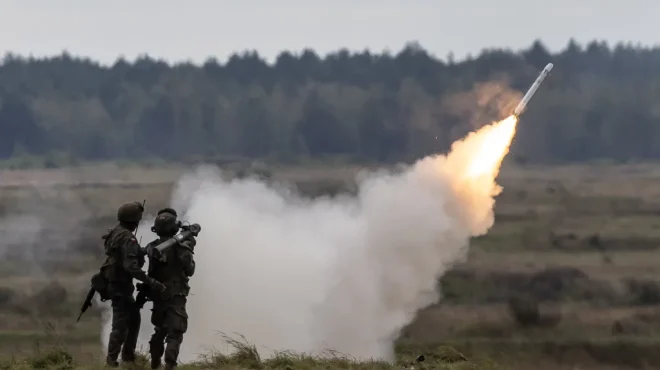
The 3M22 Zircon (NATO reporting name SS-N-33) is a Russian anti-ship missile that moscow has presented for ten years as a hypersonic cruise weapon. Its main claimed characteristics are a speed of up to Mach 9, a range of up to 1,000 km, and a ramjet engine. Since 2023 it has been considered accepted into service with the fleet, and since 2024 russia has also used the Zircon against ground targets in Ukraine. Let us examine how the missile came about, what it consists of, how far it flies, how its use has changed, and why it is hard to shoot down.
What the Zircon is
A weapon is considered hypersonic if it flies faster than Mach 5, that is, above 1.7 km/s. In this category the Zircon is one of the few systems that are mass-produced and used in combat.
The developer is NPO Mashinostroyeniya from Reutov, which also created the Onyx and the Yakhont. The missile is launched from vertical launchers (on ships and submarines) or from ground-based mobile and underground complexes.
The russian side claims that the missile has a liquid-fueled hypersonic ramjet engine. On August 31, 2026, Ukraine’s Defense Intelligence (HUR) published data according to which both of the missile’s engines are solid-fuel, there are no air intakes, and the maximum recorded speed is Mach 6.8. Some Western and Ukrainian analysts confirm this, but moscow has not acknowledged these conclusions.
History of development
The Zircon is considered the successor of the experimental hypersonic vehicle GELA (also known under the Kholod program), which NPO Mashinostroyeniya was already building in the 1990s. At that time, however, the work was more about researching hypersonic engines than about a combat missile.
The combat version, in the form of an anti-ship missile, was created in the 2010s and for a long time remained classified, so it was known only from politicians’ statements and indirect data.
| Date | Event |
| 1990s | NPO Mashinostroyeniya works on the GELA experimental hypersonic vehicle, the predecessor of the Zircon |
| June 3, 2017 | First known launch |
| December 10, 2018 | Test after which Mach 8 was officially claimed |
| February 20, 2019 | putin publicly announces a speed of up to Mach 9 and the destruction of targets at sea and on land within 1,000 km |
| December 24, 2019 | putin speaks about developing a ground-based version |
| January 2020 | First launch from the frigate Admiral Gorshkov (Barents Sea). The fleet commander admitted there were problems |
| October–November 2020 | Hit on a naval target at a distance of 450 km at an altitude of about 28 km, claimed speed over Mach 8 |
| October 4, 2021 | First launch from a submarine, the Severodvinsk |
| November–December 2021 | Additional launches from the Gorshkov, completion of the test cycle |
| late 2022 | Start of serial production. On December 23 shoigu announced the first batch for the Gorshkov |
| January 2023 | The Zircon is deployed for the first time as part of a combat load on the frigate Admiral Gorshkov |
Testing lasted about a decade, and the high speed figures appeared only in officials’ statements, without independent confirmation. This also explains why, until 2024, the “Zircon” became an object of military mythology: there was no one to verify the data. Hence the myth arose and spread that the missile flies on a liquid-fueled scramjet.
The Zircon entered service in 2023, and already in February 2024 it was used for the first time against ground targets in Ukraine.
Design and technical characteristics
According to HUR data published on August 31, 2026, the Zircon is a two-stage missile with two solid-fuel engines. The booster engine operates first, and after it separates, the 3L2211 sustainer engine from NPO Iskra takes over. No air intakes or liquid fuel were found in the design.
In February 2024, the Kyiv Scientific Research Institute of Forensic Expertise (KNDISE) stated that the debris indicated an air-breathing engine rather than a solid-fuel one. HUR reached a different conclusion only after about two years of additional analysis of debris and intelligence data. The first assessment may have been mistaken: a stabilized speed above Mach 5 looked too much like the operation of a ramjet, and some debris parts were taken for fuel tanks.
What is known about the structure:
- The booster and sustainer engines are solid-fuel. The sustainer is the 3L2211 (NPO Iskra).
- The 3G22 warhead from GOSNIIMash weighs about 120 kg, of which only approximately 40 kg is explosive.
- The 3B222 homing head is an active radar seeker (NPP Radar MMS).
- Guidance: an inertial system during cruise and an active seeker at the end. Satellite correction is also used. The onboard computer is the Baget-83.
- Control: electrohydraulic steering actuators and grid fins on a titanium tail section, which fold for storage and deploy after launch.
- Initial orientation: orientation and stabilization thrusters on a protective fairing, which is then jettisoned.
Claimed versus estimated values:
| Parameter | Claimed by russia | Estimate from debris and radar |
| Type | hypersonic cruise missile with a scramjet | solid-fuel, quasi-ballistic with maneuvering |
| Engine | liquid-fueled ramjet (hypersonic) | two solid-fuel stages (HUR data) |
| Maximum speed | Mach 8–10 | Mach 6.8, not throughout the flight |
| Warhead weight | 300–400 kg | about 120 kg |
| Length | 8–9.5 m | approximately 8–9 m |
| Diameter | about 0.6 m | 0.666 m (body) |
| Flight altitude | 28–40 km | 28–40 km, then descent in the final phase |
| Cost | unknown | unofficially up to $10 million |
In terms of the weight of its explosive charge, the Zircon falls far short of the Kinzhal (about 500 kg) or the Kh-101 (about 400 kg). For a small-tonnage ship this would be enough, for large ships or aircraft carriers it would not. Such a warhead is also of little effectiveness against buried or hardened targets. On the other hand, it carries large kinetic energy from its speed.
The HUR portal War&Sanctions publishes data on 70 enterprises participating in the cooperation chain and on the foreign equipment involved in production. The original study also identifies American microchips (Altera Cyclone II FPGAs, TriQuint TGA2704 amplifiers) in the seeker and computer, as well as machine tools of German, Japanese, American, Korean and Chinese manufacture.
Range: claimed and real
The official russian figure is up to 1,000 km, and 1,500 km is sometimes mentioned. Independent estimates differ by flight profile, because range depends on how high the missile climbs and how long it flies in dense layers of the atmosphere.
| Profile / source | Range |
| russian claim (2019) | up to 1,000 km |
| Full altitude, analysts’ estimate | 250–500 km (low profile) |
| Semi-ballistic trajectory | 450–740 km, by other estimates up to 700–1,500 km |
| In tests (October 2020) | 450 km at an altitude of about 28 km |
| Average estimate by independent analysts | 400–450 km |
russia has used different locations to launch the missiles:
- Crimea. In February–March 2024, Zircons flew toward Kyiv from the peninsula. The Air Force estimates the flight time from Crimean positions to any point in Ukraine at about 10.5 minutes.
- Kursk region. In 2026, russian Bastion complexes were moved north, into russia, which cut the flight time to Kyiv to a few minutes. This was confirmed by Air Force spokesman Yurii Ihnat. Currently, according to Air Force reports of September 30, 2026, Zircons and Onyxes were launched from the Kursk region.
Carriers and upgrades
The missile was created as a naval weapon, but over twenty years it has been tied to three types of carriers. Its vertical launchers are the same as those for the Kalibr and Onyx, so rearming ships merely means introducing a new munition.
Surface ships
- Project 22350 frigates (Admiral Gorshkov and their successors) are the first carriers, since January 2023.
- Project 1144 cruisers Admiral Nakhimov and Pyotr Velikiy are being refitted with 3S-14 launchers, up to 80 cells per ship. Admiral Nakhimov is completing a modernization lasting about 27 years: in June 2026 it put to sea under its own power for the first time in a decade, with final sea trials next. It has not yet been returned to the fleet.
- Project 20385 corvettes (Gremyashchiy) and modernized Project 1155 destroyers.
Submarines
The first known launch from a submarine carrier was in October 2021 (Severodvinsk). The main carriers are considered to be the nuclear-powered Project 885M Yasen-M submarines and modernized Project 949AM boats.
Coastal complexes
The ground version was announced in 2019, and in combat against Ukraine launches are carried out from two types of platforms:
- Mobile Bastion-type launchers. A wheeled chassis that normally carries the Onyx, converted for the 3M22. After a launch, the complex can leave its position within five minutes, so it is difficult to destroy with a counterstrike.
- The stationary underground complex “Object 100” (“Sotka”) near Balaklava: a Soviet structure in the rocks, restored after 2014, with horizontal launchers.
In 2026, russian Bastion launchers began to be moved to russian territory, including the Kursk region. The next known Ukrainian strike on these complexes was on March 24, 2026, when HUR reported the destruction of two Zircons and one launcher on the peninsula.
Production and stockpiles
There is only one public report, which mentions an order of about 80 missiles per year. Aviation expert Valerii Romanenko believes the real pace is about three missiles per month. HUR has reported stockpiles of up to 230 Zircons, but Romanenko himself questioned this and explained that the figure may only cover the needs of all fleets and coastal complexes.
Combat use
The Zircon has not been used against ships: the missile’s combat record is entirely land-based. The missile has become a tool for strikes on Ukraine’s cities and energy infrastructure.
| Date | Event |
| February 2024 | First confirmed use against Kyiv. Debris is examined at KNDISE |
| March 25, 2024 | Two Zircons from Crimea at Kyiv. russia claimed hits on an SBU building and Zhuliany airport. Ukraine said both were intercepted |
| February 2026 | Patriots hit only half of four Zircons in a single attack |
| March 24, 2026 | HUR: two Zircons and one Bastion launcher destroyed in Crimea |
| May 24, 2026 | Three Zircons at Kyiv overnight. None intercepted |
| June 1–2, 2026 | A record eight Zircons in one night: four from the north, four from Crimea. No reports of shootdowns. In total that night: 729 attack assets, 17 killed |
| August 16, 2026 | Ukrainian strike on a Bastion complex in Crimea |
| August 31, 2026 | HUR publishes data on the design and production |
| night of September 30, 2026 | Zircons and Onyxes from the Kursk region. In total, 5 ballistic targets, including Iskanders, were shot down or suppressed |
| October 10, 2026 | Daytime Zircon attack on Kyiv at about 14:00. Debris damaged a restaurant in Obolon, eight people were injured |
The number of launches is growing: from single missiles in 2024 to eight in one night in June 2026. Attacks are carried out in mixed salvos: Zircons together with drones, Iskanders and Onyxes. Most strikes are on Kyiv.
Why is the Zircon hard to shoot down?
Altitude and speed
On the cruise segment the missile flies at altitudes of about 28–40 km at a speed of Mach 5.5–6.8. In the thin atmosphere drag is low, this altitude is beyond the reach of short- and medium-range mobile systems, and interceptor aircraft cannot climb that high. Only high-altitude surface-to-air missile systems, such as the Patriot or SAMP/T, can reach it.
Short reaction time
The flight time on routes to the Kyiv region is about 3.5–5 minutes, and from Crimea to any point in Ukraine up to 10.5 minutes. This time must be divided among detection, tracking, the launch decision and the interceptor’s own flight. After the Bastions were moved to the Kursk region, the interval became even shorter.
Shortage of interceptors
Aviation expert Valerii Romanenko suggests that on the night of June 1–2, 2026, all the available missiles on the launchers had already been expended, and that is why the “Zircons” got through. Several interceptors are often needed to shoot down a single missile.
Where is the Zircon vulnerable?
In the final segment the missile enters the dense layers of the atmosphere (below about 20 km) and decelerates. It follows a predictable trajectory: a kinetic “hit-to-kill” intercept by a PAC-3 MSE interceptor is possible. Air Force representative Yurii Ihnat stressed that in the terminal phase the missile flies along a ballistic arc, and Patriot systems are specifically needed to shoot it down.
Conclusions
The Zircon is a fast missile, but it can certainly be hit. According to HUR, it is not accelerated by a ramjet engine, it weighs less than claimed, and it loses speed in the final phase. To protect against it, a sufficient number of Patriot systems and a stock of PAC-3 MSE missiles are needed.
The following sources were used to prepare this material:
- 3M22 Zircon — Wikipedia
- HUR MOD published details on the 3M22 Zircon — ArmyInform, 31.08.2026
- The 3M22 Zircon turned out to be a solid-fuel ballistic missile — Defense Express
- Russia intensifies Zircon attacks on Ukraine — New Voice of Ukraine
- Russia uses Zircon hypersonic anti-ship missiles against Ukrainian cities — Defence Industry Europe
- Admiral Nakhimov returns to the russian fleet — UNIAN, 17.07.2026
- Attack on Kyiv: the Air Force said how many ballistic missiles were shot down — UNIAN
- russians attacked Kyiv with Zircons and drones — LB.ua, 10.10.2026