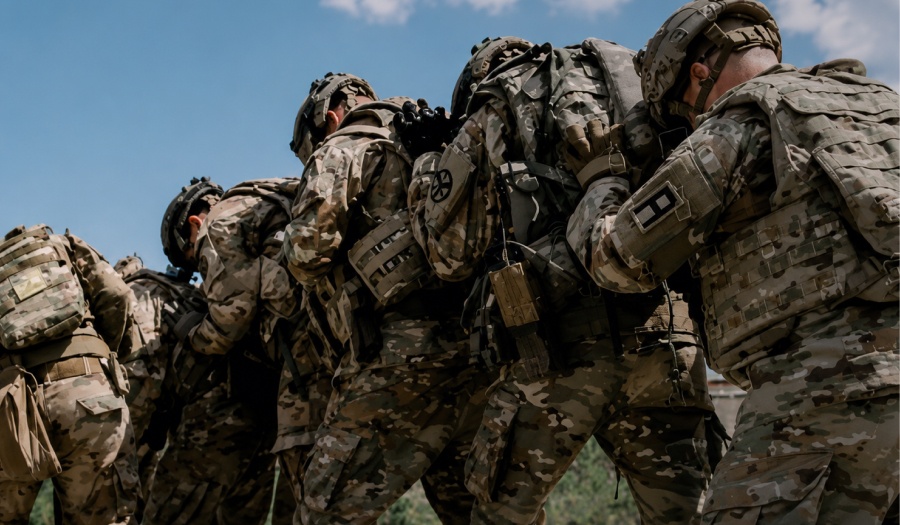
The modern battlefield is characterized by the constant presence of drones, strike systems, and other engagement assets from the air. That is precisely why the safety measures of the Armed Forces of Ukraine in conditions of an aerial threat have become one of the key elements of preserving the lives of servicemen. Even a well-prepared unit can suffer losses if it does not follow clear response procedures.
This material has been prepared by the BlueBird Tech team for the military, unit commanders, UAV operators, and everyone who wants to better understand the principles of safety in modern combat conditions. The article will help to understand what actions need to be performed during a threat from the air, how the response of units is organized, and why discipline directly affects survival.
What Is Considered a Threat From the Air in Modern Combat Conditions
A threat from the air in modern warfare can be various types of engagement assets. These include: strike FPV drones, the enemy’s reconnaissance UAVs, loitering munitions, guided aerial bombs, artillery shells with aerial correction, missiles, and other precision systems.
Most often, the first sign of danger is precisely the detection of a drone over positions or near them. This can be either a reconnaissance craft that corrects fire or a strike drone that directly carries an explosive charge.
A threat from the air is dangerous in that very little time can pass between the moment of detecting a target and delivering a strike — sometimes only a few minutes. Therefore, the speed and correctness of a unit’s reaction are of decisive significance.
Main Risks for Personnel During Attacks From the Air
Aerial attacks create a number of serious risks for the military. These include: sudden strikes on clusters of personnel, the engagement of equipment and shelters, the correction of artillery on detected positions, the engagement of logistical routes, psychological pressure, and the disorganization of units.
The most vulnerable are open positions, columns on the march, field camps, and places of rest of personnel. The enemy often uses drones to search for such targets, after which it delivers point strikes. An additional risk is the delay in reaction. If the military does not have clear algorithms of action, even a small pause can cost lives.
Basic Safety Measures for Protecting the Military
There is a set of proven measures that significantly reduce risks during an aerial threat. The main ones are: constant observation of the airspace, the equipping of reliable shelters, the dispersal of personnel, the camouflage of positions, the minimization of clusters of people and equipment, the limitation of the use of open communication channels, the control of movement in open terrain.
The timely detection of a threat plays an important role. For this, units use observers, monitoring assets, and technical warning systems. An effective example of such a tool is the «Chuika 3.0» from BlueBird Tech — an early drone detection complex that makes it possible to record the appearance of enemy UAVs in advance and promptly react to danger. Such solutions help win critically important minutes for sheltering personnel and preparing for protection.
A unit must have a clearly defined procedure for alerting and the immediate transition to shelter. Separately, care should be taken regarding individual protection assets: helmets, body armor, protective glasses, first-aid kits, and preparation for providing pre-medical aid.
Actions of Units Upon Receiving a Signal About a Threat From the Air
When a unit receives a signal about an aerial threat, the actions must be as clear and well-rehearsed as possible. The basic algorithm looks like this: the immediate cessation of open movements, rapid dispersal, the transition to prepared shelters, the minimization of radio exchange, the camouflage of equipment and personnel, control over the execution of commands.
Unit commanders must organize the alerting of all groups, check that no serviceman remains in open terrain, and ensure readiness for possible further actions.
An important element of protection is technical counteraction assets. For example, an effective solution can be the modular dome EW «Hrets XL» — a powerful asset for countering FPV drones, which, thanks to its modular design, makes it possible to install the necessary frequency modules for specific threats. Such systems help create a protective dome around positions, complicating the work of enemy drones.
Typical Mistakes That Increase the Risk of Losses
In practice, the greatest losses often arise not because of the threat itself but because of the incorrect actions of people. The most common mistakes are: ignoring alarm signals, clustering in one place, attempts to observe a drone instead of immediate sheltering, the use of mobile phones with geolocation turned on, non-compliance with camouflage, a slow reaction to commands.
Staying near equipment during a threat is also dangerous — it is precisely the equipment that often becomes a priority target for the enemy’s strike systems. Another typical mistake is the underestimation of reconnaissance drones. Even if a craft does not carry explosives, it can correct artillery fire.
The Role of Discipline and Clear Procedures in Preserving Life
In modern warfare, discipline and well-rehearsed procedures are of no less significance than armament. Units that regularly train and follow safety rules usually suffer significantly smaller losses.
Every serviceman must clearly know: where their shelter is, what actions to perform during different types of threats, how to act in the event of a comrade’s wounding, how evacuation and communication are organized. Regular training, briefings, and control over the observance of rules create a culture of safety that saves lives at a critical moment.
More about the comprehensive aspects of unit safety can be read in the article: «The military safety of AFU units», which examines a systematic approach to protecting personnel in various conditions.
Conclusions
The safety measures of the Armed Forces of Ukraine during a threat from the air are not a formality but a critically important element of combat work. The preservation of servicemen’s lives directly depends on the speed of reaction, discipline, and the clear observance of procedures.
Modern technical assets, organized surveillance, and competent tactics of action make it possible to significantly reduce risks even in the most difficult conditions. But the decisive factor always remains the preparation of people and the clear execution of rules.