The drone war has evolved into a constant technology race. Just last year, the main challenges remained strike “Shaheds” and reconnaissance quadcopters that could be suppressed by electronic warfare means. Now fiber-optic FPV drones pose an equally serious threat. This changes military tactics and the behavioral requirements for civilians in frontline regions.
What Constitutes UAV Detection
UAV detection is the recording of signs of an unmanned aerial vehicle’s presence in the air or near positions. This refers not only to visual observation, but also to acoustic signals, the characteristic sound of an engine, disruptions in communications, or the receipt of information from technical airspace monitoring systems.
In combat and frontline conditions, a rapid response after detecting a UAV is of critical importance. Even a brief presence of a drone may be sufficient for gathering intelligence data or adjusting fire, so any delay increases the risk of a strike.
In addition to visual and auditory observation, technical early-detection systems are being used increasingly widely, making it possible to record UAV activity before it becomes visible to the naked eye. Read more about the operating principles of such solutions and their role in the security system in the article: “What is a drone detector?“.
First Actions After Detecting a UAV
After detecting a drone, the first priority is to assess the situation without panic: the direction of movement, approximate altitude, and the nature of behavior (hovering, circling, straight flight). Next — minimize your own visibility: cease movement in open terrain, eliminate light sources, and reduce radio communications.
If a fiber-optic drone is suspected (low, slow speed, characteristic thin sound), the best course of action is to find physical cover and move to it as quickly as possible. Practice shows that the only truly effective countermeasures are physical destruction of the drone (by small arms fire, a shotgun, or specialized net systems) or physical damage to the cable itself, if it can be reached.
This is why Ukrainian units are making greater use of “last resort” means. One example is the portable net launcher “Chipa” from BlueBird Tech. It is a single-use, pistol-type device: when fired, the net deploys in a roughly 3×3-meter spread and entangles the drone’s rotors at a distance of up to 25 meters.
Transmitting Information and Notifying Responsible Persons
After the initial detection of a UAV, information must be passed to responsible persons as quickly as possible. For military personnel, this means the unit commander, duty services, or designated communication channels. For civilians — emergency services, military administration, or authorized agencies.
The report should be brief and clear:
- location of detection,
- direction of movement,
- altitude,
- approximate time of observation.
It is important not to spread unverified information through public channels and social media, as this can create additional risks.
Notably, mobile fire groups are already integrated into a unified air defense command system and receive data simultaneously from radars, visual observation posts, civilian alert networks, and satellite systems. According to Air Force data, air defense effectiveness against strike UAVs in 2025–2026 ranges between 80–91%, and it is precisely the timely transmission of “raw” data from people that contributes to these figures.
Actions to Ensure Personnel Safety
The priority after detecting a UAV is reducing risks to personnel and maintaining unit controllability. This means dispersing personnel, restricting vehicle movement, and changing radio communication modes.
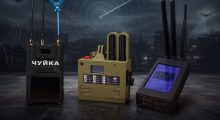
Alongside organizational measures, technical electronic warfare means are also employed. Among such solutions is the vehicle-mounted UAV signal jammer “Hrets” 4G, designed to block communications over CDMA, GSM, 2G, 3G, and 4G channels. Such systems are used exclusively by military units as an element of comprehensive protection.
It is precisely the integrated approach — combining discipline, tactical actions, and technical means — that makes it possible to reduce risks to personnel and buy time for further decisions in the event of an aerial threat.
Prohibited Actions and Critical Restrictions Upon Detecting a UAV
Strictly prohibited: attempting to shoot down a drone on your own without proper means and authorization, photographing or filming a UAV at close range, turning on flashlights and other light sources, approaching the crash site of a drone or debris due to the risk of mining. For civilians, it is critically important not to approach the potential crash site of a drone or debris, as they may be mined.
Typical Mistakes When Responding to a UAV
The most common mistakes are underestimating the threat, panic, or chaotic actions. People often ignore the first signs of a UAV’s presence, considering it “distant” or “not serious,” which leads to a delayed response.
Another mistake is excessive activity in open space, the gathering of people, or attempts to counter the drone independently without preparation.
The algorithm of actions upon detecting a UAV is based on simple but important principles: timely detection, rapid information transfer, minimizing your own visibility, and strict adherence to safety rules. The correct sequence of actions significantly reduces risks for both military personnel and civilians.