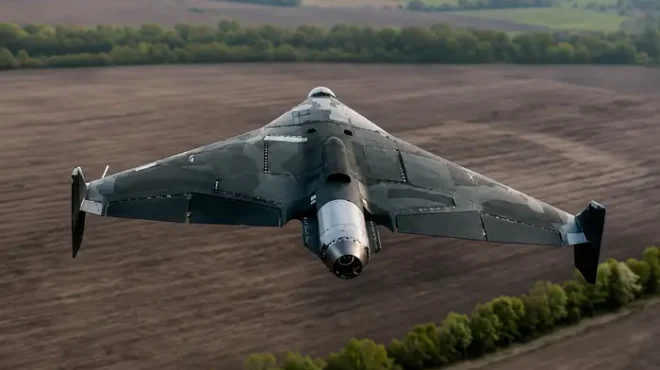
In the summer of 2026, a video appeared at the front that resembled a scene from a science-fiction film: a heavy drone flies deep into occupied territory, opens up — and a ground robotic system carrying an anti-tank mine descends to the ground. After landing, it independently continues moving toward the target. A few weeks earlier, a similar feat was repeated at sea: an unmanned boat approached the occupied shore of the Kinburn Spit, lowered a ramp, and released a tracked robot armed with a machine gun, which immediately opened fire on enemy positions.
Military analysts called this the “marsupial” tactic — by analogy with animals that carry their young in a pouch. The idea is this: one unmanned vehicle transports another closer to the target and “releases” it where the smaller vehicle could not have flown or driven on its own. DefPulse examined how effective this is and whether the tactic can be scaled up.
The Problem the Carrier Solves
A small drone — whether an FPV drone, a UGV, or a maritime vessel — always has a physical limit: a constrained battery or fuel reserve, and therefore strictly defined range and autonomous operating time. The smaller the vehicle, the less range it has.
There is another problem: vulnerability along the route. A ground robot slowly covering several kilometers of open terrain under constant surveillance from reconnaissance drones may either hit a mine or be struck by an FPV before completing its mission. A maritime vessel approaching the shore comes under fire from coastal defenses. In all cases, the approach to the target is the riskiest and most costly phase of the mission.
A carrier drone solves all these problems simultaneously: it covers the main distance — where it can fly high, fast, and outside the engagement range of small arms or short-range FPVs — while the small vehicle expends its limited resources only on the final, shortest, and most precise segment of the mission.
Victor Pavlov, a UGV battalion officer of the 3rd Assault Brigade, drew attention to precisely this point when commenting on the tactic’s prospects. The key factor is the carrier’s payload capacity — which determines how many vehicles and of what type it can physically lift and deliver to the drop point.
The Ukrainian Case: FPV on Wings
The first mass-produced Ukrainian carrier drones appeared in early 2025 and were used with FPV drones. Then-Minister of Digital Transformation Mykhailo Fedorov described the principle as follows: a carrier — either fixed-wing or multirotor — carries up to six FPV drones at once and acts as a communications relay between the operator on the ground and the FPV in flight. After reaching a safe distance, the carrier drops the FPVs, which then independently complete the strike on the target.
The carrier itself can operate at distances of up to 100 km (on average 40–70 km), and after being dropped, the FPVs fly an additional 3–7 km deeper — toward electronic warfare systems, air defense assets, headquarters, or troop concentrations. The operator remains at a distance beyond the reach of counter-strikes throughout.
The idea is not new — the concept was discussed even before the full-scale war, and the United States tested similar systems under military programs as early as the early 2000s. But Ukraine had to implement the same idea under wartime conditions and with limited resources — and not as a concept, but as something requiring mass deployment.
Marsupial Tactics on Land
A logical evolution was the application of that same logic to ground robotics. In August 2026, the Defense Forces conducted an operation in which a heavy drone delivered the ARK-1 ground robotic system carrying an anti-tank mine deep behind the front line and released it there. After landing, the robot continued its mission independently on the ground.

Forbes, which was first to report on the operation, noted: compared to a classic helicopter assault, the logic is the same — only without risk to human life. When the deployed assets are a drone and a ground robot rather than soldiers, the risk of casualties disappears entirely.
The scale of the ambition is evident from procurement plans: according to Fedorov, approximately 25,000 UGVs were planned for purchase in the first half of 2026 alone — roughly twice as many as in all of 2025 — with the goal of replacing up to 30% of frontline personnel with robotic systems.
The Maritime Variant: An Assault Without Assault Troops
Ukrainian units tested the same scheme at sea. In July 2026, soldiers of the 123rd Separate Territorial Defense Brigade conducted what they described as the world’s first fully robotic amphibious operation: an unmanned surface vessel approached the occupied shore of the Kinburn Spit, lowered a bow ramp, and released a tracked ground robotic system armed with a machine gun. The robot entered combat immediately after landing.
Western military analyst Thomas Newdick, commenting on the operation’s footage, noted that the Kinburn Spit is an “ideal testing ground” for unmanned operations precisely because of the intensity of surveillance, artillery, and drone coverage there — factors that make a classic human amphibious assault extremely dangerous. Robotic systems, meanwhile, can carry out reconnaissance and combat missions without exposing troops to direct fire contact.
The Carrier as a Weapons Platform
Fire Point, Ukraine’s largest manufacturer of long-range drones, equipped some variants of its FP-2 strike drone with launch rails for eight unguided S-5 aircraft rockets of 57 mm caliber — Soviet-era munitions of which the Armed Forces of Ukraine hold enormous stockpiles that have gone largely unused. The solution has already seen sustained combat use: the first recorded launch of S-5 rockets from a drone was documented over Crimea in May 2026.

Fire Point CEO Iryna Terekh clarified that the specific type of rocket is not critical — what matters is the principle itself: a large carrier platform can cost-effectively deliver a light, lightly armed munition closer to the target, thereby compensating for the Armed Forces of Ukraine’s shortage of conventional cruise and ballistic missiles.
Not Only a Ukrainian Idea
Alongside the Ukrainian front, China is actively developing similar technologies, having demonstrated a multicopter capable of delivering a machine-gun-armed robot to the battlefield. Analysts assess that such a design is better suited to urban environments than wheeled or tracked platforms — capable, for instance, of climbing stairs. The potential applications are obvious: inserting robots onto rooftops as sniper positions or lowering them floor by floor while personnel hold the perimeter below.
In the United States, DARPA is developing the “carrier” concept at the institutional level through its Gremlins program, which launched in 2015–2016. The vision there is more ambitious and expensive: a C-130 Hercules heavy aircraft serves as an aerial carrier for a swarm of small, reusable X-61 drones. Each vehicle — approximately 4.2 meters long and weighing 680 kg — is launched from the aircraft, completes its mission (reconnaissance, electronic warfare, and, per later statements, target engagement), then docks with a retrieval line deployed from the C-130 and is winched back into the cargo bay for reuse — up to 20 cycles per vehicle.

In October 2021, DARPA successfully conducted the first mid-air drone recovery — after several failed attempts, one of which ended in the loss of a vehicle. The Gremlins program is methodically working toward something no armed force in the world yet possesses: cheap, reusable drone swarms that are launched and recovered entirely in the air.
What Limits Scaling?
Despite impressive demonstrations, the tactic remains largely a niche capability for now. The primary constraint is the carrier’s payload capacity. If a drone can only lift a single light ground vehicle into the air, scaling an operation to dozens of simultaneous robots is impossible without a significant increase in carrier class. This is precisely why, in parallel with demonstrating marsupial tactics, Ukraine is testing cargo drones with payload capacities exceeding 90 kg.
The second factor is the cost and vulnerability of the carrier itself. A heavy drone flying deep into enemy rear with a valuable payload on board becomes a priority target for air defenses and electronic warfare systems. Losing the carrier means losing several systems at once.
Marsupial tactics require a redesign of the strike architecture. Instead of a single universal vehicle that must simultaneously offer range, payload, and last-mile precision, the task is divided between two specialized links: the carrier is optimized for range, endurance, and route survivability, while the “payload” is optimized for precision and effectiveness in the final kilometers or meters to the target.
Scaling this approach requires developing a dedicated class of hardware — “carrier drones” — with their own requirements for payload capacity, release mechanisms, and communications relay. This class must develop in parallel with strike and reconnaissance drone classes. And judging by the pace at which Ukraine is moving from FPV-on-wings to air- and sea-delivered combat robots, it is our country that will determine how quickly this concept becomes the standard.
The following sources were used in preparing this article:
NV. «В Україні з’явився БПЛА, який може нести дрон» — https://nv.ua/ukr/ukraine/events/droni-v-ukrajini-z-yavivsya-bpla-yakiy-mozhe-nesti-dron-50497052.html
UNIAN. «Українські дрони: важкий безпілотник уперше десантував наземного робота в тил ворога» — https://www.unian.ua/weapons/ukrajinski-droni-vazhkiy-bezpilotnik-upershe-desantuvav-nazemnogo-robota-v-til-voroga-13459908.html
24 Канал. «Нова сумчаста тактика ЗСУ» — https://24tv.ua/military/nova-sumchasta-taktika-zsu-ukrayina-vpershe-visadila-nazemnogo_n3117234
ITC.ua. «США та Китай відкладали 30 років — зробила Україна» — https://itc.ua/ua/novini/ssha-ta-kytaj-vidkladaly-30-rokiv-zrobyla-ukrayina-zsu-vpershe-u-sviti-ckynuly-nazemnyh-robotiv-z-drona-u-tyl-voroga/
Espreso.tv. «Морський десант роботів: 123-тя бригада висадила НРК на Кінбурнській косі» — https://espreso.tv/viyna-z-rosiyeyu-pershiy-u-sviti-morskiy-desant-robotiv-na-kinburnskiy-kosi-organizuvali-biytsi-123-i-brigadi-tro
Forbes.ua. «Fire Point показала ШІ-дрони з дальністю до 2700 км і бойовою частиною 200 кг» — https://forbes.ua/news/fire-point-predstavila-droni-z-dalnistyu-do-2700-km-18062026-39746.
The Debrief. «DARPA’s Latest Gremlins Drone Will Cause Some Serious Mischief» — https://thedebrief.org/darpas-latest-gremlins-drone-will-cause-some-serious-mischief/
Popular Science. «DARPA grabbed a drone out of the sky. Here’s how.» — https://www.popsci.com/technology/darpa-gremlins-recovers-flying-drone/
tro.mil.gov.ua. «Використання безпілотних літальних апаратів в Силах ТрО Українських Збройних Сил» — https://tro.mil.gov.ua/drony-yaki-vykorystovuye-zsu/