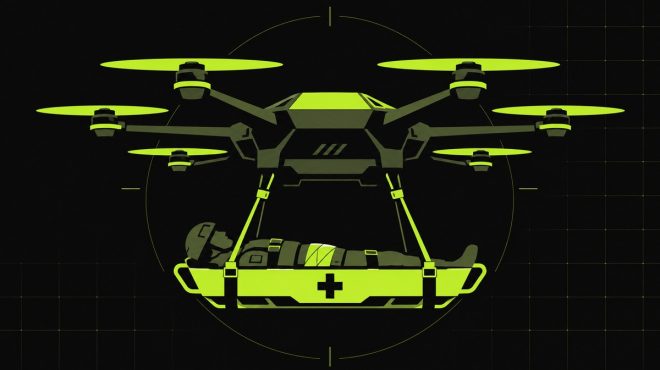
The Cabinet of Ministers has adopted a resolution on an experimental project to deliver donor organs, blood samples, medicines, and medical products by unmanned aerial vehicles.
The decision was announced on October 16 by Prime Minister Serhiy Koretskyi. The first site will be the Kyiv Heart Institute of the Ministry of Health.
The project will be implemented by the Ministry of Health and the Ministry of Digital Transformation. The Heart Institute already has three specialized drones with a range of up to 700 km, capable of landing on hospital pads. According to MP Olha Vasylevska-Smahliuk, eight flights are planned for 2026–2027 with a budget of approximately UAH 1 million, to be covered by the institution itself. The experiment will run during martial law but for no longer than two years.
The aircraft make has not been officially named. However, according to media reports, the company Ukrspecsystems modified the PD-2 UAV for the institute according to the clinic’s technical specifications: adding temperature-regime support, vibration resistance, and extended flight duration. The manufacturer claims vertical take-off and landing, up to 8–10 hours in the air, and up to 11 kg of payload. The PD-2 is the very drone the clinic tested last year: a pig heart and red blood cell mass were placed in a thermobox, the drone was flown for four hours at both −10 and +30 °C, after which biopsy and analysis were performed. The results, according to Director Borys Todurov, were successful.
According to the draft resolution, each flight is to be approved by the Armed Forces General Staff, with requests submitted at least one hour in advance. Drones will be prohibited from flying over Kyiv, regional centers (except on approved routes to hospitals), and critical infrastructure. The aircraft will have special status and will be identified in the air, and in the event of an air-raid alert, a landing at a reserve point is provided for. If flight is impossible, a ground team will collect the cargo.
The main argument is time and money. A donor heart is viable for only a few hours, and ground transport in wartime depends on congested roads and checkpoints. Todurov estimated that a drone covers the distance nearly twice as fast as a car, and a flight of 700 km requires about six liters of fuel (≈UAH 360) compared to several thousand dollars per hour for a helicopter.
The experiment lays the groundwork for a national civilian UAV management system. Ukrspecsystems expects the Ministry of Transport to establish a regulatory framework and air corridors, and believes such drones should be available in every regional center. After the project concludes, the government will assess safety, economic feasibility, and effectiveness before deciding on permanent implementation.
On a related note, in the first nine months of 2026, Ukraine performed 473 transplants, while 4,382 patients — including 92 children — remain on the waiting list.