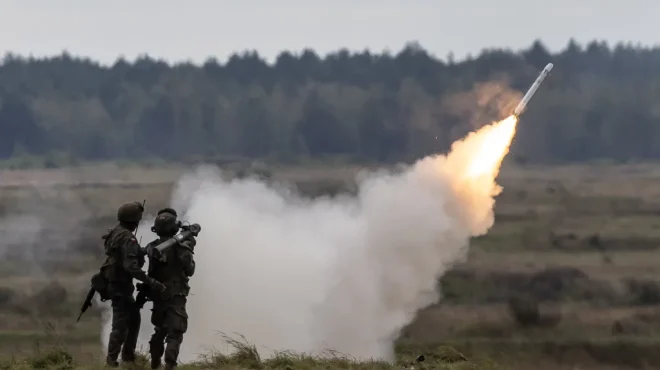
Finland will purchase heavy single-use anti-tank systems RGW 110 from German company Dynamit Nobel Defence for approximately €84.5 million excluding VAT. The new weapons will replace the French APILAS grenade launchers that the Finnish Army has been using since the 1980s. This was announced by the Finnish Ministry of Defence and the country’s Army. Delivery of the systems, training equipment, and military training will begin in 2027.
What Is Known About the System
The RGW 110 is a family of single-use shoulder-fired anti-tank systems of 110 mm caliber, developed by German company Dynamit Nobel Defence. The manufacturer positions it as the successor to the Panzerfaust 3 grenade launcher, designed to counter modern and future main battle tanks.
According to the company’s description, the systems in the family are intended for engaging armored vehicles, other vehicles, and structures.
Key Specifications
| Parameter | Details |
| Developer and Manufacturer | Dynamit Nobel Defence, Germany |
| Family | RGW 110 |
| Caliber | 110 mm |
| Type | Single-use shoulder-fired anti-tank system |
| Primary Purpose | Engaging armored vehicles |
| Secondary Targets | Other vehicles, structures |
| Stated Range of RGW 110 HH-T | Up to 800 m |
| Weight Comparison with Panzerfaust 3 | Approximately 3 kg lighter, according to the manufacturer |
Warhead and Armor Penetration
One of the known variants of the family is the RGW 110 HH-T. The designation HH-T stands for HEAT/HESH-Tandem. An article in Soldat & Technik notes that the baseline version is intended to combine the advantages of the Panzerfaust 3-IT warhead with the ergonomics and operating principles of the RGW family systems.
The tandem shaped-charge warhead is designed, among other things, to counter armored vehicles equipped with explosive reactive armor. Such protection uses explosive elements intended to disrupt the shaped-charge jet. The tandem arrangement involves the sequential action of two charges to overcome this barrier and achieve penetration of the main armor.
Why Finland Chose the RGW 110
According to the Finnish military, one of the main criteria in selecting the new system was the ability to defeat the protection of modern main battle tanks.
Testing was conducted against a target with protection characteristics close to those of real combat vehicles. After comparing available systems, the Finnish military jointly with the manufacturer further improved the warhead to ensure the required effectiveness. The evaluation process also took into account the experience of the war in Ukraine.
The Finnish Army cites the following advantages of the new system:
- Several soldiers can simultaneously attack a single target from different positions.
- The single-use design eliminates the need to return the launcher for reuse.
The system is intended to complement other anti-tank defense assets and be compatible with soldiers’ equipment. The RGW 110 will replace the French single-use anti-tank grenade launchers APILAS, which Finland purchased in the 1980s. The new system is set to serve as a heavy close-range anti-tank weapon in infantry units.
A €84.5 Million Procurement
The total value of the Finnish order is approximately €84.5 million excluding VAT. The contract provides for the delivery of systems, training equipment, and training of military personnel. Delivery of the RGW 110 and training of Finnish troops are scheduled to begin in 2027.