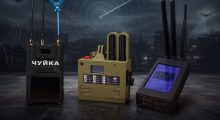
Today, the term “drone jammer” is the general name for devices that are used for counteraction to enemy drones. Thanks to the rapid development of drones, these technologies have become extremely relevant in the military and civilian spheres. But it is important to understand that the notion of “jammer” covers a wide spectrum of devices, among which are electronic warfare (EW) systems. We will tell in more detail about their types, difference, and goals below.
Which types of drone “jammers” exist?
There exist several main types of systems for counteraction to drones, each of which has its own features, sphere of application, and advantages. In particular, we manufacture:
Dome EW systems. They create a radio-frequency “dome” over a defined territory.
Trench EW systems. Developed for the protection of separate military positions or equipment during combat operations (in trenches).
Vehicle EW systems. They guard military or specialized machines during movement or a stop.
We will tell in more detail about each type further.
Features of dome EW systems.
Dome EWs are perfectly suited for the protection of military bases or critical infrastructure. They are distinguished by:
Reliability. The quadrifilar antennas used in the system create an electronic “dome” that protects a defined territory from all sides.
Autonomy. They work continuously and automatically, not requiring the manual intervention of an operator.
Mobility. The system can be quickly installed, reconfigured, or moved to another location.
By the way, our dome EW “Hrets” 3M and 4M with quadrifilar antennas also easily integrates with other security systems.
Features of trench EW systems.
These systems are intended for the protection of military units and equipment in trench positions. They are popular among the military because of:
Compactness. Thanks to the small dimensions, the system is quick to deploy in difficult conditions and move between positions.
Inconspicuousness. The EW system can be placed directly in trenches, protecting it from damage. The antennas are extended out onto a tripod or another construction.
Effectiveness. Thanks to directional and omnidirectional antennas, the “drone jammer” blocks signals in the chosen direction and over a large territory.
By the way, our trench EWs of the “Hrets” series 3M, 3MTs, 4M, 4MTs, 5ML, 5MTs, and 6M ensure a high level of protection from drones, easily adapting to changing conditions.
Features of vehicle EW systems.
These systems protect armored personnel carriers (APCs), ambulances, tanks, convoys, and other transport from the attacks of drones. Their features:
Flexibility. The systems are easy to install on the rails of various military and special vehicles and to move.
Large radius of action. Thanks to the antennas (directional and omnidirectional), the “drone jammer” effectively jams the signals of enemy UAVs at distances of from 30 to 500 m.
Adaptivity. The system is capable of instantly reacting to new threats, promptly configuring the parameters for effective protection.
By the way, our vehicle EW technologies of the “Hrets” series 3M, 3MTs, 4M, 4MTs, 5ML, and 5MTs ensure effective protection in any conditions.
Conclusion.
Overall, a “drone jammer” is a powerful instrument for protection from enemy drones. Choosing between dome, trench, or vehicle EW systems, be guided by concrete needs and conditions of use. Each of these options has its own advantages and is indispensable in various situations.
If you have questions regarding the choice of an appropriate device or system, turn to our managers. They will help to select the optimal solution for protection from drones.