Drones have become an integral part of combat operations, so timely detection of their presence is an important element of security. This is precisely what drone detectors are used for.
There are many popular detection solutions on the Ukrainian market, each of which has its own advantages, features, and application scenarios. To make the right choice, it is important to understand the principle of operation of such devices, know their key differences, and evaluate the characteristics in accordance with real operating conditions.
This material was prepared by BlueBird Tech for military personnel and volunteers who are selecting equipment for defense needs. The article will help you understand how early threat detection equipment works and choose a model for specific tasks.
How drone detectors work
A drone detector is a device designed to detect unmanned aerial vehicles by analyzing the radio frequency spectrum.Unlike radar, it does not search for the object itself in the air, but records the signals that the drone exchanges with the remote control or transmits video.
The principle of operation of such equipment is to continuously scan certain frequency ranges. Having recorded a characteristic radio signal, the system determines its parameters or communication protocol and informs about the threat using a sound, light or vibration signal.
Popular drone detector models in Ukraine
The field of drone detection tools is rapidly developing in Ukraine, offering solutions for various operating conditions and user needs. Manufacturers are constantly improving their devices, expanding the list of supported frequencies, and introducing new features to increase the efficiency of drone detection.
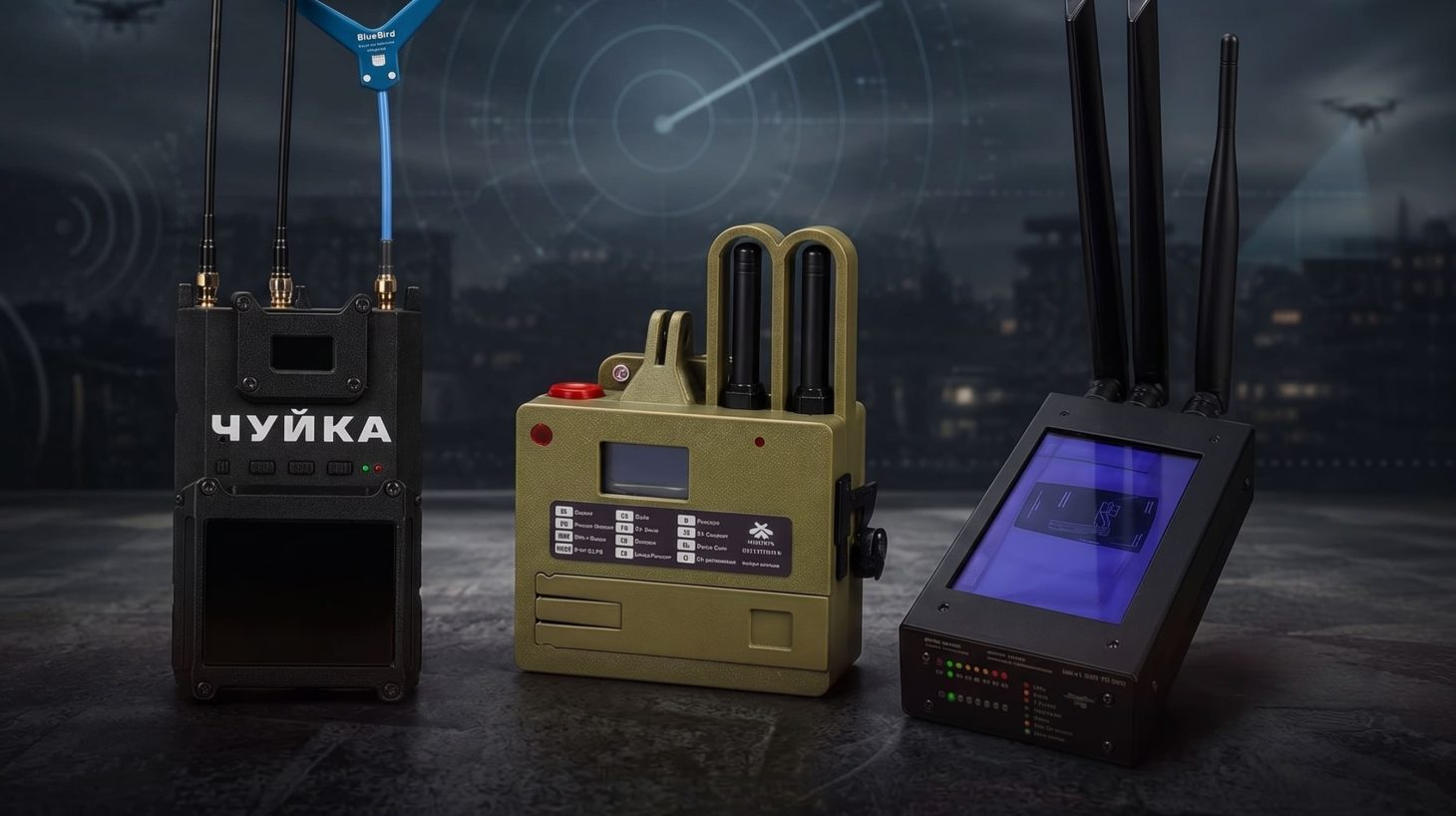
Among Ukrainian developments, the most famous are “Chuyka”, “Tsukorok”, “Obriy”, etc. Each of these models has its own design and functionality, so before choosing, it is advisable to familiarize yourself with their main characteristics and capabilities.
Drone detector “Chuyka”
Portable drone detectorsBlueBird Tech’s “Chuyka” is designed for operational detection of FPV-UAVs in 2-4 frequency bands depending on the model. For example, “Chuyka 4.0” operates in four frequency bands: 900–1800 MHz / 2870–4080 MHz / 4860–6060 MHz / 6100–8600 MHz.
The device analyzes the radio air in just a few seconds and fixes air targets at a distance of up to 4 kilometers. A durable plastic case protects the internal modules, and the battery guarantees autonomy of up to 6 hours. Information about the threat is displayed on the screens, and is also duplicated by light and sound warnings, which allows you to react as quickly as possible.
Drone detector “Sugar”
The compact device from the Magura brand simultaneously scans four popular frequency ranges that are most often used for control FPV drones, DJI Mavic, as well as reconnaissance aircraft. When a threat is detected, “Sugar” notifies the user with sound, vibration, and information on the screen.
The main advantages of the model are its small size and weight, long battery life, and convenient charging via USB Type-C, making it a practical option for everyday use.
Drone detector “Obriy”
“Obriy” is a line of early detection devices from Kara Dag Technologies, covering a wide range of frequencies from 1 to 6 GHz. The detector is distinguished by its ability to detect both analog signals and digital video.
The device is equipped with a reliable metal case and a capacious battery for long-term battery life. And thanks to the self-diagnosis function, the device immediately warns the owner of any internal malfunctions.
Comparison of detector models
Before choosing early detection equipment, it is advisable to compare the key parameters of the devices. They all have a common goal – to spot an enemy drone in time, but they differ significantly in functionality, design, and application conditions.
| Criterion | “Chuyka” | “Sugar” | “Obriy” |
| Detection type | Intercepting analog video signals from FPV drones | Analysis of control panel signals | Interception of analog and digital video signals |
| Frequency ranges | 1.2 / 3.3 / 5.8 / 8.6 GHz | 865-885, 895-928, 970-1020, 2400-2500 MHz | 1-6 GHz |
| Fixation range | Up to 4 km (2-2.5 km at 8.6 GHz) | 8-16 km (up to 400 m on 2.4 GHz) | Up to 4 km |
| Autonomy | 6 hours | 12-20 hours | 6-8 hours |
| Features | Scans quickly (up to 8 seconds) and has NATO codification | Compact and weighs 100g | Performs self-diagnosis |
| Price (depending on model) | from 22,680 UAH to 50,280 UAH | from 3,600 to 5,500 UAH | from 23,500 UAH to 32,500 UAH |
Choosing the best detector depends primarily on what types of drones you most often encounter and what conditions the device will be used in. It is also important to pay attention to user feedback. For example, reviews of the Chuyka can be found directly on the manufacturer’s website.
Advantages of using “Chuyka”
“Chuyka” is distinguished by a combination of reliable video signal interception, mobility and ease of useIn particular, the Chuyka 3.0 model has received NATO codification, confirming its compliance with established requirements for military products and Alliance standards.
Among the key advantages of the device are quick deployment, the presence of two displays for convenient information display, the ability to update the firmware via a mobile application, as well as support for remote antennas and a car mount, which expands the detector’s usage scenarios.
Equally important is that the device does not emit its own signals, therefore remaining invisible to enemy electronic intelligence. Buy “Chuyka”You can do so directly on the website — BlueBird Tech specialists will help you choose the optimal model and configuration according to your needs and operating conditions.
What to look for when choosing a drone detector
When choosing a drone detector, it is important to consider not only the cost of the device, but also its technical capabilities, ease of use, and prospects for further support.
Before buying, pay attention to the following characteristics:
- supported frequency ranges;
- the types of drones the device can detect;
- signal detection speed;
- detection range;
- firmware update capability;
- autonomy of work;
- dimensions and weight;
- user-friendly interface and management;
- the presence of remote antennas, mounts or other additional accessories;
- warranty and service by the manufacturer.
Properly selected equipment will ensure stable operation, ease of use, and will remain up-to-date thanks to regular software updates.
FAQ
Is special training required to operate the drone detector?
Special training is mostly not required, as modern detectors are designed as easy-to-use devices with an intuitive interface and ready to work immediately after switching on.
However, a basic understanding of the display principles, range settings, and working with accessories will help you use the device to its fullest potential. Manufacturers, including BlueBird Tech, usually provide instructions and advice for new users.
Can multiple drone detectors be used at the same time on a position?
Yes, and this is common practice, especially when a unit covers a perimeter from multiple directions or wants to cover a wider range of frequencies.
Combining different models allows you to compensate for the limitations of each individual device and increase the overall probability of timely detection of a drone regardless of the type of signal it uses.
Can civilians buy a drone detector?
Yes, drone detectors are not weapons or electronic warfare devices that suppress signals, so they can be freely purchased by both military and civilian individuals or volunteer organizations. The device only passively scans the airwaves and does not affect the operation of the drone or other radio systems.
Can a drone detector give false alarms?
Yes, since the device responds to signals in a certain frequency range, it can theoretically perceive external radiation sources as a threat, especially in places with dense radio electronic activity.
Modern models try to filter signals according to the specific protocols of UAVs, which significantly reduces the number of false positives.
How often should I update the detector software?
It is recommended to update the firmware whenever a new version is released by the manufacturer. Regular updates help maintain compatibility with new types of drones, improve signal analysis algorithms, and can add new features without the need to replace the hardware.
For example, in Chuyka, firmware updates are performed through a special mobile application – this allows the user to independently and quickly keep the device on the most current software version without contacting a service center.
Conclusion
The drone detector market is constantly evolving, and manufacturers are regularly improving their devices, adapting them to new challenges and drone technologies. That is why it is worth choosing solutions that have manufacturer support and the possibility of further updates.
Reliable early detection equipment is a long-term investment in security. Learn more about the Chuyka drone detector line, their capabilities, and available configurations on the website BlueBird Tech.