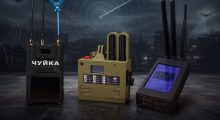
Multi-band electronic warfare (EW) systems have become one of the key elements of protection against modern unmanned threats. Among the popular solutions on the Ukrainian market, the EW systems “Hrets” and Kvertus AD Kraken stand out — complexes that share a similar purpose but differ in design and functional capabilities.
This material has been prepared for military personnel seeking effective electronic warfare tools. The article explains how multi-band EW systems work, what distinguishes the Hrets and Kvertus AD Kraken EW complexes, and what role antennas play in their effectiveness. It also outlines what to consider when selecting EW equipment.
What Are Multi-Band EW Systems
Multi-band electronic warfare (EW) systems are complexes designed to affect the control, navigation, and data transmission radio channels of unmanned aerial vehicles. They are capable of operating simultaneously across several frequency bands, enabling effective countermeasures against a wide range of drones and UAVs.
Features of such EW complexes:
- configuration flexibility for specific tasks and use scenarios;
- enhanced suppression effectiveness through simultaneous coverage of multiple frequency bands;
- versatility, as a single device replaces several narrow-band jammers;
- ease of use for both static positions and mobile crews.
These are precisely the capabilities offered by the Hrets EW and Kvertus AD Kraken complexes.
Hrets EW Systems: Specifications and Advantages
Hrets EW systems are multi-band electronic warfare complexes from BlueBird Tech that create radio interference in the control, navigation, and data transmission channels of unmanned aerial vehicles. The series is represented by several models that differ in configuration, the number of supported frequency bands, and design, making it possible to select the right option for various needs and operating conditions.
The advantages of Hrets EW systems include:
- availability of multiple modifications for different needs;
- support for operation across multiple frequency bands;
- availability of ready-made complexes and modular solutions;
- the ability to use different types of antennas depending on operating conditions.
A distinctive feature of the Hrets lineup is the variety of design solutions. In addition to ready-made complexes with a fixed configuration, modular systems are also available, allowing the equipment to be reconfigured according to the tasks at hand.
Design Features and Capabilities of the Kvertus AD Kraken
The Kvertus AD Kraken EW complex series is designed to block the control and navigation channels of unmanned vehicles. They feature a monoblock design in which all key components are already integrated into a single enclosure. As a result, the device requires no complex installation or lengthy configuration — it is ready for operation immediately after deployment.
Key features of the Kvertus AD Kraken include:
- rapid deployment of the complex to operational readiness;
- convenient transportation and mobility at positions;
- wide frequency range for countering various types of UAVs;
- availability of modifications for different tasks.
The complex’s design is oriented toward use in the form in which it is supplied by the manufacturer.
Hrets and Kvertus AD Kraken: Key Differences
Both complexes belong to the category of multi-band EW systems and perform the same basic task — creating radio interference to counter unmanned aerial vehicles. However, despite this, the Hrets and Kvertus AD Kraken EW systems have certain differences.
| Characteristic | Hrets | Kvertus AD Kraken |
| Configuration | Can be fixed or variable (depending on the model) | Each model has a fixed configuration |
| Frequency bands | Depends on the model and complex configuration | Depends on the complex modification |
| Antennas | Possibility of using different antenna types depending on the model | Integrated into the enclosure |
| Scalability | Provided for modular complexes | Not provided by the design |
| Deployment | Modular systems require selection and configuration | Ready for use after installation |
The main difference between the complexes is that Hrets combines ready-made and modular solutions, whereas the Kvertus AD Kraken is designed as an all-in-one complex with a fixed construction.
The Role of Antennas in EW Systems
EW antennas are critical components of any electronic warfare system. They provide the reception and emission of radio signals, so their design, quantity, and placement directly affect the operational characteristics of the complex.
Depending on the system architecture, antennas may be integrated into the enclosure or installed separately. Modular solutions may also provide the option of using different antenna types in accordance with the complex’s configuration and operating conditions.
What to Consider Before Purchasing an EW Complex
Before purchasing an EW system, it is important to analyze the operating conditions. There is no universal system that equally effectively solves all tasks, as the enemy constantly changes tactics and frequency bands. To ensure the selected device performs at maximum efficiency, several critical parameters must be taken into account before making a decision:
- characteristics of the radio frequency environment;
- availability of different equipment modifications;
- antenna configuration features;
- deployment speed;
- scalability options;
- compatibility with additional components;
- availability of official technical documentation and service support.
Proper equipment selection makes it possible to build an effective electronic defense and reduce the risks posed by hostile unmanned vehicles.
FAQ
What advantages do multi-band systems have over specialized solutions?
Multi-band EW systems provide greater versatility of application. They can support work with multiple signal categories within a single configuration, allowing one complex to be used for different scenarios.
This also simplifies equipment upgrades, reduces the need to use several separate systems, and increases operational flexibility.
Can Hrets and Kvertus AD Kraken EW systems be used together with a drone detector?
Yes, EW systems can be used together with drone detectors if this is provided for by the solution’s configuration. The detector performs the function of signal detection, while the EW system handles radio-electronic countermeasures.
Combining such components allows for a comprehensive solution to be created, but equipment compatibility should be verified in accordance with the manufacturer’s recommendations.
Can an EW system be upgraded after installation?
The possibility of upgrading depends on the design of the specific system. Some complexes allow for configuration changes or the addition of individual components, while others are supplied as ready-made solutions with a fixed design. Therefore, before making any changes, it is advisable to review the manufacturer’s technical documentation and the capabilities of the specific model.
Can different antennas be used with EW systems?
Yes, but this depends on the design of the specific complex. Some systems provide the option of using different antenna types, while in others the antennas are an integrated part of the design. It is important that the antennas meet the technical specifications and are compatible with the equipment.
What is better: ready-made or modular EW complexes?
It all depends on the conditions and tasks for which the EW system is being selected. Ready-made complexes are supplied in a pre-assembled configuration and do not require additional component selection. Modular solutions, in turn, provide greater flexibility, as they allow the configuration to be changed or the system to be supplemented with individual components.
The choice between these options should be made taking into account the specific operating conditions, functional requirements, and possibilities for further adaptation of the equipment.
Conclusion
Multi-band EW systems are an important component of electronic defense, and their effectiveness largely depends on the design, configuration, and capabilities of a specific model. A comparison of the Hrets and Kvertus AD Kraken systems demonstrates that different approaches to building complexes allow for a solution to be selected in accordance with defined requirements and operating conditions.