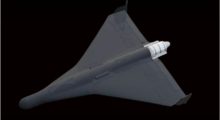
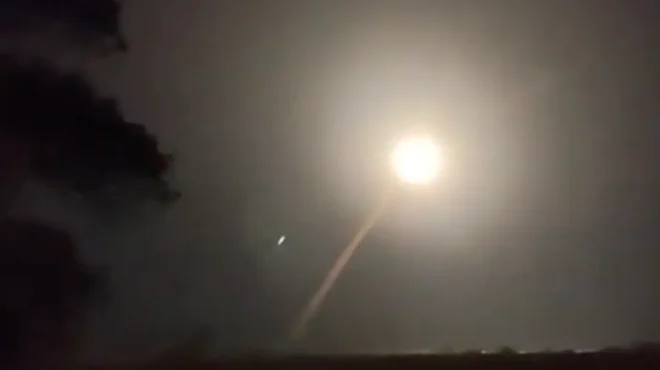
The Main Intelligence Directorate of Ukraine’s Ministry of Defense has published a detailed technical profile of the Russian ballistic missile RM-48U on the War&Sanctions portal. The occupiers manufacture it from decommissioned surface-to-air missiles of the S-400 Triumf system.
Along with a 3D model of the weapon, the intelligence directorate published data on its component base, 63 cooperative enterprises involved in production, as well as a list of foreign equipment and individuals implicated.
According to HUR, the RM-48U is essentially a hybrid design assembled from elements of three different products of the Soviet-Russian missile complex. The solid-fuel engine is borrowed from the 48N6DM surface-to-air guided missile of the S-400, the tail section comes from the export missile 48N6E2 used in the S-300PMU1/2 and S-400, and the instrument section is assembled from components of the 9M96 and 48N6E2 missiles. It is precisely this “hodgepodge” of different products that earned the missile the nickname of a ballistic “Frankenstein.”
This is a single-stage, solid-fuel missile that flies a ballistic trajectory at speeds of Mach 4–6 and has a stated range of up to 400 kilometers. The warhead is a fragmentation-high-explosive type weighing 199 kilograms, fitted with pre-formed cubic-shaped striking elements.
Guidance is provided by an autonomous strap-down inertial navigation system combined with a satellite signal via Kometa-R12 receivers, which Russia calls a “space PKNS.” To conduct strikes against ground targets at tactical and operational depth with such surface-to-air missiles, the occupiers have formed dedicated units employing both radio-command and satellite guidance.
HUR noted that the missile’s electronics match the typical pattern of component origins found in Russian armaments. Of the 117 electronic components identified, the vast majority — 95 — are of American origin; 4 components came from Taiwan, 3 from Switzerland, and 2 each from Germany, the Netherlands, Japan, and South Korea. The intelligence directorate also drew attention to a new detail — a laser diode manufactured by the French company 3SP Technologies.
According to HUR representatives, Russia cannot significantly scale up production of expensive ballistic missiles such as the Iskander-M or Kinzhal, and has therefore found a workaround — more than doubling the output of converted surface-to-air missiles for mass strikes against Ukraine.
The combat effectiveness of the RM-48U is limited: it carries a considerably lighter warhead, its range is at most half that of the Iskander-M, and its accuracy is low. However, the danger posed by these missiles lies in their sheer numbers: according to analysts, they effectively serve as a more expensive analog to decoy drones, overwhelming Ukraine’s air defense system with ballistic targets.
Compounding the situation is the fact that these missiles can only be intercepted by the same means required against Iskanders and Kinzhals — PAC-3 interceptors for Patriot systems or Aster-30 missiles for SAMP/T.