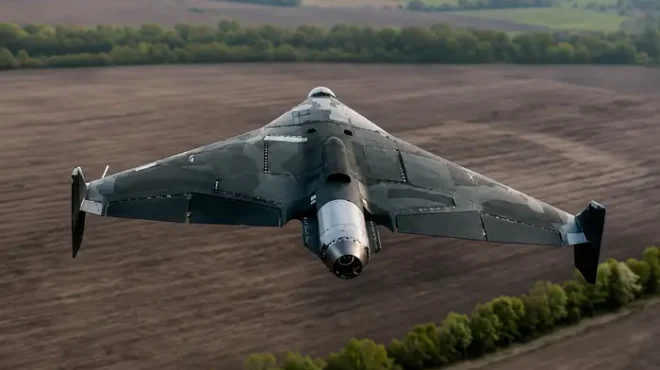
KAB stands for guided aerial bomb, while the FAB-500 is a high-explosive bomb of Soviet design from the 1960s. Combined with a cheap set of wings and navigation (the UMPK), it has become the main “gliding” munition of Russian aviation: the half-tonne warhead is released 40–100 km from the target. According to the General Staff of the Armed Forces of Ukraine, in August 2026 Russia used 8,766 such bombs, about 283 per day, the most since February 2022. Let us look at where this weapon came from, how it is built, how it has changed since 2023, why it is so hard to intercept, and what Ukraine is countering it with in 2026.
What the FAB-500 and KAB are
In everyday speech, any guided bomb is called a “KAB,” but there is a difference.
FAB (high-explosive aerial bomb) is an ordinary unguided bomb with its mass in kilograms in the name: FAB-250, FAB-500, FAB-1500, FAB-3000. The UMPK (unified gliding and correction module) is a separate kit that attaches to the bomb and turns it into a glide bomb. In other words, a “KAB with a UMPK” is an old FAB inside a new “body kit.”
True KABs are a separate family of bombs with their own homing seeker. The KAB-500Kr was developed in the USSR in the 1980s: it has a television seeker that locks onto a target at a distance of about 15–17 km, weighs about 520 kg, and can penetrate up to 1.5 m of reinforced concrete. There is also a satellite-guided version, the KAB-500S-E. However, it was the cheap UMPK module, not such bombs, that became the mass solution.
The UMPK works as follows. After release, a spring with a pyrotechnic charge deploys two folding wings. An inertial navigation system controls the flight, while the Kometa-M antenna corrects the accumulated error using GLONASS/GPS signals. Two servo drives move the tail surfaces, and two batteries power all the equipment. The target coordinates are entered before release.
The kit’s hallmark is ease of installation. While the American JDAM requires replacing the tail section and work at a base, the UMPK can be attached right at the airfield. The kit fits the FAB-250, FAB-500, FAB-1500, FAB-3000, the thermobaric ODAB-500 and ODAB-1500, and the RBK-500 cluster bomb. The most common combination is the FAB-500.
History: from a 1930s bomb to the “Russian JDAM”
Work on the FAB-500 began in 1929, and the first model, the FAB-500sv, went into series production in 1931. The Second World War produced the M-43 and M-44 models with welded fins, followed by the M-46. In 1954 the M-54 appeared for internal carriage in heavy bombers, and in 1962 the M-62, which has lower drag and was created for the external hardpoints of fighter-bombers. This profile remains the basic one to this day. The bomb was used in Afghanistan in the 1980s, in Syria (2011–2019) and during the invasion of Ukraine in 2022, as an ordinary unguided weapon.
The idea of fitting wings to bombs had been known to the Russian defense industry since 2002: NPO Bazalt showed a four-tier family at the Farnborough air show. The project drew no interest: the Russian military machine did not expect protracted conflicts, and contractors preferred more expensive guided bombs.
In 2022 it turned out that high-precision munitions were in short supply, while stocks of Soviet bombs were almost limitless. RUSI analyst Justin Bronk estimated them at “hundreds of thousands in warehouses.” A cheap kit to modernize them proved the simplest way out.
| Date | Event |
|---|---|
| January 2023 | A photo of a FAB-500 M-62 with a crudely made set of wings appears on Russian networks |
| March 2023 | The Ukrainian Air Force (Yurii Ihnat) records more frequent use of winged 500-kg bombs from distances of tens of kilometers |
| April 2023 | A Su-34 hits Belgorod with a bomb; according to the blogger Fighterbomber, the bomb had a UMPK |
| May 2023 | The Russian Ministry of Defense publicly acknowledges the UMPK for the first time |
| September–November 2023 | The FAB-1500 appears. A Conflict Armament Research study finds a Kometa navigation module in the kit |
| March 26, 2024 | First use of the UMPB D-30SN, against Kharkiv |
| June–July 2024 | First use of the FAB-3000 with the kit (known date June 20, officially announced July 14) |
| March 2025 | The first photo of the extended UMPK-PD appears on a Su-34 |
| October 2025 | Evidence of a jet engine in the kit (fragments near Poltava). Ukraine’s military intelligence (HUR) speaks of a bomb with a range of up to 200 km |
| July–August 2026 | Monthly records: about 8,300 (July) and 8,766 (August) bombs per month |
Table sources: Wikipedia: UMPK, Wikipedia: UMPB D-30SN, The War Zone, Defence UA, Migflug.
Technical specifications
The FAB-500 M-62 has a one-piece cast steel body with a large explosive fill, so it can penetrate soil or a floor slab before detonating. The main parameters are in the table.
| Parameter | FAB-500 M-62 |
|---|---|
| Mass | about 500 kg |
| Length | 2,470 mm |
| Diameter | 400 mm |
| Explosive | about 201 kg |
| Release altitude | 570–12,000 m |
| Carrier speed at release | 500–1,900 km/h |
| Accuracy with UMPK (CEP) | 10–15 m in normal mode; worse under electronic warfare |
| Cost of the UMPK kit | approximately 2 million rubles (about $25,000); other estimates, up to $30–50,000 |
The spread in cost is explained by the lack of official prices: these are expert estimates. The accuracy of the UMPK is lower than that of Western analogues: a kit built on civilian electronics is cheap but less reliable. Some bombs fail to explode, and some have fallen on Russia’s own territory.
According to open-source estimates, the crater from one bomb is about 5–8.5 m in diameter and up to 3 m deep. The blast wave reliably kills people at a distance of about 10–15 m, while the destruction of brick walls and severe concussions extend several tens of meters. Fragment damage reaches hundreds of meters. For comparison, Ukraine’s Ministry of Defense cites for the FAB-1500 a crater up to 6 m deep and 20–25 m in diameter, with a concussion zone of 300–350 m. In addition, the impact creates a seismic wave that can destroy dugouts without a direct hit.
Modifications and upgrades up to October 2026
Over three years the kit has gone through three stages: a basic version for different calibers, the extended-wing UMPK-PD, and an engine. Hybrid munitions combining a bomb and a cruise missile have also appeared.
| Variant | What it is | Range (estimates) |
|---|---|---|
| Basic UMPK, 2023 | Kit for the FAB-250/500/1500/3000 and their derivatives | 40–70 km. According to Ukraine’s Ministry of Defense, 60–65 km |
| UMPK for the FAB-1500 and FAB-3000 | The same modules for heavy bombs | about 60 km (FAB-1500) and 50–60 km (FAB-3000) |
| UMPK-PD, 2025 | Larger wing area, stronger mounting, more powerful drives. Kometa-M antenna with 8 or 12 elements | up to 95–100 km without an engine (release from an altitude of about 12 km) |
| UMPK-PD / UMPB-5R with a turbojet engine | Small turbojet engine (identified as the Chinese Swiwin SW800Pro-Y, about 180 lbf of thrust) | strikes at 100–150 km; up to 200 km claimed (HUR points to 193–200 km in tests) |
| UMPB D-30SN, 2024 | A separate gliding vehicle of about 250 kg with roughly 100 kg of explosive and an engine. Can be launched from a Su-34 and from the Tornado-S MLRS | 90–120 km |
| “Grom-E1” (hybrid of a bomb and the Kh-38 missile) | Warhead of about 315 kg, solid-fuel rocket motor from the Kh-38, launch mass of about 600 kg | up to 120 km. Lighter variants, up to 200 km |
Sources: Migflug, DSnews, The War Zone, Defence UA, Wikipedia: UMPB D-30SN, Universe Magazine.
The electronics changed the most. Ukrainians learned fairly quickly to jam the four-element Kometa antennas, so they were later replaced with eight-element ones. Researchers also report twelve-element ones.
The manufacturer of the KAB has not been officially named: sources write that the modules may be produced by several enterprises.
Range and trajectory
The range of a glide bomb is a consequence of the release profile. The bomb has no engine (apart from jet-powered versions) and flies on potential energy: the higher and faster the carrier aircraft, the farther it glides. The classic release point is about 12 km altitude and around 1,000 km/h. It is under such conditions that the unpowered UMPK-PD is estimated at 95–100 km. For comparison, the American StormBreaker flies about 74 km, and the Israeli SPICE 2000 about 100 km.
The trajectory of an engineless bomb is a descending glide with a gradual loss of altitude. Over the target it can have a speed of 800–1,000 km/h, and the time from radar detection to impact ranges from several tens of seconds to a few minutes.
Why the KAB is hard to shoot down
The problem lies in a combination of causes:
- The bomb’s streamlined body gives it a small radar signature, so it is detected late. An engineless bomb emits no heat, so heat-seeking missiles and MANPADS are practically useless against it.
- On the final leg the bomb can fly at 800–1,000 km/h. For automated air defense systems this leaves little time to react.
- The Su-34 and Su-35 carriers operate outside the range of most Ukrainian air defense systems.
- A UMPK kit costs about $25,000–50,000, while a PAC-3 MSE missile costs about $4.2–5 million.
- At an average rate of about 283 bombs per day (August 2026), complete interception by missiles is impossible with any missile stockpile.
- The Russian side adapts to electronic warfare. And even without a satellite, the bomb flies on its INS: the error grows, but at a distance of 60–80 km it is only a few hundred meters.
Prospects for KAB development
As of October 2026, Ukraine has no mass system for intercepting guided bombs. So the emphasis is on strikes against carriers and depots.
In 2026, strikes on airfields and depots remain one of the main lines of effort: on July 5 a guided-bomb storage site at the Borisoglebsk airfield was hit, and in early August the SBU conducted a 40-day operation against several Crimean airfields. This is cheaper than shooting down bombs.
Patriots deployed in forward ambushes have also shot down Su-34s and Su-35s, but at the same time the batteries become a priority target for Russian strikes, and missile stocks are limited.
In February 2025, one bomb was reportedly shot down near Zaporizhzhia by a ZU-23-2 anti-aircraft gun with a detection device. In autumn 2025, the missile forces had already destroyed about 100 bombs in three months.
Ukraine is now working with NATO (JATEC) on radars, recognition algorithms and interceptor drones. The German Tytan and a French “drone wall” concept have been tested, but none of them yet works at the required scale. In December 2025, the General Staff announced tests of an undisclosed system against KABs.
In June 2025, the design bureau Medoid showed a Ukrainian kit for the FAB-500 with a range of 60 km and plans for 80 km. On May 18, 2026, Defense Minister Mykhailo Fedorov announced the first domestic glide bomb with a 250-kg warhead from DG Industry through the Brave1 hub.
Western partners are supplying Ukraine with JDAM-ER, French AASM Hammer (about 70 km) and GBU-39. In May 2026, the US approved a potential sale of more than 1,500 JDAM-ER kits worth up to $373.6 million.
Sources
- UMPK (bomb kit) — Wikipedia
- FAB-500 — Wikipedia
- KAB-500Kr — Wikipedia
- UMPB D-30SN — Wikipedia
- UMPK Glide Bombs: 8,766 Dropped in August — Migflug
- Russia Is Now Launching Jet-Powered Glide Bombs At Ukraine — The War Zone
- Everything about the KABs Russia drops on Ukraine — DSnews
- What are the new Russian KABs that can strike at 95 km — Defence UA
- Russia’s reactive KABs — Universe Magazine
- The Glide-Bomb Range Race — WeaponSpecs
- Ukraine’s answer to Russia’s glide bombs — The Ukrainian Week
- Ukraine Tests Secret New Weapon — UNITED24 Media
- Ukraine Deploys First Domestic 250 Kg Glide Bomb — Army Recognition