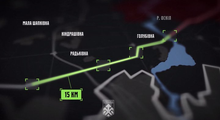
The “Lava” Unmanned Systems Regiment of the 2nd Corps of the National Guard of Ukraine “Khartiya” conducted a logistics mission on the Kharkiv direction using a ground robotic complex (GRC) integrated with an autonomous AI-based control system. The robot completed 93% of a 20 km route without direct operator intervention.
This was reported by the regiment on Facebook on October 28.
According to the military, the operator had to take over control only on a 1.4 km stretch. “Khartiya” described the trial as the first such mission conducted in real-world combat conditions anywhere in the world.
To carry out the mission, the military used software developed by Apex.AI. Prior to the main run, a dedicated ground robot traveled the route and used LiDAR to scan the terrain, creating a three-dimensional model of it.
The main GRC then navigated using the pre-built model. Its cameras recognized the road, roadside, and obstacles in real time, while the software system analyzed the situation and determined subsequent actions. The operator could adjust the trajectory and set speed on specific sections, but was not required to continuously control the vehicle manually.
As reported, this approach differs from traditional remote control, in which an operator continuously monitors the platform’s movement via a communication channel. Autonomous navigation reduces dependence on a continuous communication link with the robot — including via Starlink, which may be unavailable or operate unreliably.
Andriy Kopach, battalion commander of the GRC battalion of the “Lava” regiment, call sign “Matematyk,” noted that autonomous control is set to change the role of a servicemember during logistics missions.
“The most important change is that the operator stops being a driver and becomes a dispatcher,” he explained.
According to the commander, the ultimate goal is for a single servicemember to simultaneously oversee multiple ground robotic complexes.
At present, logistics is described as the primary mission for autonomous platforms within the unit. The next area of development may be the evacuation of wounded from hazardous areas, where continuous remote control is complicated by the risk of operator casualties, loss of communication, or the need to traverse a route quickly.
The software solution is being developed by Apex.AI, while “Lava” personnel participate in shaping the technical requirements and conducting field trials.
Apex.AI is an international technology company founded in 2017 and headquartered in Palo Alto, California. It develops software infrastructure for autonomous vehicles and robotic platforms. Its Apex.Autonomy solution, in particular, is designed for unmanned ground vehicles and supports autonomous navigation, convoy movement, and evacuation missions. The company’s software platform is also focused on real-time sensor data processing and integration with various hardware systems.