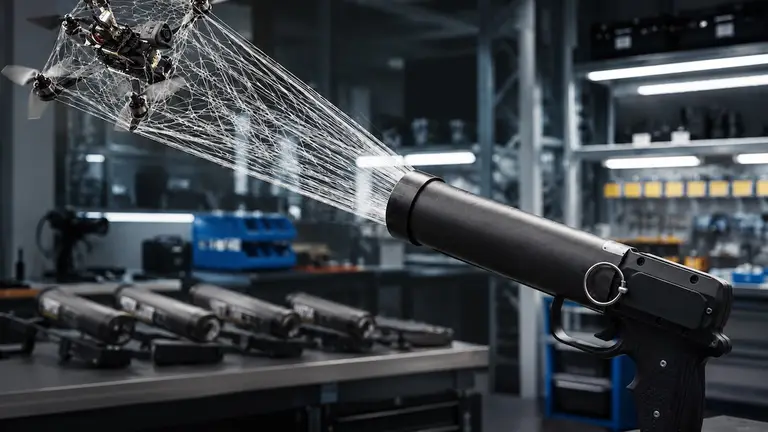
The proliferation of small unmanned aerial vehicles is accelerating the search for new counter-drone tools. Electronic warfare (EW) remains an important part of protection, but it does not always work against autonomous systems, protected communication channels, and FPV drones with fiber-optic control. That is why anti-drone physical interception technologies — including net guns — are developing alongside EW.
What is a net gun
A net gun is a device that launches a folded net toward an aerial target. After firing, the net deploys, engulfs the drone, and becomes entangled in the propeller plane. The vehicle loses thrust and control, falls, remains on a tether, or descends on a parachute — depending on the system’s design.
An anti-drone net gun operates differently from EW and anti-drone rifles: it does not suppress communications but physically restricts flight. Unlike firearms, it does not destroy the target with a bullet or fragments. The technology is sometimes described as kinetic interception, though physical interception is more accurate — the result is achieved not by impact force but by entangling the propulsion system.
How a net gun works against drones
The net is stored in a projectile or cartridge. After launch, weights on its edges spread outward and deploy the mesh in front of the target. Production devices use pneumatic, gas, pyrotechnic, and other factory-built mechanisms.
Even partial blocking of one or more propellers can destabilize a quadcopter. Some systems supplement the net with a tether to retain the target or a parachute for a controlled descent. This reduces the risk of a crash and allows the UAV to be preserved for examination, but does not guarantee safety — especially if a kamikaze drone has been intercepted.
A ground-based net gun is best suited to small multirotor aircraft: commercial quadcopters, lightweight reconnaissance UAVs, and FPV drones. The type of control channel is irrelevant to the net,
Therefore, a net gun can intercept drones equally regardless of the control method, including fiber-optic ones.
Against high-altitude, heavy, or fast fixed-wing UAVs, handheld models are largely ineffective. Their use is practical at close range when EW is undesirable, unavailable, or has failed.
Types of net guns
Categories partially overlap: for example, a single device can simultaneously be handheld, portable, and reusable.
Handheld and portable
A handheld net gun is held and aimed by the operator independently. A portable system can be mounted on a tripod or support, making prolonged sector surveillance easier. The advantages of such systems are mobility, rapid deployment, and the ability to selectively cover a position, checkpoint, or small facility. The disadvantages are limited range and dependence on the operator’s reaction time and accuracy. More complex portable systems are more stable but heavier.
An example of a reusable handheld system is the SkyWall Patrol by OpenWorks Engineering. According to the manufacturer, it features an aiming module and uses interchangeable projectiles, each deploying a single net of approximately 8 m². Options are available with a net only or with a net and parachute for the controlled descent of a captured drone. Such a system is designed to guard defined areas and facilities.

Single-use and reusable
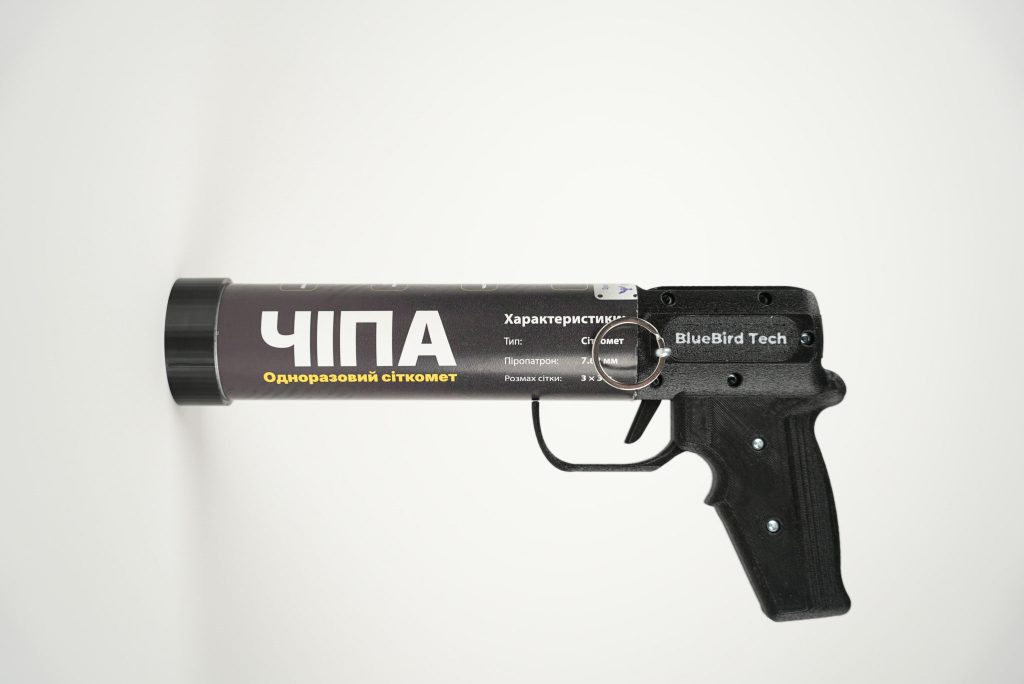
A single-use net gun is a factory-built ready-to-fire product that is not reloaded after firing. It is compact and requires no separate cartridges, but offers only one attempt, making it a last-resort tool.
A Ukrainian example is the «CHIPA» net gun from BlueBird Tech. The developer positions it as a compact single-use pistol-type device against FPV drones and light quadcopters at close range. The manufacturer’s stated effective range is up to 25 meters, with a price of UAH 3,240, making the «CHIPA» a relatively affordable close-range interception tool.
A reusable model is fitted with a new projectile or cartridge after firing. An example of such a solution is the «Sitkomet Ptashka» by Ptashka Drones. The infantry version launches a net approximately 3.5 meters in diameter to a distance of up to 30 meters. It was tested during basic combined-arms training as a last-resort tool against FPV drones. The ability to reload is useful for permanent posts and prepared mobile teams, although such devices require spare cartridges and maintenance.
Stationary
A stationary net gun is installed near a facility, sometimes on a rotating platform. It can be integrated with a camera, radar, or other detection means. Advantages include constant readiness, stable aiming, and control of a defined sector; disadvantages include lack of mobility and dependence on correct placement. Typical scenarios involve covering a perimeter, passages between structures, and predictable UAV approach corridors.
Automated
In an automated system, sensors detect the target while software tracks it and determines the moment of interception. This reduces dependence on operator reaction time and simplifies around-the-clock operation, but increases cost and recognition requirements. The system must distinguish a threat from a bird or an authorized UAV, and the decision to engage may remain with a human operator.
On robotic platforms
Net modules are integrated into ground robots and interceptor drones. An airborne platform pursues the target and launches the net in close proximity, partially overcoming the main limitation of ground-based models — short range.
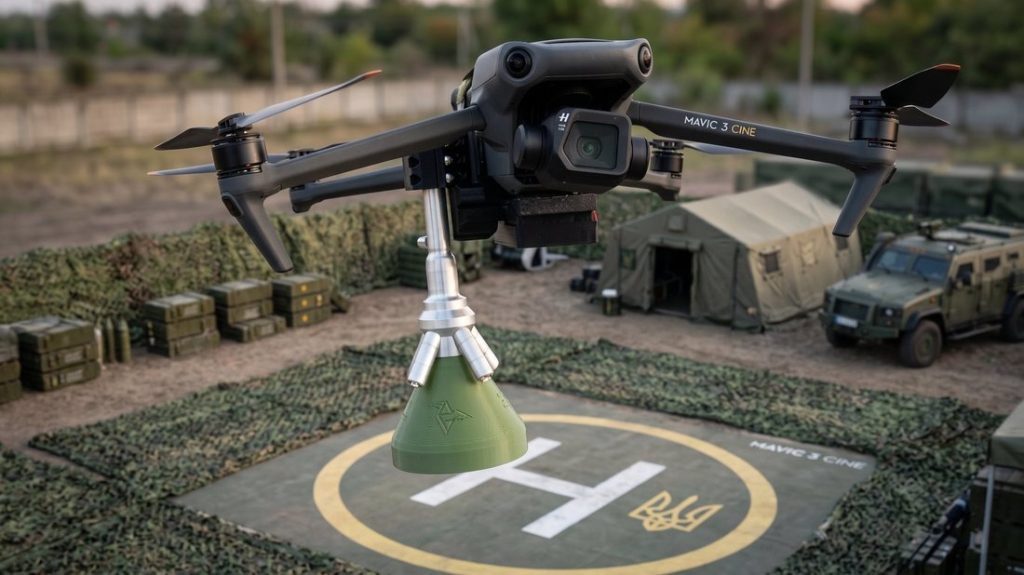
For example, Ptashka Drones also developed an airborne version of the «Sitkomet Ptashka», installed on an interceptor drone. It features an interchangeable cartridge and an electromechanical release. The carrier approaches the aerial target and covers it with the net from above. This method is best suited for intercepting slow UAVs or copters that are hovering or following a predictable trajectory.
The DroneHunter F700 by Fortem Technologies is an autonomous interceptor with an onboard radar and interchangeable net modules. According to the manufacturer, it can capture a small drone with a tethered net and tow it away, while larger targets are handled by a net with a parachute. The advantages of this format are a larger operational area and automatic tracking; limitations include system complexity and cost.
Advantages of net guns
The main advantage is independence from the target’s radio-electronic architecture. The net is indifferent to the frequency the UAV operates on, whether it has autonomous navigation, a protected channel, or fiber-optic control.
Other strengths:
- does not create interference for friendly communications and navigation;
- can operate where EW use is undesirable (near friendly communication systems, at airports, critical infrastructure, etc.);
- carries a lower risk of accidentally striking unintended objects than firearms;
- suitable for point protection of facilities and controlled urban spaces;
- sometimes allows the aircraft to be preserved for technical examination.
Disadvantages of net guns
The primary limitation is short range. When a fast FPV drone has already closed in, there may not be enough time for detection, identification, and aiming. The outcome also depends on the direction of flight, visibility, weather, obstacles, and net size.
A single net gun cannot cover a large perimeter, cannot guarantee protection against a simultaneous attack by multiple aircraft, and does not replace short-range air defense systems. A falling captured UAV also poses a risk to people and infrastructure.
Net guns or EW: which is better
EW affects control, video link, or satellite navigation and is capable of covering a wider area. Its effectiveness depends on frequency ranges, UAV architecture, and the radio-frequency environment. A drone that loses its signal does not necessarily crash — it may return, hover, or continue flying on its algorithm.
A net gun has a shorter range but provides direct physical interception of drones and is independent of frequencies. It potentially works against autonomous and fiber-optic targets if they come within physical reach.
| Parameter | Net gun | EW |
|---|---|---|
| Operating principle | Physically blocks flight | Suppresses or distorts radio signals |
| Area of effect | Close range | Typically wider |
| Dependence on target’s frequencies | None | Yes |
| Impact on friendly communications | Creates no radio interference | Possible |
| Main limitation | Short range and difficulty of accurate deployment | Dependence on drone architecture and radio-frequency environment |
| Effectiveness against fiber-optic FPV | Potentially high (depending on range) | Low |
Consequently, these are not interchangeable counter-drone technologies. They complement each other: sensors detect the target, EW attempts to disrupt its operation at greater range, and the anti-drone net gun covers the close-in layer. Effective counter-UAV operations require a combination of multiple countermeasure tools.
Where net guns are used
In the military domain, a net gun can serve as the last line of defense for positions, command posts, and equipment locations. At critical infrastructure facilities, it can supplement radars, optical sensors, and EW where radio interference is undesirable. In both cases, a safe zone is needed for the aircraft to fall or descend into.
Foreign developers also offer such anti-drone systems for airports, government facilities, correctional institutions, and mass public events. Here the priority is to stop an airspace violator with minimal risk and, where possible, to preserve the drone as evidence. The prospects for civilian use are tied to automatic target recognition, controlled descent, and clear legal regulation.
However, no net gun provides universal drone protection. It is a specialized close-range interception tool that must work alongside detection, EW, engineering defenses, and other counter-UAV measures.