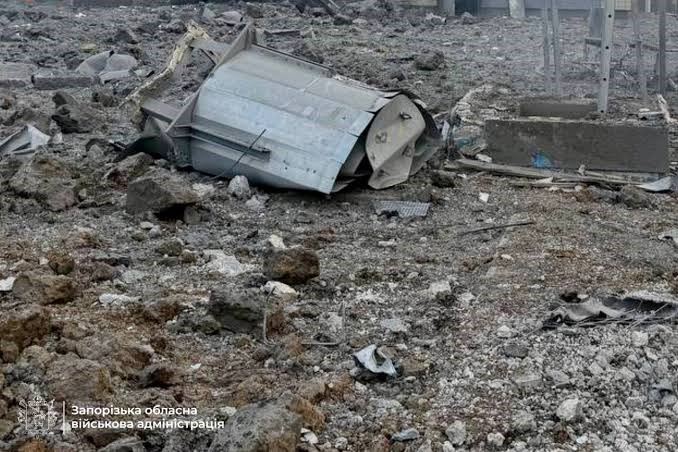
On November 2, Russian forces carried out a series of air strikes on the village of Komyshuvakha in Zaporizhzhia Oblast, using at least nine FAB-3000 aerial bombs. This was reported by the acting head of the Zaporizhzhia Regional Military Administration, Mykhailo Semikhin.
A school used for distributing humanitarian aid and as a shelter was struck. As of the evening of November 2, the death toll stands at 26, including two State Emergency Service rescuers and four police officers.
According to Ukrainian President Volodymyr Zelensky, Russian forces attacked Komyshuvakha several times throughout the morning. After the first strike on the school, enemy aircraft carried out a repeated strike with aerial bombs on the shelter where people were located.
Acting head of the Zaporizhzhia Regional Military Administration Mykhailo Semikhin reported that Russian aviation used FAB-3000 bombs.
The FAB-3000 is a Soviet high-explosive aerial bomb of great power that Russia has resumed mass-producing and began employing during its full-scale war against Ukraine.
Key characteristics of the munition:
| Parameter | Specification |
| Type | High-explosive aerial bomb |
| Weight | Approximately 3,000 kg |
| Warhead weight | Approximately 1.2 tonnes of explosive |
| Base modification | FAB-3000 M-54 |
| Glide system | UMPK — when the corresponding kit is fitted |
| Carrier | Su-34 frontline bomber |
In its basic configuration, the FAB-3000 is a gravity bomb. To extend its range, Russian forces equip the bomb with universal glide-and-correction modules (UMPK).
Such a kit adds wings and a guidance system to the bomb, allowing the aircraft to release the munition from a stand-off distance from the target.
Estimates of the FAB-3000’s glide range when fitted with UMPK vary. Russian sources put it at approximately 50–60 km. Ukrainian experts have cited ranges of up to 70–80 km for certain UMPK configurations. Komyshuvakha is located near the front line, so Russian aviation may have employed the bombs from a relatively short distance.
Ukrainian military experts had previously noted accuracy problems with the UMPK module for the FAB-3000. In particular, Oleksandr Kovalenko of the Information Resistance group pointed out that the module’s design for the super-heavy bomb does not provide the precision one would expect from modern guided munitions.
At the same time, the FAB-3000’s enormous destructive power allows Russian forces to use it against large targets even when guidance accuracy is insufficient.
This is not the first strike on humanitarian infrastructure in Komyshuvakha. On June 15, Russian forces attacked with drones in the area near the school where the Proliska humanitarian mission was operating.
At that time, the organization’s staff helped people move to an underground shelter. Following the attack, the mission suspended humanitarian aid deliveries to the village and focused on evacuating residents.
After the November 2 strike, the prosecutor’s office opened an investigation. Zaporizhzhia Oblast declared November 3 a day of mourning for the victims.