When in the spring of 2023 Russia’s flagship tank, the T-90A nicknamed “Vladimir,” ended up in the workshop of engineers at the Center for Research of Trophy and Advanced Weapons, the conclusion was devastating for the Kremlin. It turned out to be an old T-72 fitted with imported electronics instead of any genuine “innovations.” Publishing this finding damaged the tank’s reputation more than any shell: in its wake, a number of T-90 supply contracts were suspended. One disassembled tank cost Russia billions of dollars in export revenue.
That is the essence of trophy intelligence — TECHINT, technical intelligence, in NATO parlance. A large team of engineers studies how enemy equipment is built, what it is made of, and where its weak points lie. In the AFU, this has become an industry. It involves thousands of people: from sappers extracting tanks from minefields to programmers dumping firmware from drones in Ghidra.
From Trench to Laboratory
A trophy can be reported by technical reconnaissance, infantry, local residents — or even a random post on Telegram. Sometimes equipment is acquired as a “bonus” alongside captured prisoners. Even monitoring the news helps. For instance, Center engineers located an intact Orlan-10 reconnaissance drone near Vyshhorod thanks to media reports about a police operation.
Abandoned enemy equipment is almost always booby-trapped: occupiers leave tripwires, attach explosives to hatches, and mine the approaches. Protection against trophy intelligence is often built in during factory assembly. As Serhii “Flash” wrote in July:
“Attention! The new AI-equipped ‘Molniya’ drones feature a dedicated detonation circuit. It activates when the top cover is opened.”
That is why every evacuation team includes sappers, and officers from the Center itself undergo counter-mine training.
After initial demining, the item travels under escort to a technical base or directly to the laboratory. There it is logged and tagged with a number so it does not get lost among hundreds of other specimens.
What Happens Behind Closed Doors
The initial inspection is, in essence, a “digital autopsy.” 3D scanning of the hull with laser or photogrammetric scanners produces a precise model that can then be “disassembled” and “reassembled” on a computer hundreds of times — even after the original has been cut into metal samples. Every marking, every serial number, and every weld seam is recorded.
Next comes hands-on work. A tank or IFV is broken down into modules: the turret, antennas, and explosive reactive armor blocks are removed. For armor, metallography is applied — studying the steel’s microstructure under a microscope — plus firing tests on a range to verify whether the protection actually performs as the manufacturer claims.
This is exactly how, in June 2022, a captured BMP-2 fitted with the new 675-sb3KDZ appliqué armor kit was tested. Bursts from a heavy machine gun and a grenade launcher shot revealed precisely where that “shell” held and where it did not. The results were incorporated into infantry manuals: exactly how to aim at such a vehicle so as not to waste ammunition.

Electronics and software are handled separately. Logic analyzers and oscilloscopes read signals on circuit boards, spectrometers identify the frequencies of control channels, and IT specialists dump controller firmware and run it through tools such as Ghidra, IDA Pro, or Hex-Rays. SD cards and flash memory are extracted from drones individually — they often retain route logs and even camera footage.
Missiles and munitions are a separate matter. A seized fuze is sent to the laboratory for chemical analysis of the propellant by gas chromatography, while the warhead is inspected for concealed self-destruct devices that could trigger in a researcher’s hands.
The adversary operates in the same way, however. A U.S. M1A1 Abrams tank captured in Donetsk Oblast in 2024 — disabled by a mine and finished off by FPV drones — was sent by the Russians to Uralvagonzavod, which manufactures the T-72 and T-90. A captured Leopard 2A6 reportedly ended up there as well. Both tanks were studied for their composite armor and fire-control systems.
A Drone Copied in a Matter of Weeks
Not all the results of this work remain confined to reports and infantry manuals. One of the most telling examples is the strike drone “Blyskavytsia” (Lightning), which Ukrainian engineers developed after studying the design of the Russian kamikaze drone “Molniya” (also meaning Lightning). It is a fast and cheap way to ramp up production of similar systems using domestic capacity, without waiting for a new development cycle. This is the classic logic of technical intelligence: there is no need to reinvent the wheel if the enemy has already field-tested the design for you.
Yet a complete specimen is not always needed for reverse engineering — fragments often suffice. That was the case with the hypersonic Kinzhal missile shot down over Kyiv on 4 May 2023. Specialists from the Kyiv Scientific Research Institute of Forensic Expertise (KSRIFE) disassembled the remnants of the warhead and established that it was loaded with octogen — the same explosive used in the warhead of the 9M723 ballistic missile of the Iskander system. This pointed to a shared production base and shared vulnerabilities in both types of missiles.
How Disassembling Enemy Equipment Changed the Course of Conflicts
Ukraine is not a pioneer — reverse engineering of trophies has a long history.
The most prominent example is the defection of Soviet pilot Viktor Belenko to Japan on 6 September 1976, flying the cutting-edge MiG-25 Foxbat interceptor. In the West, this aircraft was regarded as a technological monster capable of flying at Mach 3 and outrunning any Western fighter. A dedicated missile, the AIM-97 Seekbat, was even developed to counter the threat.

When American and Japanese engineers took the aircraft apart, it turned out to be a heavy, unwieldy plane with a crude radar and engines that destroyed themselves at the advertised speeds. The myth evaporated, the dedicated missile program was cancelled, and an understanding of the MiG-25’s real weaknesses influenced the subsequent development of the F-15.
Notably, a similar move was repeated in 1997, when the United States purchased 21 MiG-29 fighters from Moldova: officially to prevent them from falling into Iran’s hands, but unofficially also to allow American engineers to disassemble them without restriction.
TrophyLab: The Globalization of Trophy Intelligence
In June 2026, the Ministry of Defense officially launched the state portal TrophyLab — a unified database of trophy equipment research, into which data is entered by Defense Forces units, the DIU, the SBU, and relevant scientific institutions.
At launch, the catalog contained more than 115 samples of Russian weaponry organized by category. A registered and verified user — a researcher, a military unit, or a defense company from a partner country — can submit a request for a sample or a fragment of it for independent study. Demand proved greater than anticipated: within just one month of launch, more than 300 applications had been submitted to the platform, nearly 200 of them from foreign defense companies.
The Price of Knowledge
Behind the effectiveness lie real risks. The very same T-90 story that cost Russia its export contracts simultaneously reveals to the enemy exactly what Ukrainian analysts already know about its equipment. Databases such as TrophyLab are an attractive target for cyberattacks, and access by foreign partners amplifies the risk of sensitive data leaks.
Yet the greatest risk is borne by the people who drive out to retrieve a trophy from no-man’s-land or a freshly abandoned position. And the work itself — handling enemy munitions and explosives under laboratory conditions — is a daily hazard for engineers and scientists.
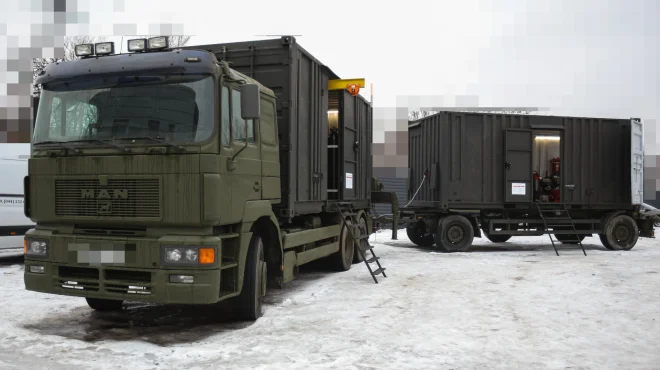
The Center speaks of the need for mobile laboratories closer to the front line so that valuable samples are not lost due to evacuation delays, and of expanding its equipment fleet. Scientists need portable X-ray units and micro-CT scanners to examine equipment without disassembly.
Four years of active work by the Center have demonstrated that in war, victory is sometimes decided not only on the battlefield but also at the laboratory bench — when a disassembled trophy is transformed into an infantry manual, a tip for electronic warfare developers, or the argument that causes a foreign buyer to cancel a contract with the manufacturer.
The following publications were used in preparing this article:
- Ministry of Defense of Ukraine. TrophyLab from the Ministry of Defense Opens Trophy Weapon Technologies to the World
- Interfax-Ukraine. Already 200 Foreign Defense Companies Have Applied to TrophyLab
- TrophyLab, official website. About the Project
- ArmiyaInform. One Year of the Center for Research of Trophy and Advanced Weapons: Russia’s Defense Industry Market Poorer by Billions of Dollars
- NV.ua. Thanks to the Occupation of Berdychiv, Russians Captured an Abrams Tank
- National Security Journal. A Russian Pilot Defected With a Mach 2.83 MiG-25 Foxbat Fighter Jet — American Engineers Broke It Apart
- National Security Journal. The Day the U.S. Got a Secret Russian MiG-25 Fighter (It Was Junk)
- Wikipedia. Defection of Viktor Belenko