In combat conditions, the effectiveness of electronic warfare assets is determined not only by their frequency capabilities or power but also by the stability of power supply. Even a correctly configured EW system loses its meaning if it works with interruptions or shuts down at a critical moment.
On the front line, the autonomy of EW often becomes a weak point. Limited access to stationary power sources, unstable generators, worn batteries, and constant load create risks for the continuous operation of systems.
Why Autonomy Is Critical for EW
EW is an active system that constantly consumes electrical energy during operation. Unlike many other assets, it cannot function intermittently or with pauses without losing its protective effect.
Any break in the power supply means a window of vulnerability that the enemy can exploit. In real combat conditions, even a few minutes of downtime can lead to the engagement of a position by an FPV drone or the loss of equipment.
That is precisely why autonomy for EW is not a matter of convenience but a basic condition of its combat expediency.
Main Power Sources on the Front Line
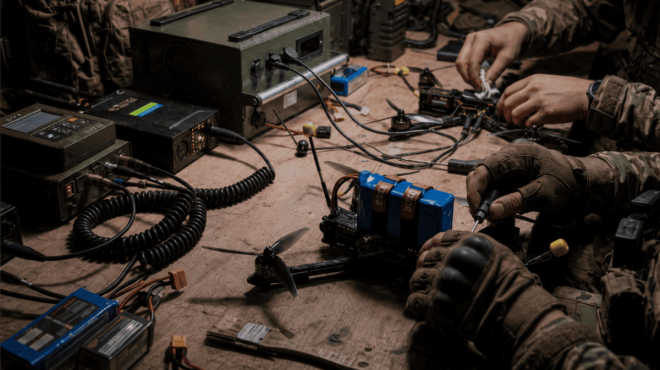
At the front, different power sources are used for EW, each of which has its own limitations. The most widespread remain generators, battery packs, and combined solutions.
Generators ensure long-term operation but depend on fuel, create noise, and unmask the position. Batteries provide silence and mobility but have limited capacity and require regular recharging.
In reality, units are forced to combine these sources, adapting to the situation and available resources.
Typical Problems With Power Supply
The most common problem is the mismatch of the power source with the real load of the EW. Batteries discharge quickly, generators work unstably, and cables and connections wear out in field conditions.
Another factor is weather conditions. Low temperatures reduce the effective capacity of batteries, and moisture negatively affects contacts and electronics.
As a result, the system is formally present at the position but does not ensure continuous protection.
Backup Systems and Redundancy
To reduce risks, units apply backup power schemes. This can be the redundancy of batteries, the parallel use of a generator and batteries, or the dispersal of power sources between different points.
Such an approach makes it possible to maintain the operation of EW even in the event of the failure of one of the elements. It is important that the redundancy be well-thought-out, and not formal, with a clear understanding of the autonomous operation time.
The practical aspects of autonomous power supply are examined in more detail in the article: «Power supply of drones and EW at the front: the autonomous operation of equipment in combat conditions».
The Impact of Load on the Stability of Operation
The load on an EW system changes depending on the operating mode, the number of active channels, and the duration of radiation. Maximum modes consume significantly more energy than is assumed in «paper» calculations.
If the power source is selected without a reserve, this leads to a voltage drop, unstable operation, or the emergency shutdown of the system. In combat conditions, such failures can have critical consequences.
Therefore, the load should always be assessed taking into account the worst-case scenario, and not average values.
How to Correctly Organize EW Power Supply
The correct organization of power supply begins with assessing the consumption of the specific EW system and the conditions of its application. Next, the basic power source and backup options in case of failure are determined.
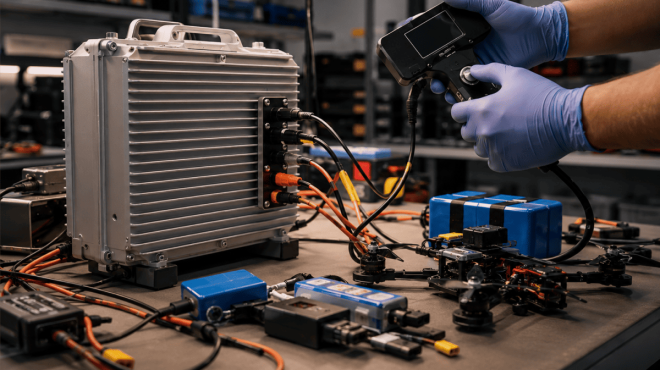
In field conditions, specialized power devices are often used, in particular the “Genera-28” 28 V, which ensure a stable voltage supply for EW systems and make it possible to reduce dependence on unstable sources.
Such an approach increases the survivability of the system and makes it possible to focus on carrying out the combat task, rather than on the constant monitoring of power supply.
Conclusions
Autonomy and stable power supply are key factors in the effectiveness of EW at the front. Even a powerful system loses its meaning without well-thought-out power supply.
The rational organization of power supply, redundancy, and the correct choice of equipment make it possible for units to ensure continuous protection in difficult combat conditions.