An FPV drone may be technically sound, but that does not mean it will complete the task. In combat conditions the result is determined not by the platform itself but by how correctly it is prepared for launch.
In practice, most losses happen not because of the difficulty of the task but because of minor mistakes before the flight: an unstable contact, an unverified signal, an underestimated load, or weather conditions. In the air these factors can no longer be fixed — they simply manifest themselves.
Checking the Technical Condition of an FPV Drone Before Launch
The physical condition of the drone determines how it will behave in the air under load. Even minimal defects that ‘cannot be seen on the table’ turn into instability, vibration, and a loss of control precision in flight.
The inspection begins not formally but with an understanding of what exactly can go wrong. The frame is checked for microcracks and warping, since under load they change the geometry and affect the distribution of thrust.
Motors are checked not only for rotation but for evenness and the absence of play, because even a small deviation creates parasitic oscillations. Propellers are a critical point. A damaged or unbalanced propeller does not just reduce efficiency but creates vibration that ‘disrupts’ the flight controller and degrades the video. As a result, the operator gets worse stabilization and a delay in decision-making.
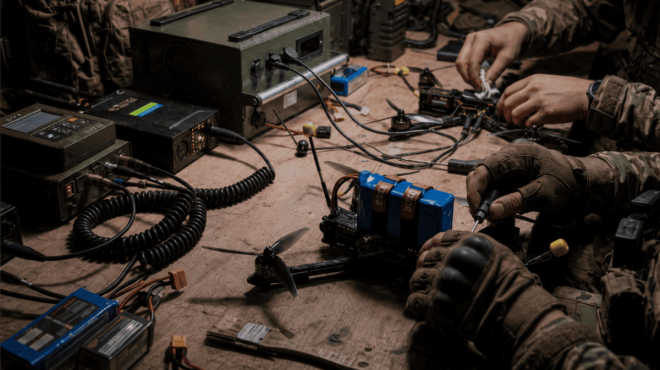
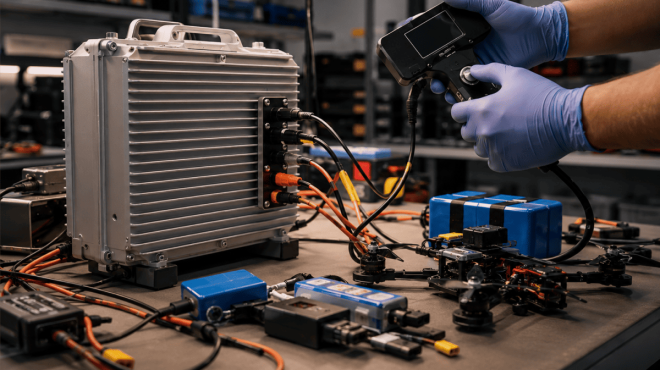
Electronics are checked separately: cable fixation, the tightness of contacts, and the absence of burnt elements. In practice, most losses happen because of trivial things — a cable that came loose from vibration, or a contact that ‘held, but not all the way’. This is the stage where 80% of problems are revealed. If the drone passes it well, the chance of a stable flight rises sharply.
Configuring the Control, Communication, and Video Systems
The control system is what determines how precisely the drone executes commands and whether control is maintained in flight. If the signal is unstable or has a delay, the operator effectively works ‘blind’ or with a lag. Verification must take place not next to yourself but at a distance as close as possible to the working one. A very common mistake is testing in comfortable conditions where the signal is perfect, but in reality it degrades due to distance, terrain, or obstacles.
The video signal is a separate critical area. What matters is not only the image quality but its stability and latency. If the video periodically ‘drops’ or has a delay of even a fraction of a second, it creates a gap between action and perception. To better understand the basic logic of how FPV systems work and how control, video, and flight interact, see the article: «What is an FPV drone?», where these principles are explained at a basic level and help form a holistic understanding of the system.
In difficult conditions one more factor is added — the impact of EW. The signal may not just weaken but behave unpredictably: disappear, become distorted, ‘fluctuate’ in quality. Therefore the task is not to verify that something ‘works’ but to understand how the system behaves in extreme conditions. This is exactly what determines whether there will be control in flight.
Configuring the Drone’s Flight Parameters
Flight settings determine the drone’s character — how it reacts, how steadily it holds position, and how it behaves under load. This is not ‘fine-tuning’ but the basis of controllability.
Calibration of the controller is necessary for the correct operation of the sensors. If it is done imprecisely, the drone may ‘drift’ even without the influence of external factors or react with a delay.
It is also important to take the load into account. A drone without a load and a drone with a combat payload are different systems in terms of behavior. If the settings are made without taking this into account, instability arises in flight.
A test launch is not a formality but a check of behavior. It is here that you can see whether there are parasitic oscillations, how the drone holds its course, and whether there are delays in reaction. In practice, most ‘strange’ problems in the air are not a malfunction but incorrect settings that were not checked before launch.
Preparing the FPV Drone’s Power Supply
Power affects not only flight time but the drone’s behavior under load. If the battery cannot deliver the required current, the drone loses thrust at the critical moment. Checking the battery is not only the charge level. It is important to assess its condition, internal resistance, and ability to work under load. A battery may show 100% but ‘sag’ during a sharp increase in thrust.
A key point is the balance between power and flight time. The higher the load, the faster the discharge. But trying to ‘stretch’ the time with a weaker battery leads to a loss of stability.
External conditions are also critical. Cold reduces battery efficiency and can shorten flight time by a third, while overheating causes instability. In practice, most accidents in the air are related not to control but precisely to power.
Preparing for Combat Conditions
The environment is a factor that cannot be controlled but can be taken into account. It is exactly what most often ‘breaks’ perfect settings. Wind changes the trajectory and forces the drone to constantly compensate for deviations. As a result, the load on the system grows and the battery is used up faster.
Terrain and buildings affect the signal. In an open field and in an urban area the system’s behavior will be radically different. Task planning is also important. If the operator does not understand the route and scenario, they begin to improvise, which sharply reduces effectiveness. Ultimately, preparing for the environment is not an additional stage but one of the key factors of stable operation.
Typical Mistakes When Preparing an FPV Drone
The most dangerous mistake is the confidence that ‘it works anyway’. It is exactly what leads to skipping critical checks. The second problem is testing in ideal conditions. The drone is tested where there are no obstacles, wind, or load, and then behaves completely differently in reality.
The third mistake is underestimating the small things. A contact, a propeller, settings — these are exactly the things that most often become the cause of losses. And one more critical thing is the lack of a system. When preparation is done ‘from memory’ rather than by a clear algorithm, mistakes become inevitable.
Even when using ready-made solutions like the Zhakh 10” FPV Drone, which is a standalone platform designed to work under load, these mistakes do not disappear. The equipment may be of high quality, but without proper preparation it behaves unpredictably, since most risks are related not to the design but to how exactly the drone is checked and configured before launch. All these problems have one thing in common: they are fully controllable on the ground and uncontrollable in the air.
Conclusions
Preparing an FPV drone is not a formal stage before launch but a key part of the entire system that determines whether there will be control in the air at all. All the failures that occur during flight are, as a rule, set up on the ground through an underestimation of the load, the signal, the power, or the environmental conditions.
Stable drone operation is the result not of a single check but of a systematic approach: control of the technical condition, precise settings, a test under load, and an understanding of how the system behaves in real conditions. It is this sequence that makes it possible to reduce risks and make the work predictable.
In practice this means a simple thing: the drone does not ‘make mistakes’ in the air, it executes what was prepared before launch. The more precise the preparation, the less randomness in the result.