The stability of military communication depends not only on the quality of the equipment or the power of the transmitter. One of the key factors that determines the real range of signal transmission is the radio horizon — a physical limitation on the propagation of radio waves due to the curvature of the Earth.
In field conditions, this factor often becomes critical. Even a modern military radio can lose the signal if the transmitter and receiver are located beyond the bounds of direct radio line-of-sight.
What the Radio Horizon Is and How It Is Calculated
The radio horizon is the maximum distance over which a radio signal can propagate between two antennas under the condition of direct radio line-of-sight. The main reason for such a limitation lies in the curvature of the Earth’s surface.
When antennas are located at a low height, the radio wave propagates only up to a certain limit. After this, the signal is essentially blocked by the Earth’s surface, and communication becomes unstable or completely disappears.
In practical radio engineering, the radio horizon depends primarily on the height of the antennas and the conditions of signal propagation in the atmosphere. On average, for ground antennas installed at a height of several meters, the radio horizon can be several dozen kilometers, but the exact range changes depending on the height of placing the equipment and the features of the terrain.
The Impact of Antenna Height on the Radio Horizon
The height of the antenna’s placement is one of the most important factors affecting the radio horizon. The higher the transmitting or receiving antenna is located, the greater the distance the signal can cover.
In field conditions, even raising the antenna by several meters can significantly improve the stability of communication. This is explained by the fact that the zone of direct radio line-of-sight between the points of signal transmission increases. That is precisely why, in field conditions, masts, tripods, or elevated points of the terrain are used to install antennas.
The Radio Horizon in the Operation of a Military Radio
For most tactical radio stations, it is precisely the radio horizon that forms the limit of stable radio communication. The power of the transmitter or the type of equipment can improve the quality of the signal but are not able to fully overcome the physical limitations on the propagation of radio waves.
In the operation of military radio stations, the radio horizon determines at what distance units will be able to maintain stable communication without using additional repeaters or elevated points of antenna placement.
Therefore, during the deployment of a radio network, it is important to take into account the height of the antennas, the placement of equipment, and possible obstacles in the terrain.
The Terrain and Limitations of the Radio Horizon
In practice, the radio horizon depends not only on the curvature of the Earth. A significant impact is exerted by natural and artificial obstacles, such as hills, forest areas, or urban development.
Such objects can block the line of radio line-of-sight even at a relatively short distance. As a result, the signal weakens or completely disappears, although formally the radio horizon has not yet been reached.
That is precisely why, during the planning of a communication system, it is important to take into account the terrain, the placement of buildings, and other factors that can affect the propagation of the radio signal.
The Radio Horizon for UAVs and Repeaters
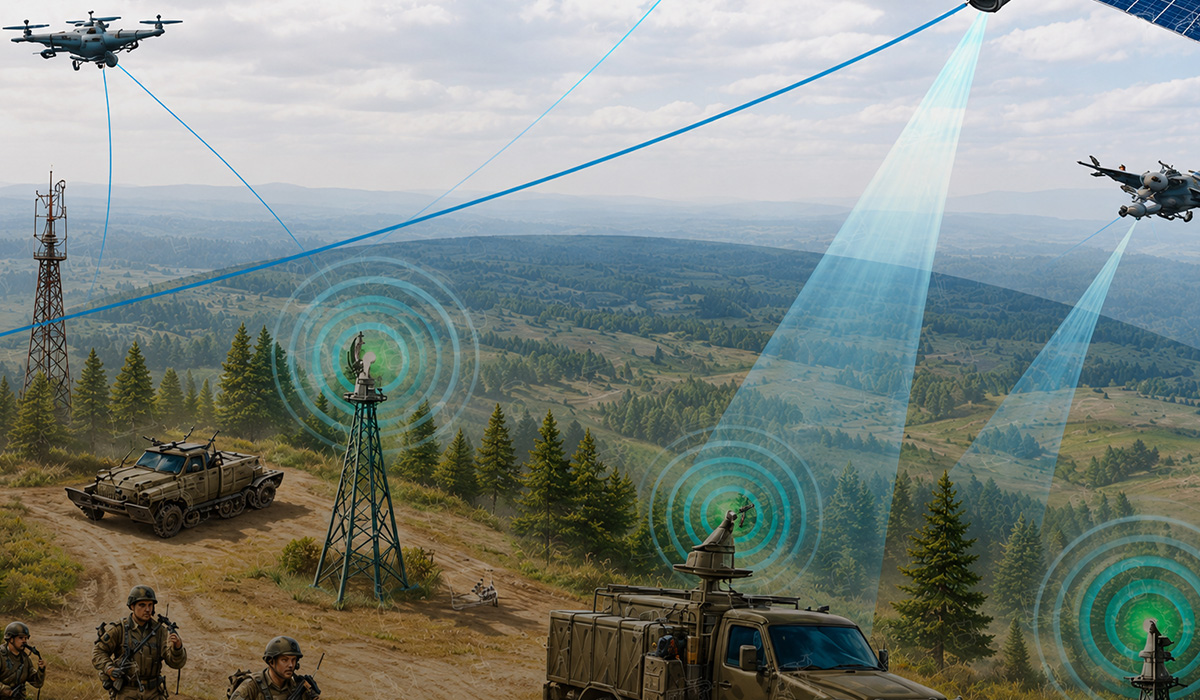
Unmanned aerial vehicles and repeater drones can significantly increase the radio horizon of communication systems. Thanks to their flight altitude, they ensure direct radio line-of-sight between ground stations or between different elements of the control system.
In such configurations, a UAV essentially acts as an intermediate point of signal transmission. This makes it possible to maintain stable communication even in difficult terrain or at a significant distance between units. Thanks to this, repeater drones have become an important element of modern systems for command and coordination on the battlefield.
Practical Application of the Radio Horizon in Military Communication
During the planning of a communication system, commanders and operators take into account the radio horizon to determine the optimal placement of antennas and control points.
The practical principles of building such systems are examined in more detail in the article: «The organization of military communications in the Armed Forces of Ukraine: structure, levels, and management», which explains how a multi-level military communication system is formed and how the operation of different channels is coordinated.
To increase the radio horizon in field conditions, additional technical solutions are often applied. For example, a telescopic mast (aluminum) is used to raise antennas to a greater height. It is not a standalone communication asset but makes it possible to improve radio line-of-sight between the transmitter and receiver and increase the stability of the operation of radio stations.
Conclusions
The radio horizon is one of the key factors that determine the real range of military communication. It depends on the height of the antennas, the terrain, and the presence of obstacles between the transmitter and receiver.
In combat conditions, a correct understanding of the radio horizon makes it possible to deploy radio networks more effectively, increase the stability of communication between units, and avoid signal loss during the execution of tasks.