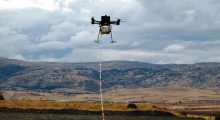
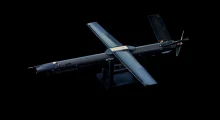
Russian forces continue to expand the capabilities of drones in the “Molniya” family. In a video published on November 23 by Ukrainian radio technology specialist Serhii Beskrestnov (call sign “Flash”), a reconnaissance version of the UAV equipped with a gasoline engine was recorded.
According to Beskrestnov, the aircraft is equipped with a MESH modem in a point-to-point configuration and a high-quality gimbal-mounted camera. The specialist noted that he had not previously encountered such a configuration.
He suggests that the gasoline engine provides the drone with greater range and flight endurance, as well as presumably higher speed. Specific characteristics of the new modification — engine power, fuel capacity, range, and flight endurance — have not yet been disclosed.
From strike drone to reconnaissance UAV
The evolution of the “Molniya” demonstrates how Russian developers are attempting to expand the functionality of a relatively simple platform without creating an entirely new drone.
According to the Main Intelligence Directorate of Ukraine’s Ministry of Defense, the adversary initially used the “Molniya” as a fixed-wing FPV kamikaze drone. The aircraft was launched from a dedicated catapult and guided by an operator onto the target.
The next stage was the “Molniya-2” with two wing-mounted engines. The HUR also noted improvements to the fuselage, increased flight range, and an enhanced warhead.
On December 22, 2025, Ukrainian intelligence reported the discovery of a specialized reconnaissance modification, the “Molniya-2R.” According to a diagram published by the HUR, it received an additional SIYI ZR10 camera with ten-times optical zoom and three-axis stabilization. The aircraft was also found to carry Raspberry Pi 5 and Mini PC F8 microcomputers.
To transmit video from both cameras, telemetry, and control commands, the developers installed a Starlink satellite terminal. Thus the “Molniya-2R” received the equipment needed to fully carry out aerial surveillance and fire adjustment missions.
MESH modems and communications improvements
On February 21, 2026, it became known that MESH modems with two channels rated at 5 W each and an operating frequency range of 1,300–1,500 MHz had been installed on the “Molniya.” Russia had already used similar solutions on the “Gerbera,” “Geran,” and “Kub” drones.
In Serhii Beskrestnov’s assessment, the adversary is systematically standardizing equipment across different UAV types. MESH modems can provide digitally encrypted communications with frequency hopping (FHSS), as well as data relay between devices. This potentially allows communication chains to be organized for controlling drones at significant distances.
Russia scales up the use of cheap reconnaissance drones
In March 2026, Beskrestnov reported a noticeable increase in the number of reconnaissance “Molniyas” at the front.
In a post dated March 4, he noted that the Russians had begun actively using such aircraft, and that up to ten photographs of drones of this type were being sent to him daily. According to his description, the typical configuration included a SIYI ZR10 camera, an AI module manufactured by SIYI, and a MESH modem in the 1,300–1,500 MHz range with two channels rated at 2 W each.
On March 24, Business Insider published a piece about the conversion of Russian strike “Molniyas” into reconnaissance platforms. The outlet spoke with Beskrestnov, who confirmed the use of additional batteries, high-resolution cameras, and MESH modems.
According to the Ukrainian specialist, Russia began deploying such modifications approximately two months before the publication. Business Insider also noted that the reconnaissance versions carry no warhead, and are instead equipped with a microcomputer and a pan-tilt camera with ten-times optical zoom.
Beskrestnov estimated that for the cost of a single Supercam or Zala reconnaissance UAV, Russia can obtain 10–15 “Molniyas.” It is precisely the lower price that, in the expert’s assessment, makes “Molniyas” more attractive for mass use under conditions of active Ukrainian interceptor drone operations.
Serviceman Dmytro Zlukhtenko of the 413th Unmanned Systems Regiment characterizes this trend as a “war of scale” — the use of large numbers of cheaper assets in place of a limited number of expensive platforms.