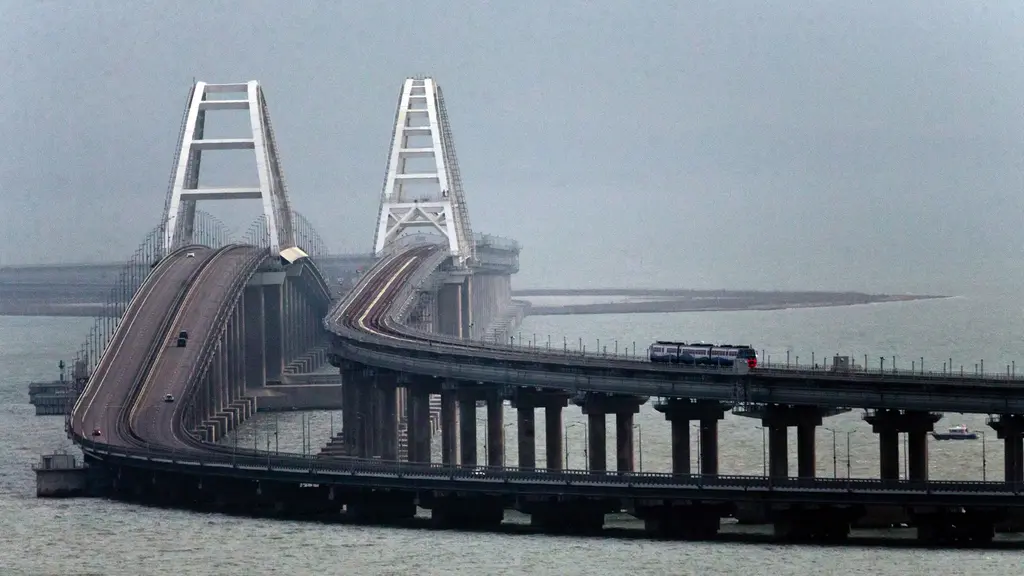
In the early hours of November 17, 2026, the Crimean Bridge across the Kerch Strait came under attack once again. This was the second strike on the crossing in less than 24 hours: the previous one had occurred on the morning of November 16. Following the new attack, traffic on the bridge was halted, and reports emerged online of a possible collapse of the road arch and one of the spans.
The repeated strike was reported by Sergei Aksyonov, the Russia-appointed head of the occupation administration of Crimea. According to him, vehicle traffic on the bridge was suspended.
The monitoring channel Exilenova+ published a video that, based on a preliminary assessment, shows the aftermath of the collapse of the arch on the road section of the crossing.
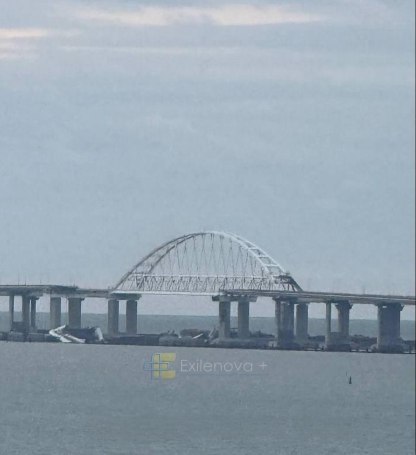
Prior to this, on November 16, an earlier attack had inflicted significant damage on the bridge. According to local sources, the strike occurred at approximately 05:38. Satellite imagery released after the attack recorded damage to the road surface in at least two locations and deformation of the road bridge arch. The structure was visibly displaced from its original position. Vehicle traffic was restored in the evening of November 16 in reversible-flow mode, following approximately 17 hours of restrictions. Rail service, according to data from the Russian side, continued to operate.
Is the arch damage critical for the bridge?
The Crimean Bridge has separate road and rail sections. Its arch structures span the navigable fairway of the Kerch Strait, allowing vessel passage between the Black Sea and the Sea of Azov. The length of the navigable arches is approximately 227 m, with a height of 35 m.
The arch is a load-bearing structural element: it transfers the load from the span to the supports. Its deformation can alter load distribution, reduce load-bearing capacity, and create risks for continued operation. Therefore, even without a complete collapse, the arches may require engineering inspection and repair. In the event of span destruction, restoring the crossing will be significantly more complex.
Urban infrastructure researcher Oleg Hrechukh described the arch over the navigable channel as the bridge’s key and most vulnerable point. In his assessment, damage to the structure could lead to prolonged traffic restrictions.
What means were used to attack the bridge
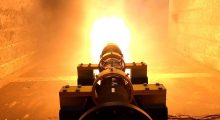
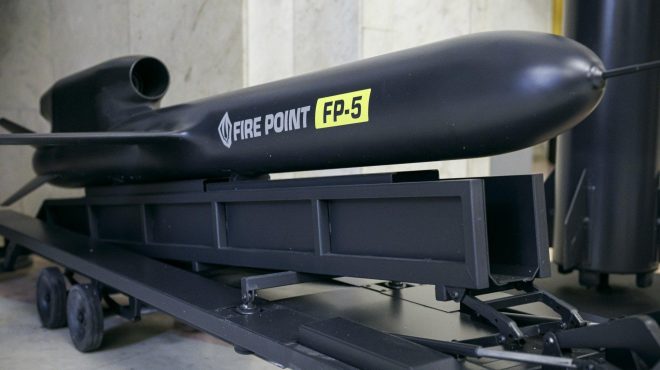
According to preliminary data, Ukrainian fixed-wing strike drones were used during the first attack on November 16. The exact model of the aircraft was not officially named.
Analysts at The War Zone drew attention to footage of the likely moment of impact. It shows a drone with the following external characteristics:
- Straight wing.
- Propeller engine.
- Twin-boom fuselage layout.
- X-shaped or inverted V-shaped tail assembly.
These characteristics are typical of a number of Ukrainian long-range strike UAVs, but do not allow a specific model to be reliably identified. The type of munitions used in the repeat attack on the night of November 17 has also not yet been confirmed.
As of the morning of November 17, the Ukrainian military command had not released official details of either attack.
Deputy Chief of the Main Intelligence Directorate of the Ukrainian Ministry of Defence Vadym Skibitsky explained in September 2026 that the Crimean Bridge is no longer as important to Russian military logistics as it once was. According to him:
- The bulk of military cargo now travels through Russia’s Rostov Oblast and the land corridor through the occupied territories of southern Ukraine.
- Ukraine has been systematically striking other logistics facilities in Crimea: railways, roads, ports, and fuel infrastructure.
- The Crimean Bridge retains political and symbolic significance.
“Perhaps it is one of the ways for the Russian occupiers to go home,” Skibitsky noted.