In the first half of 2026, the Ministry of Defense codified and approved for use in the troops 1,184 new models of weapons and military equipment. This is an absolute record in the entire history of the department and 55% more than in the same period last year. Nine out of ten codified models are of Ukrainian production. More details about codification can be found in our article.
What is codification and why is it needed?
Codification of military equipment is the process by which an item acquires the official status of an “item of supply.” It is classified, its characteristics are described, it is entered into the Item of Supply Catalog, and it is assigned a 13-digit NATO Stock Number (NSN).
The first four digits of the NSN determine the supply class according to the NATO Supply Classification (NSC), the next two are the code of the national codification bureau (for Ukraine – 61), and the last seven are the unique number of the supply item.
The system operates according to the STANAG 4177 standard “Codification – a unified data collection system”, which is implemented by all member states of the NATO codification system. The assigned numbers are included in the international catalog NMCRL (NATO Master Catalogue of References for Logistics). Thanks to this mechanism, armies of different countries can equally identify the same supply item, exchange equipment, avoid duplication of purchases and plan logistics.
In Ukraine, codification is carried out by the Ministry of Defense, working according to the rules of the international NATO codification system. Ukraine is a member of this system with Tier 2 status: the highest level of full participation (as, for example, in Poland or Romania). Therefore, the NSN assigned by the Ukrainian codification bureau is formed within the NATO Codification System and is used to uniquely identify the item of supply in the NCS system.
Codification allows the product to be officially included in the Defense Forces’ support system. For the manufacturer, this is an important stage in the transition from an experimental solution to a full-fledged element of the military nomenclature.
Uncoded products can be purchased and ordered from manufacturers and even on platforms like Brave1. These products can also be sent to parts as charitable/humanitarian aid, for testing, approbation, experimental operation, etc. However, they do not appear on the balance sheet of the part and often do not have the same warranty as products with codification.
If the product needs to be issued for regular supply through the MOU system, codification will be critically important.
Record pace in 2026
The codification procedure in Ukraine has been significantly accelerated: a few years ago it could take months, but now, provided that a correctly prepared package of documents is prepared, a new model can receive a NATO nomenclature number within up to 10 days.However, according to some manufacturers, the process may still be delayed.
The procedure is free for the manufacturer, and you can submit an application through the web portal “Window for Manufacturers of Military Equipment” at mil-tech.mod.gov.ua, which contains step-by-step instructions, standard document forms, and separate explanations for unmanned systems, electronic warfare equipment, and ammunition.
The procedure for admission to operation and codification depends on the type of product. For unmanned systems and tactical-level electronic warfare equipment, the procedures specified in the Cabinet of Ministers Resolution No. 1275 of 11.11.2022, as amended, apply. For ammunition, the Cabinet of Ministers Resolution No. 902 of 16.07.2025. For other types of EW, the Cabinet of Ministers Resolution No. 345 of 25.02.2015
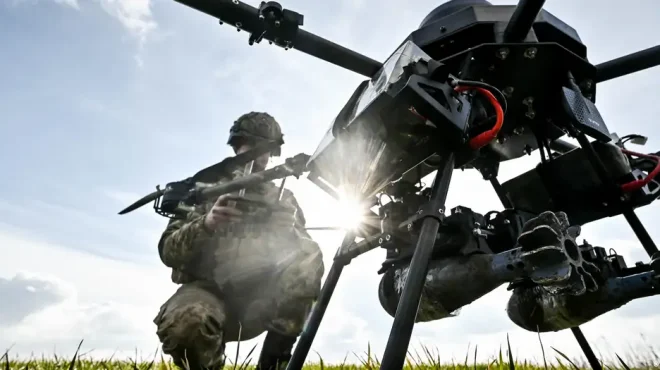
Since the beginning of 2026, the Ministry of Defense has codified 413 unmanned aerial systems: mainly copter-type strike drones and fiber-optic UAVs. The number of front-strike class strike drones has also increased significantly.
Who has already received an NSN
The list of codified samples from 2026 shows how diverse Ukrainian defense high-tech has become.
Heavy bomber drones
Frontline Robotics reports on the codification of the Linza and Zoom drones under the NATO system, and later the Buria robotic turret. Another Ukrainian manufacturer, SkyFall, has created the Vampire heavy bomber drone. According to the state program “Army of Drones.Bonus”, by the end of 2025, the Vampire became the most effective vehicle on the battlefield and took first place among the bomber drones in terms of the number of hits.
Large multi-purpose FPV
In July 2026, the Ministry of Defense codified the 17-inch Queen Hornet FPV drone from the Wild Hornets company — and in two formats at once: as a separate product and as part of an unmanned aircraft complex. The drone actually launched a class of heavy multi-purpose FPVs in Ukraine. After codification, the drone appeared on the Brave1 Market platform, where units can order it for “e-points” — combat points that are awarded for the verified destruction of enemy equipment and personnel.
Drones with homing and rib protection
The Vyriy company has codified the VYRIY PRO 10 FPV drone according to NATO standards — a rugged device with additional guidance, capable of carrying up to 4 kg of payload and hitting targets at a distance of over 25 km.
Shocking FPV from small manufacturers
BPK Systems has received an NSN for the BPK-10 HAMMER-D FPV drone.
Drone control systems
In June 2026, the Hornet Vision Ctrl, the first Ukrainian complex that allows remote control of drones from anywhere in the world, was codified. According to the developer, pilots have already hit targets at a distance of more than 500 km from their own location and demonstrated control of the Sting interceptor drone from a distance of about 2,000 km.
Ground robotics and other technology
The July list of codified assets includes the unmanned aviation complex “TALION”, the complex “Cyclops”, the ground robotic complex “Lys+”, the UAT.DESNA system, the FireFly guidance module, the all-wheel drive electric bike MUL.E and the armored repair and evacuation vehicle INGUAR-4. Among the front-strike class strike drones that have replenished the codified arsenal since the beginning of the year are “Galka”, Skyriper Minotaur, “Beshket”, Shturm, “Chumak”, “Sokil”, Hydra, “Kruk”, “Dzyga”, “Kharyok”, “Buran”, “White Wolf” and “January”.
Separately, the Ministry of Defense codifies “smaller” but critical items for operation. For example, an initiation board (detonation initiation device) for FPV drones can also receive its own NSN if the manufacturer additionally provides a passport and operating instructions for it. Similarly, a ground control station or a platform for a ground robotic complex can receive a separate nomenclature number if they are supplied and replaced separately from the main product.
What codification gives the manufacturer
Sample codificationopensthe manufacturer a number of practical opportunities:
- Only a codified sample can be officially recorded, put on the balance sheet, and written off in military units.
- Codified UAVs, ground robotic complexes, and tactical electronic warfare/electronic warfare (EW/EER) equipment can be placed in the open catalog of the BRAVE1 platform, where combat units directly purchase equipment with unit funds or for “e-points.”
- Since the NSN is formed according to the single international NATO codification system, the Ukrainian nomenclature becomes “readable” for the logistics systems of the Alliance member countries. This is a prerequisite for export supplies, joint procurement, and integration into the supply systems of partners.
- The Ministry of Defense directly calls the acceleration of the codification procedure one of the factors in the record saturation of the troops with new equipment models in the first half of 2026.
Codification has become part of Ukraine’s technological partnership strategy with the Alliance: the faster and more transparently Ukrainian companies receive NSNs, the faster their products can qualify not only for contracts with the Ukrainian Defense Forces, but also for a place in the allies’ logistics chains.