An FPV drone costs about the same as a gaming quadcopter — and that’s exactly what it used to be. But now, for a few hundred dollars, these devices are forming “kill zones” along the front lines and destroying weapons worth millions. Russia’s war against Ukraine has become the largest testing ground in world history, where civilian devices and technologies have been transformed into tools of war. The line between “peaceful” and “military” is blurring. How this happens and what the consequences are — we looked at DefPulse.
Hobby store drones: how the “kamikazes” appeared
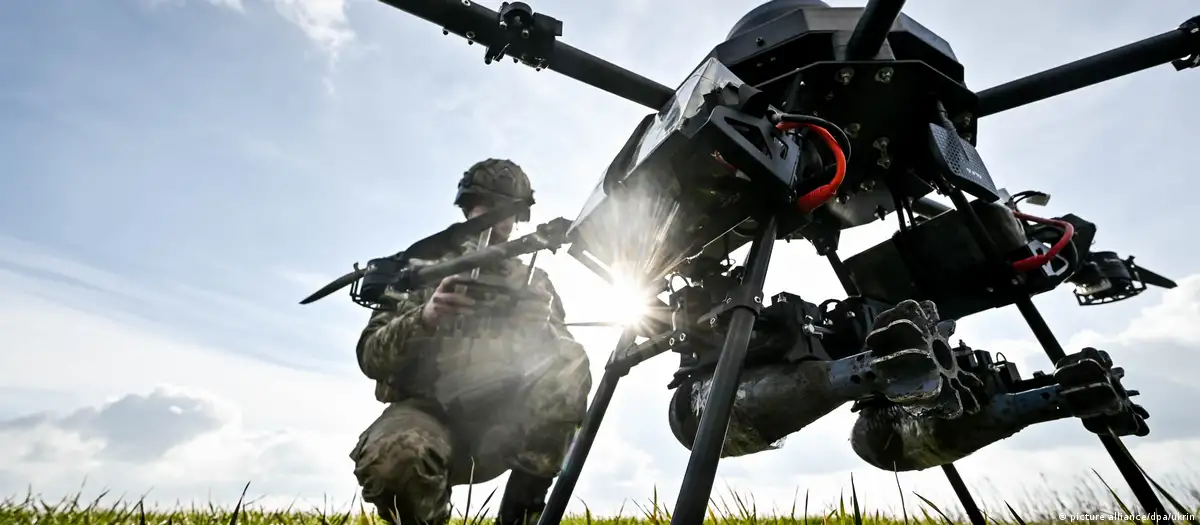
Until 2022, FPV (first person view) quadcopters were a niche hobby of racing athletes and videographers. The war turned them into the main means of defeating armored vehicles on the front. A frame, battery, camera and motors for a few hundred dollars, plus a homemade mount for a warhead – and the weapon is ready. According to the NSDC, as of 2026, the Ukrainian defense industry is capable of producing more than 8 million such drones per year, and more than 160 companies are engaged in their production – from large factories to small innovative workshops.
How far this technology has come is demonstrated by the operation of the Security Service of Ukraine “Website” in June 2025. 117 FPV drones of the “Osa” model were hidden in trucks under the guise of cargo with mobile wooden houses, transported deep into Russian territory and simultaneously, in three time zones, launched at five strategic air bases – “Olenya”, “Bila”, “Dyagilevo”, “Ivanovo” and “Ukrainka”.
According to the SBU, about 41 aircraft were hit. Among them were the strategic bombers Tu-95 and Tu-22M3 and the long-range radar detection aircraft A-50 – about a third of the carriers of air-launched cruise missiles available in Russia. The preparation lasted for more than a year and a half.
Experts on unmanned technology interviewed by Ukrainska Pravda draw attention to the next stage of evolution: the transition from drones manually controlled by an operator to devices with machine vision and automatic target acquisition, which are much more difficult to “hit” with electronic warfare means.
At the same time, a mesh network is developing – a technology where strike drones relay signals to each other, allowing the operator to control the devices in real time.
“Drones actually act as signal repeaters, transmitting it to each other,” explained the principle of mesh networks, a spokesman for the Air Force Command of the Armed Forces of Ukraine.
Printed weapons: from garage hobby to field workshop
The second example of civil-military convergence is desktop 3D printing. The technology was used mainly for prototyping in mechanical engineering and medicine. Currently, a distributed network of “field factories” is operating in Ukraine. Volunteer community «PrintArmy» reports that since the beginning of the full-scale invasion, it has transferred to the front more than 18.5 million products with a total weight of over 432 tons, fulfilling more than 185 thousand orders.
The range of products ranges from mounts for thermal imagers and mine casings to Starlink adapters and even nozzles for Javelin anti-tank systems. In the US, the military has gone even further: on aircraft carriers The USS Gerald R. Ford installed a 3D printing module to repair aircraft parts right at sea, and the X-Bow company tested a rocket with an engine printed on a 3D printer.
Commercial satellites for reconnaissance
The commercial satellite imagery market, which traditionally served land management and environmental monitoring, has become a source of operational intelligence. Ukrainian units receive imagery from Vantor (USA) at intervals of approximately 15 minutes, which, according to U24 Media, reduces the time from target detection to strike by 90%.
This is the first known documented case of unclassified commercial satellite data going directly to military personnel for combat decision-making — bypassing the traditional, slower military intelligence chain.
The weak point of the technology is the lack of independent verification: an array of “raw” commercial images without military analytical control increases the risk of false targets.
Cryptocurrency is an additional, but controversial, tool for financing the army
Cryptocurrencies have transformed from an economic experiment into a tool for financing war.
On the one hand, this is beneficial. According to estimates by the analytical company Chainalysis and data from RUSI, Ukraine had already collected about $100 million in crypto donations by the end of 2022, a significant part of which went to the purchase of weapons and medical supplies.
On the other hand, Russia is developing its own tokens — including the ruble-pegged stablecoin A7A5 — to pay for weapons components through transaction chains that are difficult to track. In May 2026, the United Kingdom imposed sanctions on 18 cryptocurrency platforms, exchanges, and financial networks, including the A7 network. According to the British government, the Kremlin uses it to circumvent restrictions and finance military purchases. That same summer, Ukraine, by its own decree, extended sanctions to operators of digital financial asset trading platforms and clearing organizations associated with Russia.
Starlink and the politics of private infrastructure
Perhaps the most striking example of the military’s reliance on private civilian infrastructure is SpaceX’s Starlink satellite internet. The terminals, provided to Ukraine at the start of the full-scale invasion, have become the basis for field communications, fire control, and drone control.
In February 2026, the Ukrainian Defense Ministry reached an agreement with SpaceX to allow terminals to operate in the country only with separate authorization. This decision was made after cases of Starlink use on Russian Shahed kamikaze drones were recorded. The temporary shutdown of unauthorized terminals that same month coincided with the first advance of Ukrainian troops since 2023 and the return of control over about 400 square kilometers of territory.
In the summer of 2026, Ukraine further tightened the rules for verifying terminals: users must provide technical identifiers KIT-number and UTID, and companies are limited to 10 terminals without special status.
Headquarters in a smartphone: messengers and applications
Mobile messengers are another civilian tool that has become a command channel. For the Russian army, Telegram has effectively become the “main messenger of war” due to its simplicity and mass appeal. Ukrainian units, on the other hand, have largely switched to Signal for its higher level of encryption.
At the same time, the market for military applications is growing: we have already written about which ones mobile applicationsmost often used by Ukrainian military personnel.
The logic of technological development has turned 180 degrees. Previously, innovations went “from the defense industry to the civilian sector” (the same Internet, GPS, composite materials), now it is the opposite, “from commerce to the army”. Drones, smartphones, artificial intelligence and satellite systems are created primarily for the mass consumer market, and only then are they adapted for combat missions.
The following sources were used in preparing the article:
- Operation Spiderweb – Wikipedia https://uk.wikipedia.org/wiki/Операція_«Павутина»
- Results of the Ukrainian defense industry in 2025: FPV drones — National Security and Defense Council of Ukraine https://www.rnbo.gov.ua/ua/Diialnist/7370.html
- FPV drones in war 2026: what limitations will the parties face? — VGI (01/29/2026) https://vgi.com.ua/fpv-drony-u-vijni-2026-z-yakymy-obmezhennyamy-zitknutsya-storony/
- DrukArmy: Strengthening Ukraine’s defense capabilities with the help of 3D printing — official website https://drukarmy.org.ua/ua/about-us
- Britain has imposed sanctions against crypto networks used by the Russian Federation — Glavkom (05/26/2026) https://glavcom.ua/world/world-economy/britanija-zaprovadila-sanktsiji-proti-kriptovaljutnikh-merezh-jaki-vikoristovuje-rf-1121952.html
- Ukraine has introduced new sanctions against the Russian Federation (Decree No. 561/2026) — DSnews.ua (07/15/2026) https://www.dsnews.ua/ukr/politics/ukrajina-zaprovadila-chergovi-sankciji-proti-rf-15072026-463495
- Ukraine regained control over 400 sq. km of territory — how did the Starlink shutdown affect it — DOU (05/22/2026) https://dou.ua/lenta/news/ukraine-regained-territories-after-starlink-was-shut-down/
- Internet via Starlink in Ukraine – new registration rules 2026 — OBOZ.UA (07/14/2026) https://www.obozrevatel.com/ukr/ekonomika-glavnaya/economy/ukraintsiv-zobovyazali-reestruvati-starlink-po-novomu-yaki-pravila-zminilisya.htm