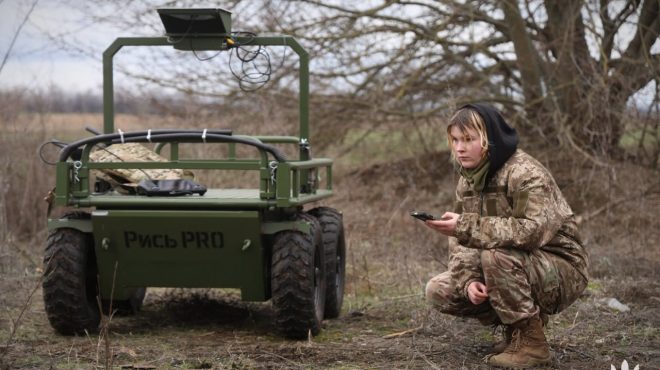
Heavy bomber drones delivered kamikaze ground robots deep behind enemy lines at the start of the second “season” of Operation Vivaldi. According to the corps, the operation ended with the liberation of two villages and the establishment of control over a third.
The Third Army Corps reported that during Operation Vivaldi it air-dropped ground robots behind Russian army lines for the first time. Heavy bomber drones were used to deliver the kamikaze UGVs, dropping the robots more than 10 km deep into enemy territory. According to the military, the second “season” of the operation began precisely with this airdrop, and the robots were delivered by heavy bombers of the Third Assault Brigade.
Simultaneously with the airdrop, the corps sealed off the combat area using air defense and electronic warfare assets. These “blinded” Russian reconnaissance UAVs, preventing the occupiers from detecting the intent of the offensive.
Populated areas were taken via an envelopment maneuver from north to south through ravines and gullies. The battlefield was simultaneously isolated: river crossings over the Chornyi Zherebets were destroyed, and command posts and ammunition depots were struck.
As a result, the corps liberated Shandryholove and Derylove in Lyman hromada and took full control of Drobysheve. DeepState confirmed the liberation of the first two villages. Across both “seasons,” 125 km² were returned to Ukrainian control, of which 50 km² had been occupied. According to the corps, Russian losses exceed 3,000 troops, with approximately 800 attributed to the second phase.
“Wars are won by infantry, but we protect our infantry — so robots go to the enemy first,” the corps explained. Corps commander Andriy Biletsky stated that the corps was the first in the world to begin air-dropping UGVs, and that during assaults, UAVs and ground robots always operate ahead of the infantry.
The idea is not new, but it was only put into practice in combat conditions during the summer. In July, a heavy hexacopter delivered an ARK-1 UGV carrying anti-tank mines behind Russian lines. Forbes described this approach as “marsupial.”