In modern combat conditions, a unit’s effectiveness directly depends on the speed of information exchange. Field data networks make it possible to transmit coordinates, commands, video, and service messages between units in near real time.
The communications of the Armed Forces of Ukraine are built as a flexible system that must work even in unstable conditions, with interference, or with a partial loss of infrastructure. That is why various communication channels and backup solutions are used.
Communication Channels in Field Networks
Communication channels are the basis of any field network. It is through them that all data is transmitted — from voice commands to video streams and coordinates.
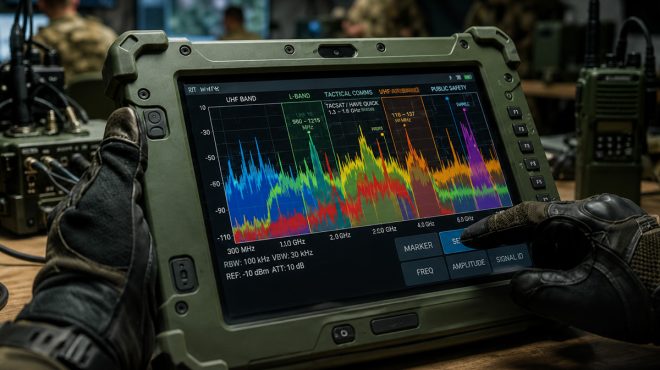
In the field, different types of channels are used: radio communication, mobile networks, satellite communication, and wireless digital channels. Low frequencies work better over long distances and through obstacles but have limited transmission speed.
Higher frequencies make it possible to transmit more data, in particular video, but are more sensitive to interference and terrain. As a result, field networks are built as a combination of channels, where each is used for a specific task.
Communication Assets and the Procedure for Working With Them in the Field
Communication assets include radios, mobile terminals, repeaters, and specialized devices for data transmission. It is important not only to have the equipment but also to correctly organize work with it.
In the field there is a clear procedure: limiting transmission time, using variable frequencies, observing radio-silence modes. This makes it possible to reduce the likelihood of detection and preserve the network’s operability. Work is conducted in short sessions, and data is transmitted as concisely as possible. This approach reduces the load on the channel and increases its resilience.
Repeaters and Communication Nodes in Field Infrastructure
Repeaters are used to expand the coverage area and stabilize communication. They receive the signal and transmit it further, making it possible to work over a greater distance or in complex terrain.
In field networks, repeaters can be installed at heights, on vehicles, or on drones. This makes it possible to create a flexible communication infrastructure without a rigid attachment to a location.
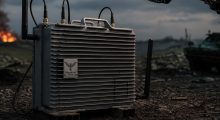
In this context, the «Vishchun» 5.8 wireless repeater plays an important role. It is a separate device that is used as an element of the field network for transmitting data over medium distances. It operates in the 5.8 GHz band and provides a stable digital communication channel between units, drones, or command posts.
In practice, such repeaters make it possible to bypass obstacles, reduce signal loss, and maintain communication even in difficult conditions. They are not a standalone control system but act as part of the overall network.
Protecting Field Networks From Interception and Jamming
Field networks are constantly at risk of signal interception or jamming. This is one of the main threats in modern combat. For protection, frequency hopping, data encryption, transmission-time limits, and directional antennas are used. Channel redundancy also plays an important role — if one is lost, communication switches to another.
More about the principles of organizing such systems can be found in the article: «Organization of military communications in the Armed Forces of Ukraine: structure, levels, and management», which explains how a resilient communication system is built at different levels. Protecting the network is a constant process of monitoring and adaptation.
Integrating Field Networks Into the Communication System of the Armed Forces of Ukraine
Field networks do not exist separately — they are part of the overall communication system of the Armed Forces of Ukraine. Data obtained at the unit level is passed up and used for decision-making.
Integration makes it possible to combine different sources of information: drones, ground units, command posts. As a result, a single information picture is formed. This ensures coordination of actions and makes it possible to react faster to changes in the situation even over a great distance.
Limitations of Field Data Networks at the Front
Despite the development of technology, field networks have limitations that affect their operation. Among the main factors are terrain, weather conditions, channel load, and the impact of electronic warfare. In some cases the transmission delay can be tens of seconds, which affects the relevance of information.
It is also important to take into account that increasing the number of devices in the network can complicate its stable operation. In real conditions, the effectiveness of communication depends not only on the equipment but also on the correct organization of the network and the unit’s actions.
Conclusions
Field data networks ensure the exchange of information between units and are the foundation of modern communications in the Armed Forces of Ukraine. They are built on a combination of different channels, communication assets, and repeaters. Network resilience is achieved through redundancy, the correct use of channels, and protection against interference.