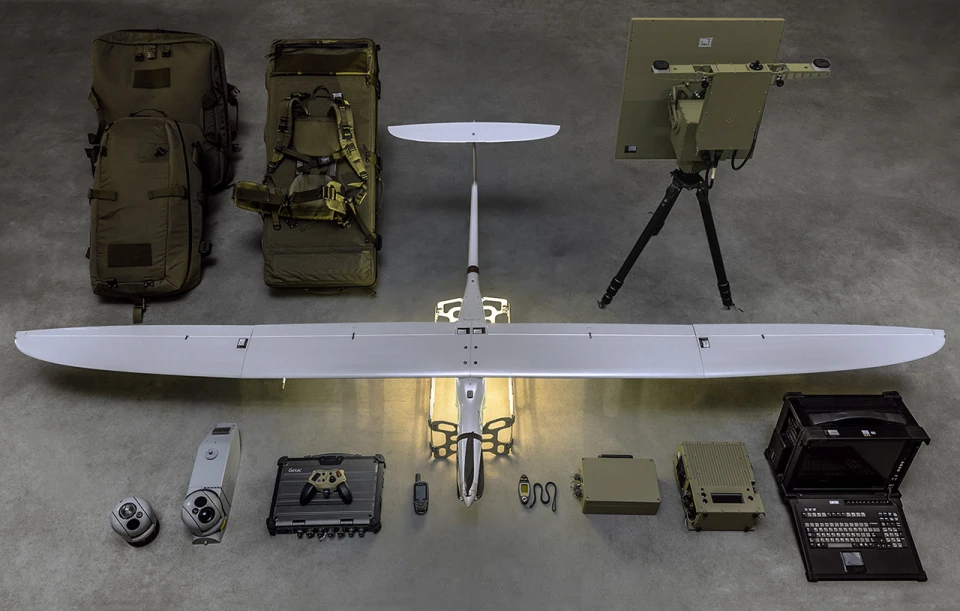
The “Omega” Special Operations Center of the National Guard of Ukraine has showcased the FLY EYE reconnaissance UAV in action. Fighters of the “XIII Legion of Omega” practiced hand launches, real-time reconnaissance, and parachute payload drops of recorded footage.
According to data from the special unit, the entire system fits in a few backpacks, deploys in 10 minutes, and requires no catapult. The aircraft’s primary mission is to gather intelligence on the enemy at ranges of up to 50 km.
This is a Polish development by WB Electronics, first introduced in 2010. It entered the Armed Forces of Ukraine even before the full-scale invasion, and was referred to as the first unmanned system to receive official adoption into service during the independence era. Such systems are now also used in the National Guard.
The airframe is made of composite materials and follows a high-wing monoplane configuration with a straight wing.
- Wingspan is 3.6 m.
- Length — 1.9 m.
- Take-off weight — 11 kg, of which 4 kg is payload.
- The propulsion is electric, with a folding propeller mounted in the nose.
- Speed — from 50 to 170 km/h.
- Ceiling — up to 4 km.
- Flight endurance — up to three hours.
The optics consist of a daylight camera and a thermal imager, allowing the aircraft to operate during the day, in smoky conditions, and at night. The thermal imager is particularly useful for adjusting artillery fire, as shell impact points are clearly visible. The camera can be controlled manually from a ground station (at distances up to 30 km) or the aircraft can fly a pre-programmed route with the option for operator intervention.
An operational advantage is the absence of launch equipment. The aircraft is hand-launched by the operator, requiring neither a catapult, nor a rail, nor a prepared strip. For reconnaissance teams operating in a mobile fashion and frequently changing positions, this is critical. Soldiers note that such a launch method reduces the time a crew spends at a single position, which is important under the threat of counter-battery fire and enemy drones.
Landing is also unconventional. Just before touchdown, the aircraft can drop its payload by parachute, after which the airframe proceeds to a designated point on its own. This is precisely the element practiced by the “Omega” fighters: the recorded footage reaches the crew regardless of how the aircraft’s own landing turns out.
The FLY EYE is not the newest or most impressive drone, but it is proven and compact, and after several years of use in Ukraine it has been well mastered. For reconnaissance at depths of up to 50 km, it is a reliable tool that is easy to carry and quick to deploy.