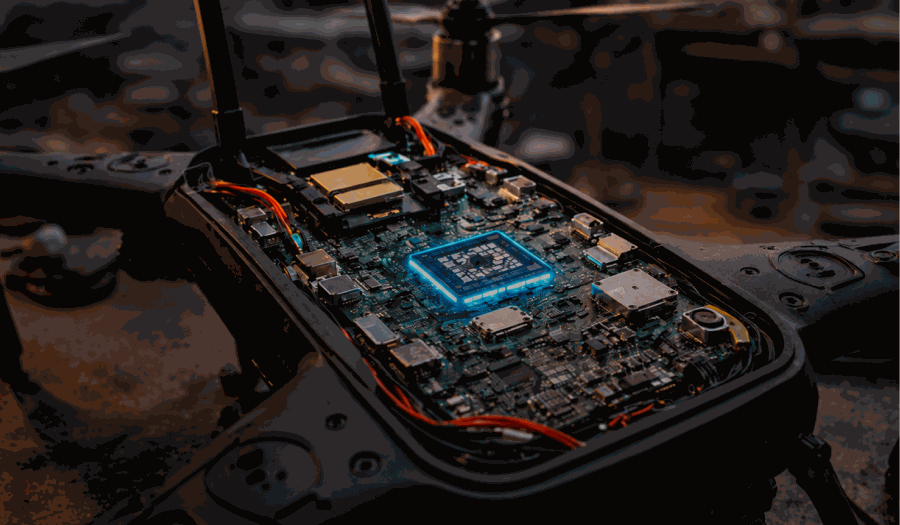
Any drone looks like a set of components: motors, a camera, a transmitter. But in fact its ‘brain’ is the onboard computer. It is what determines how the drone moves, reacts to commands, and maintains stability. Without it, even the most powerful motors cannot work in a coordinated way.
Onboard Computers in the Drone Control System
The onboard computer is the central control element. It receives data, processes it, and generates commands for all the drone’s systems. In practice this means that every action — from a tilt to a change in altitude — passes through it. It constantly analyzes the drone’s state and corrects its movement.
Data processing happens hundreds of times per second. The delay in decision-making is a fraction of a second, and even a small deviation can affect stability. Without the onboard computer the drone effectively cannot be controlled — it becomes an uncontrollable set of components.
The Drone’s Flight Controller and Its Main Functions
The flight controller performs several key functions at once. It controls movement, stabilization, and interaction with the operator. One of the main tasks is keeping the drone in a stable position. Even during wind gusts the system must quickly compensate for changes.
The controller is also responsible for distributing thrust between the motors. It determines which motor should work and with what force. All of this happens automatically. The operator sets the direction, and the onboard computer already performs the precise calculations.
Sensors and Signals in the Flight Control System
To work, the onboard computer needs data. This is provided by sensors: gyroscopes, accelerometers, barometers, and other sensors. They transmit information about position, speed, and altitude. Based on this data, the system understands what is happening with the drone at a specific moment.
In practice this looks like a continuous flow of signals that is updated hundreds of times per second. Any change is recorded instantly. It is precisely this data that allows the controller to make decisions and maintain flight stability.
Processing of Operator Commands by the Onboard Computer
Operator commands are not executed directly. They are first processed by the onboard computer. For example, the command ‘forward’ means a complex change in the balance of thrust between the motors. The system calculates this automatically.
The delay between a command and the reaction is usually tens of milliseconds. This ensures smooth and predictable control. If this delay grows, the drone becomes less controllable. In difficult conditions this can lead to a loss of control.
Interaction of the Onboard Computer With Navigation and Telemetry
The onboard computer does not work in isolation. It interacts with navigation systems and telemetry. Navigation determines the drone’s position, and telemetry transmits data to the operator. The controller combines these flows of information.
In practice this means that the operator sees not just video but the full state of the drone: coordinates, speed, altitude.
To better understand the basic principles of how drones work and their use, see the article: «What is a drone and how are they used on the battlefield», where this topic is covered more broadly.
Limitations of Onboard Computers in Drone Control Systems
Despite their high effectiveness, onboard computers have limitations. One of them is computational resources. With a large number of tasks the system can work more slowly. This affects reaction speed and stability.
The quality of the sensors also plays an important role. Inaccurate data can lead to errors in calculations. In addition, in difficult conditions the operator receives a lot of information at once. This complicates control and requires experience.
The Practical Importance of the Onboard Computer in FPV Drones
The role of the onboard computer is especially noticeable in FPV drones, where reaction speed and control precision are important. In this context, the Zhakh 10” FPV Drone is used. It is a full-fledged UAV that is a standalone platform and already contains an integrated onboard computer.
Its control system combines sensors, algorithms, and a controller into a single logic. It is precisely this that ensures stability and predictable behavior. Without a good onboard computer, even a powerful drone becomes unstable. With it, the operator gets precise control in real time.
Conclusions
Onboard computers are the foundation of drone control. They ensure stability, command processing, and the interaction of all systems. The combination of sensors, algorithms, and fast data processing allows the drone to work accurately and predictably.