Modern warfare has shown that the effective management of troops is impossible without stable, controllable, and protected communication. Even with the availability of trained personnel and modern equipment, the absence of a well-established communication system leads to the loss of coordination, the failure of combat tasks, and the growth of risks for units.
What Military Communication in the AFU Is and Its Role
Military communication in the AFU is the totality of technical assets, organizational measures, and procedures that ensure the transmission of commands, information, and data between management bodies, units, and individual servicemen.
Its key role lies in ensuring the continuous management of the troops, the coordination of actions, the transmission of orders, and the receipt of feedback. Without stable military communication, the full-fledged planning of operations, the correction of the actions of units, and the timely response to changes in the combat situation are impossible.
Main Principles of Building the Military Communication System
The military communication system is built on basic principles that ensure its viability in combat conditions. These include hierarchy, the redundancy of channels, protection from interception, resistance to engagement, and the ability to adapt to changes in the situation.
The organization of military communication involves the use of different types of channels and assets, so that in the event of the loss of individual elements the system continues to function. It is precisely the principle of redundancy that makes it possible to preserve controllability even during intensive combat operations or the active influence of the enemy.
Levels of Military Communication and Their Functions
Military communication in the AFU is organized by levels, each of which performs clearly defined functions. The strategic level ensures communication between higher military management bodies, the operational level — coordination between groupings of troops and the command, the tactical level — the management of units directly on the battlefield.
Each level has its own requirements for the speed, reliability, and security of information transmission. The interaction between levels makes it possible to transmit decisions from the top down and receive operational information from the bottom up without the loss of controllability.
The Management of Military Communication in the Structure of the AFU
The management of military communication is carried out through specialized bodies and officials responsible for the planning, deployment, support, and control of the communication system. In effect, this is about who, when, and in what way is responsible for the stability of communication in a unit.
This process includes the determination of communication schemes, the distribution of frequencies, control over the use of technical assets, and response to disruptions or the loss of channels. The management of military communication is not only a technical but also an organizational task that requires the constant analysis of threats and adaptation to the conditions of combat operations.
The Organization of Military Communication in Conditions of Martial Law
In conditions of martial law, the organization of military communication is complicated by the active application of electronic warfare assets, the actions of the enemy’s reconnaissance, and the high dynamics of combat operations. The communication system must function even with the partial loss of infrastructure or individual technical assets.
The loss of communication in combat conditions means not only the disruption of management but also real risks to the lives of personnel and the execution of combat tasks. Therefore, the protection of channels, control over radiation, and the timely detection of threats acquire special significance.
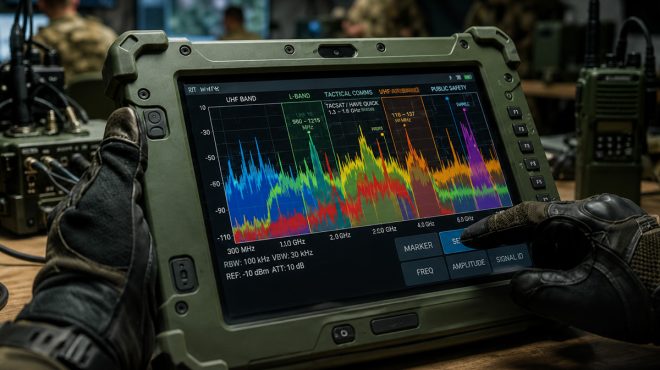
As an auxiliary element of situational awareness, portable assets for detecting activity in the radio spectrum can be applied. For example, the «Chuika 3.0» from BlueBird is used to record the radio-electronic signs of the operation of unmanned assets and is not a communication asset, but it can help assess the risks for the operation of control channels. Such solutions are applied exclusively as a supplement to the main communication system, and not as its replacement.
Why the Systematic Organization of Communication Determines the Effectiveness of Troop Management
The effectiveness of troop management directly depends on how systematically military communication is organized. Even the best decisions of the command lose their value if they do not reach the executors or arrive with delay.
The systematic organization of military communication ensures the coherence of actions, reduces chaos, and makes it possible for units to act as a single mechanism. It is precisely thanks to this that the command can maintain control and adapt to changes in the combat situation.
To understand how these principles are implemented directly in combat conditions, it is worth getting acquainted with the article: «Military communication on the front line: how coordination between units works», which complements the topic with practical context.
Conclusions
The organization of military communication in the AFU is a multi-level system on which the controllability, coordination, and effectiveness of combat operations depend. Military communication combines structure, technical assets, and management processes into a single system capable of working in conditions of modern warfare.
A systematic approach to the organization and management of military communication makes it possible to reduce risks, preserve controllability, and ensure the execution of tasks even in the most difficult conditions. Behind every communication channel stand decisions, time, and the lives of servicemen, so the role of this system is critical for the entire defense.