Loitering drones are turning roads, intersections, and military logistics routes into a new type of minefield. An unmanned aerial vehicle can remain motionless with its engines off for several days, then attack a vehicle or a group of soldiers within seconds. Russia is developing fiber-optic FPVs, acoustic triggers, and hibernation systems, while Ukraine is developing its own platforms with autonomy of up to 14 days, mother drones, and robotic countermeasures. DefPulse examined the specifics of the technology.
How a loitering drone works
In a classic scenario, an FPV drone expends its battery charge flying to a target. If the operator cannot locate the target within the flight time, the craft loses power and falls. A loitering drone, by contrast, flies to a pre-selected location, lands, shuts off its engines, and enters standby mode.
Ambush positions can include roadsides, bushes, rooftops, courtyards, bridge structures, or power line cables. When a target appears, the operator activates the craft, which takes off and attacks.
By deployment method, there are two main types of aircraft:
- Ground-based loitering drones. They fly independently to the ambush area, land, and wait for a target. This is the most common FPV usage scenario.
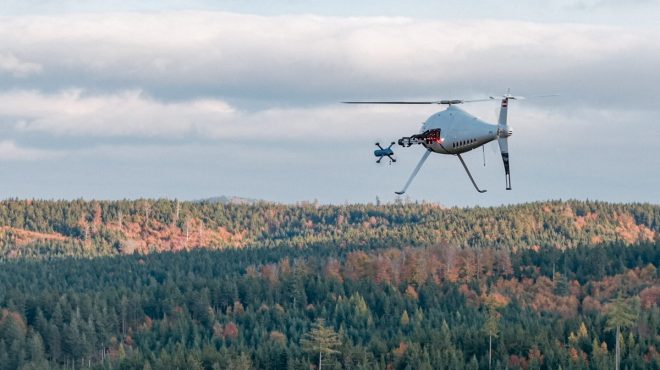
- Airborne mother drones. Larger unmanned aircraft deliver strike FPVs closer to the target, after which the FPVs continue their flight independently. This approach makes it possible to increase the depth of engagement.
A drone can remain in position with its radio transmitter switched off but its command receiver active, or it can use a fiber-optic cable. The combination of prolonged waiting and low radio visibility has made such drones a difficult target for traditional counter-UAV systems.
Technological features of loitering drones
The difference between a loitering drone and a conventional FPV drone lies in the power management system. While waiting, the craft must consume as little energy as possible while still retaining the ability to quickly switch to combat mode.
To achieve this, special deep-sleep boards or delayed-start modules are used. They shut down power-hungry components — the video transmitter, flight controller, and other systems — while keeping the command receiver or a separate low-power controller active. Upon receiving a signal, the system restores power to the main electronics and the drone can take off.
The second element is the communication channel. Some loitering drones use conventional radio control, but this scheme has limitations: the radio channel can be detected and the link can be suppressed by electronic warfare means. Fiber optics serve as an alternative.
A separate area of development is automated activation. According to Ukrainian specialist Serhii Beskrestnov, Russian modifications have begun to incorporate microphones that respond to the sound of a vehicle. This allows the craft to be activated without constant manual control. Another way to extend the standby period is small solar panels — more on this below.
Russian loitering drones: from “Knyaz Vandal” to acoustic traps
Enemy forces are actively developing this area, using both specialized FPV platforms and serial drones adapted for ambushes. The units of the Rubikon unmanned systems center play a significant role in spreading the tactic.
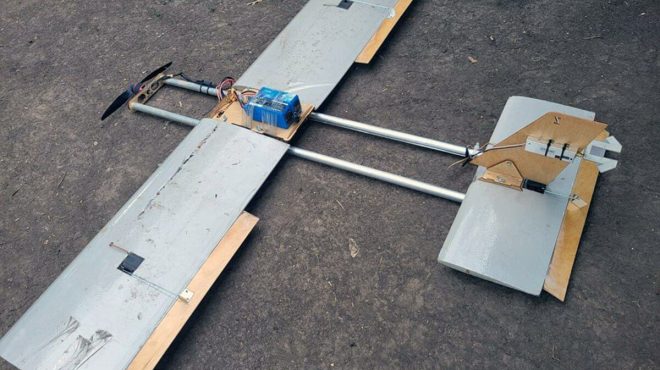
One of the adversary’s main platforms has become the fiber-optic FPV “Knyaz Vandal Novgorodsky” (KVN), developed by the Russian research and production center “Ushkuynik.”
According to the Ukrainian portal HUR War & Sanctions, the maximum take-off weight of the craft is 8 kg, the warhead weighs 2.2 kg, and the stated active flight duration is 8–12 minutes. Cruising speed is 50–80 km/h, maximum speed is 100–140 km/h. The base range of application is up to 20 km, and control is exercised via a fiber-optic cable.
In 2025–2026, Russian developers worked on increasing the range. Specialized publications reported tests at 42 km, and later reported upgraded versions with a stated range of 50–65 km.
The KVN is used for ambush tactics because fiber-optic control does not require a radio channel. However, it also has drawbacks: the cable reel adds weight, limits the payload, and the fiber itself can break or snag on obstacles. According to adversary developers, cable break issues were recorded in 10–20% of launches.
Another area of development is the “Dzhokker-10” from the Russian enterprise TsKBR. Its distinctive feature is the ability to enter hibernation mode — a deep sleep during which most of the onboard electronics are de-energized.
As Serhii Beskrestnov explained while analyzing captured modules, Russian engineers use special relays to disconnect the video transmitter. According to data he published, depending on the configuration, the drone can wait approximately 12–17 hours. After that, the battery retains enough energy for a short combat sortie.
In the second half of 2026, Russian units began adding new elements of autonomy to such systems.
In August, “Flash” reported the emergence of FPV loitering drones equipped with microphones. The drones are placed outside the driver’s direct line of sight — for example in courtyards along a road. An acoustic sensor responds to an approaching vehicle, after which the drone activates.
Another area is solar power. According to a November analysis by the Bavovna project, small tourist-grade solar panels rated at approximately 5 W were spotted on Russian drones. They can sustain the electronics during the waiting period, partially compensating for battery discharge.
The use of winged drones as carriers poses a separate threat. Russian “Molniya-2R” aircraft and modified “Orlans” can deliver FPVs closer to Ukrainian positions. This allows strike craft to be placed in locations that a standard FPV could not reach from a distance safe for the operator.
A new modification of the “Molniya” also proved noteworthy. On November 19, 2026, Serhii Beskrestnov reported the more active use of Russian “Molniyas” with fiber-optic control on various sections of the front. According to him, they fly at an altitude of about 50 meters and can penetrate up to 30 km into the rear. The high video quality allows them to be used for strikes and reconnaissance.
Ukrainian developments: Power Key, fiber-optic FPVs, and mother drones
Ukraine is developing loitering drones along several lines. One of the main ones is increasing standby time without the need to use a heavy fiber-optic reel.
The main solution has been the Power Key system from TAF Industries, designed for integration into the Kolibri 7, 8, and 10 strike FPV drones.
The system operates on a deep-sleep principle. After landing, the operator remotely shuts down the main onboard systems, leaving only the command receiver active. In this mode, the drone emits virtually no radio signals and becomes difficult to detect by radio-technical reconnaissance means.
According to the manufacturer and the “Technological Forces of Ukraine” association, tests confirmed the possibility of keeping such an FPV in ambush for up to 14 days. After receiving a command, the craft resumes operation and uses the remaining charge to carry out an attack.
The first prototypes were handed over to the military for testing in August 2025, and serial production began in December. The system was publicly announced in January 2026.
Another area is fiber-optic FPVs. Ukrainian manufacturers, including Ptashka Drones, are working on their own platforms, and international cooperation is enabling faster adoption of new technologies.
One example is the Czech Jan Žižka, created by Spark on the basis of a captured Russian “Knyaz Vandal Novgorodsky.” Ukrainian forces handed the captured drone to Czech engineers, who disassembled it and performed reverse engineering. The new craft uses fiber-optic control, and its reels are up to 25 km in length. Production was organized in the Czech Republic for supply to Ukraine’s Defense Forces.
This case clearly illustrates a feature of the modern technological race: a sample captured on the battlefield can become the basis for creating a new weapons system.
Yet another area involves mother drones and airborne relay platforms. By some estimates, Ukrainian mother-drone-to-FPV links can operate at ranges exceeding 150 km.
How to detect a loitering drone and why conventional detectors don’t help
Most traditional UAV detection systems are designed to find a craft that is in motion or transmitting a radio signal. In the case of a loitering drone, these indicators may be absent.
- Radio-frequency detectors. They do not detect fiber-optic craft, nor FPVs with the video transmitter switched off and a hibernation system active — not until the moment of wake-up.
- Acoustic systems. They respond to the sound of running engines and are therefore largely ineffective against a stationary drone. At the same time, they can help detect it during take-off.
- Radars. They have limitations when detecting small stationary objects on the ground. Low-altitude winged UAVs are also harder to track at long ranges.
- Thermal imagers and optical cameras. They make it possible to find physical objects remaining at an ambush site, although effectiveness depends on camouflage, thermal contrast, and observation conditions.
The emphasis therefore shifts to preventive reconnaissance. Before equipment is moved, routes are checked using reconnaissance UAVs equipped with optical and thermal cameras. Attention is paid to roads, adjacent courtyards, roadsides, and intersections.
For example, on November 11, 2026, a ground robotic complex belonging to the State Border Guard Service brigade “Forpost” passed a Russian loitering drone during trials and detected it. The operators relayed information about the ambush, after which Ukrainian drone operators destroyed the unmanned aircraft. The ground robotic complex continued its mission.
How loitering drones are countered: nets, ground robotic complexes, and kinetic destruction
Countermeasures rely on three approaches: physical detection, engineering protection of routes, and destruction of discovered craft.
Anti-drone nets over roads
Net structures create a physical barrier between the drone and vehicles, reducing the likelihood of a direct hit.
According to the Ministry of Defense of Ukraine, as of November 16, 2026, more than 2,200 km of frontline roads had been equipped with anti-drone protection. The work began in April 2025 and is being carried out by the State Special Transport Service.
Nets do not guarantee absolute protection: their effectiveness depends on the design, condition, and specific method of attack. However, they complicate the operation of FPVs and help maintain traffic on important logistics routes.
Destroying ambushes with other drones
Ukrainian units employ reconnaissance and strike UAVs to search for and neutralize stationary FPVs. A discovered craft can be struck by another drone or by specialized means without endangering personnel.
In September 2025, Ptashka Systems presented a non-detonation solution for neutralizing loitering drones: an interceptor UAV drops a special net that blocks the propellers of the enemy craft. The advantage of this approach is the ability to neutralize an ambush without expending a warhead.
Ground robotic complexes
Ground robotic complexes can check dangerous areas, detect suspicious objects, and relay their coordinates to strike UAV operators. In some cases, robotic platforms are used to physically neutralize ambushes. For example, in May 2026, fighters of the “Lyut” brigade showed how a ground robot flipped a Russian FPV loitering drone.
Changes to movement organization
Military personnel factor in the threat of ambushes when planning routes, use aerial and road-infrastructure surveillance, and avoid predictable movement patterns.
Who has the technological edge?
The technology currently has limitations common to both armies:
- Limited energy resources
- Dependence on the operator.
- Fiber-optic limitations.
- Dependence on communications after wake-up.
- Possibility of physical detection.
The next stage of development may be the integration of artificial intelligence. Automatic target recognition and tracking algorithms could potentially reduce dependence on constant operator involvement. Individual automatic terminal guidance modules are already listed on the Brave1 marketplace.
Another area is the integration of various detection means into a unified system. Radar, optical and thermal cameras, acoustic sensors, reconnaissance UAVs, and robotic platforms must complement one another. A comprehensive approach makes it possible to compensate for the weaknesses of individual detectors.