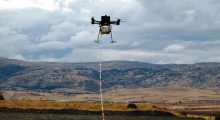
The Polish division of Ukrainian defense technology company OSIRIS AI, together with Austrian unmanned systems manufacturer Schiebel, has tested the launch of the high-speed drone HSCD-1 from aboard the CAMCOPTER S-100 unmanned helicopter. After separation, the helicopter continued to provide communications relay for the smaller aircraft.
Schiebel announced the successful technology demonstration on November 18. The tests took place in Austria with the participation of Osiris Poland, which is part of the OSIRIS AI group.
How the Drone Launch System Works
During the tests, the CAMCOPTER S-100 unmanned helicopter took off with the HSCD-1 (High-Speed Camera Drone) secured to a lateral launch mount.
After separation, the HSCD-1 continued independent flight. Control commands and video signal were transmitted via the CAMCOPTER S-100, which served as an airborne relay between the smaller drone and the ground station.
In this way, the developers verified three capabilities: transporting a small unmanned aircraft on an external mount, launching it during the carrier’s flight, and maintaining a communications link after separation.
This scheme allows a larger unmanned aircraft to be used as an airborne platform for delivering smaller ones. In particular, the helicopter can bring them closer to the area of operation so they do not expend their own energy reserves covering the entire distance from the ground launch point.
The Technology Is Planned for Use in UAV Interception
According to Schiebel, an inert variant of the HSCD-1 was used during the demonstration, meaning the tests did not involve the use of a warhead.
At the same time, the companies are exploring the possibility of using a similar architecture for launching high-speed interceptor drones.
The technology could also potentially be applied to other small unmanned aircraft and loitering munitions. Schiebel notes that the role of airborne carrier can be performed not only by the CAMCOPTER S-100 but also by other aircraft in the family, including the S-300, S-101, and S-301.
For now, this is a proof-of-concept validation. The companies have not announced any combat application of such a system or its serial production.
At the same time, the companies are exploring the possibility of using a similar architecture for launching high-speed interceptor drones. defpulse previously explained how such unmanned aircraft work and what technologies are used to destroy aerial targets.
What Is Known About the CAMCOPTER S-100 and OSIRIS AI
The CAMCOPTER S-100 is a multi-purpose unmanned helicopter by Austria’s Schiebel, designed for reconnaissance, surveillance, and other missions. Thanks to vertical takeoff and landing, it can operate without a runway, including from ships.
According to the manufacturer’s specifications, the helicopter’s maximum takeoff weight is 200 kg, with a typical payload of 50 kg. Flight endurance exceeds six hours, and with an auxiliary fuel tank can exceed ten hours.
OSIRIS AI is a Ukrainian defense technology company that develops software solutions for autonomous drone control and its own interceptor drones. Its core software product, DroneOS, is designed to integrate navigation, flight control, and additional functions of unmanned systems.
In March 2026, the company introduced the OSIRIS UEB-1 — an interceptor capable of reaching speeds of up to 315 km/h. Its stated flight range is up to 18 km, with an airborne endurance of more than 15 minutes.
The company also operates in Poland through Osiris Poland Sp. z o.o. It was this division that participated in the joint tests with Schiebel in Austria.