Modern combat operations largely depend on the stable control of unmanned systems. Over recent years, alongside classic radio-controlled UAVs, fiber-optic drones have begun to be actively used. Such systems apply a different principle of signal transmission, which makes it possible to maintain control even in a difficult electromagnetic environment.
When electronic warfare assets are actively used on the battlefield, radio control channels can lose stability or be completely suppressed. In such conditions, a need arises for a communication channel that does not depend on radio frequencies. That is precisely why a fiber-optic cable, which creates a physical channel for data transmission between the operator and the drone, has begun to be used in unmanned systems.
What a Fiber-Optic Drone Is and How It Works
A fiber-optic drone is an unmanned aerial vehicle whose control is carried out through a physical cable made of optical fiber, which connects the drone with the control point. Unlike radio-controlled systems, where the signal is transmitted over the air, in this case the data is transmitted in the form of light pulses inside the fiber-optic cable.
During flight, the drone gradually unwinds the cable from a special spool installed on the craft itself or in a ground module. Through this channel, the video signal from the camera, telemetry, and control commands are transmitted. In practical systems, the length of the cable can be from several kilometers to tens of kilometers depending on the design of the drone and the characteristics of the fiber.
Thanks to the use of a physical signal transmission channel, fiber-optic drones depend significantly less on the radio-electronic environment, which makes it possible to maintain control even in areas of active operation of electronic warfare assets.
How a Fiber-Optic Drone Works
The operating principle of a fiber-optic drone is based on transmitting information through optical fiber in the form of light pulses. A special transmitter converts the electrical signal into a light one, after which it propagates inside the fiber and is received by a photodetector at the other end of the channel.
Such technology is widely used in telecommunications, since it makes it possible to transmit large volumes of data over significant distances with minimal signal loss. In unmanned systems, this makes it possible to transmit video from the camera, telemetry, and control commands without using radio frequencies.
Since the signal travels inside the cable, electronic warfare assets practically cannot jam or intercept it. It is precisely this feature that explains the interest in fiber-optic drones in an environment where radio channels are often subjected to suppression.
Fiber-Optic Drones and Their Differences From Radio-Controlled UAVs
The main difference between fiber-optic drones and traditional radio-controlled UAVs lies in the method of signal transmission. In standard drones, control is carried out through radio-frequency channels, which can be intercepted or suppressed by electronic warfare systems.
Fiber-optic drones use a cable communication channel, which is significantly more difficult to suppress or intercept. This makes them effective in an environment of active radio-electronic counteraction.
At the same time, radio-controlled drones have greater freedom of maneuvering and can work at significantly greater distances. Fiber-optic systems are limited by the length of the cable, so they are usually applied for tactical tasks at relatively short distances.
To better understand in what conditions such drones are used most effectively, it is worth getting acquainted with the article: «Fiber-optic drones in modern warfare». It examines in detail the scenarios of using such systems, their advantages when working in a zone of active EW, and the typical limitations during combat operations.
Design and Technical Features
The design of a fiber-optic drone includes the standard elements of an unmanned craft and additional components necessary for working with the cable communication channel. The basic elements include the frame, motors, the flight controller, the power system, the camera, and the video signal transmission module.
A key element is the spool with the fiber-optic cable and the mechanism for unwinding it. Such a system must ensure the uniform tensioning of the cable during flight in order to avoid tangling or damage to the fiber.
The fiber-optic cable has a very small diameter, which makes it possible to reduce its weight. That is precisely why engineers constantly work on the balance between the length of the cable, the mass of the spool, and the flight characteristics of the drone.
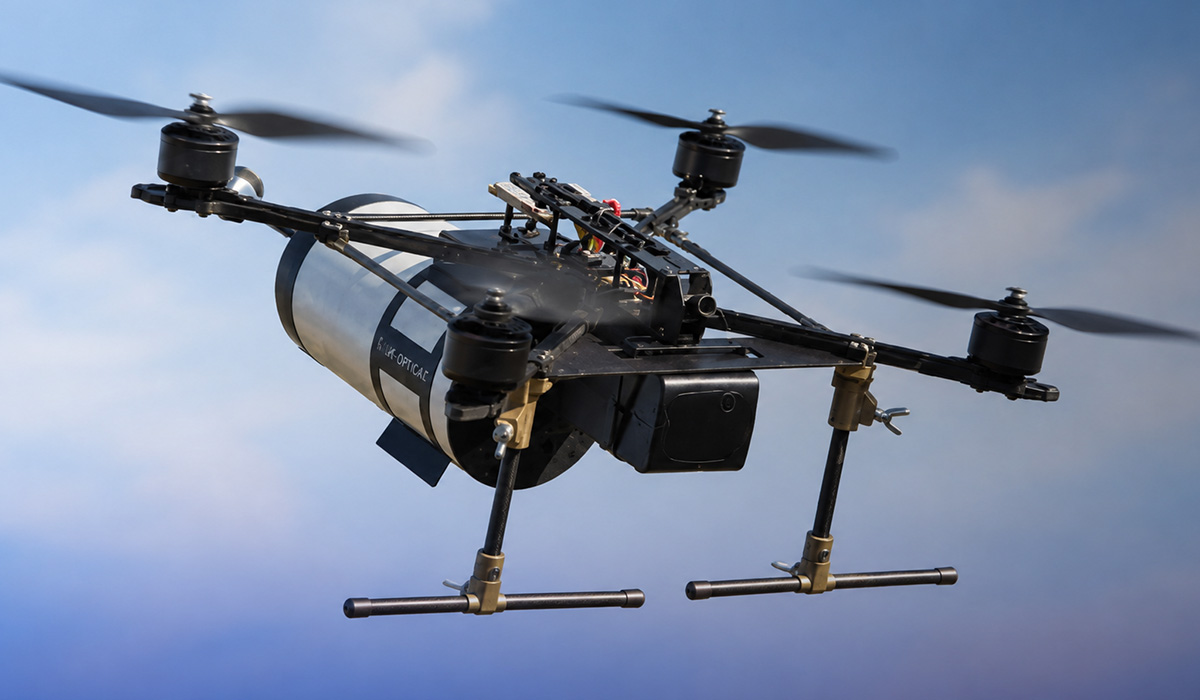
Similar principles of optimizing weight, thrust, and stability are also used in modern FPV platforms. For example, the «Zhakh 13” FPV Drone from BlueBird Tech is an FPV drone that is applied as a strike platform for carrying out tactical tasks. It is used as a standalone drone or as an element of a larger UAV system of a unit, where the key factors are flight stability, thrust, and the adaptation of the design to specific combat scenarios.
Limitations of Application in Combat Conditions
Despite their advantages, fiber-optic drones have a number of limitations. The most obvious factor is the length of the cable, which determines the maximum flight distance of the drone.
Another difficulty is flights in an environment with a large number of obstacles. Buildings, trees, infrastructure elements, or difficult terrain can create a risk of the cable catching during maneuvering.
It is also worth taking into account the preparation for launch. The use of a cable communication channel can require additional procedures during the deployment of the complex, so such systems are usually applied for specific tactical tasks, where the key factor is the stability of control.
Prospects for the Development of Fiber-Optic Drones After 2026
The development of fiber-optic drones is connected with the general evolution of unmanned systems. Engineers are working on reducing the weight of the optical cable, increasing its strength, and improving unwinding systems.
In the future, platforms specially designed for working with a fiber-optic control channel may appear. This will make it possible to increase the effectiveness of flight and reduce the load on the design of the drone.
Conclusions
Fiber-optic drones have become one of the technological solutions that appeared in response to the active use of electronic warfare assets on the battlefield. The use of a physical signal transmission channel makes it possible to maintain stable control of a drone even in a difficult electromagnetic environment.
At the same time, such systems also have certain limitations connected with the length of the cable and the features of maneuvering. That is precisely why fiber-optic drones are usually applied for specific tactical tasks, where the key factor is the reliability of control.