Ukrainian defense company TENETA Defence has introduced two new counter-drone solutions: a four-round net launcher for aerial interception of FPV drones and an automated protection system for ground vehicles. Both developments use physical target interception via a specialized net, but differ in their method of employment and architecture.
The new products were presented on November 3 during the IRON HALLOWEEN PARTY 2026 event. The aerial system is designed to be mounted on unmanned aerial vehicles, while the ground system is intended for integration on armored vehicles, automobiles, and unmanned ground vehicles (UGVs). For the ground version, the company also incorporated an electro-optical module with an artificial intelligence model for detecting aerial threats.
Aerial Net Launcher: Four Rounds for Drone Interception
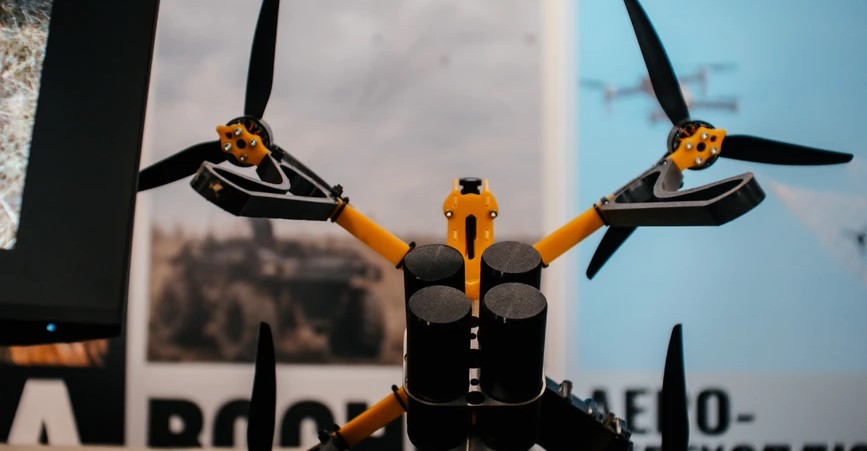
The TENETA Defence aerial system is designed to be mounted on UAVs and intercept enemy drones without direct contact with them.
Unlike single-round solutions, the new system features four autonomous cartridges. This increases the number of available interception attempts per sortie and potentially allows a single drone to counter multiple aerial threats.
Stated specifications of the aerial system:
| Parameter | Value |
| Purpose | UAV interception |
| Employment type | Air-to-air |
| Number of rounds | 4 |
| Ammunition type | Autonomous interchangeable cartridges |
| Total system weight | Approximately 800 g |
| Weight of a single cartridge | 165 g |
| Platform compatibility | FPV drones on a 10-inch frame |
| Stated platform payload capacity | Up to 2 kg |
The total weight of the system is approximately 800 g, while a single cartridge weighs 165 g. According to the manufacturer, this payload allows the use of standard FPV platforms with a 10-inch frame and a payload capacity of up to 2 kg. This potentially simplifies integration of the system onto existing drones without requiring a specialized heavy carrier. The modular design with four separate cartridges also provides for sequential use of the rounds.
2. Automated Protection System for Ground Vehicles
The second TENETA Defence development is designed to protect armored vehicles, automobiles, and UGVs against FPV drones. By functional purpose it can be classified as an active protection system (APS). It places emphasis on automated target detection and rapid net deployment.

The system architecture consists of several components:
- Electro-optical module. Used to detect aerial objects via optical sensors.
- Machine vision module. A trained AI model analyzes imagery and assists in recognizing potential threats.
- Control unit. Ensures interaction between the detection system and the actuator.
- Launcher. Deploys the net and ensures its rapid opening in the path of an approaching drone.
According to the manufacturer, the electro-optical unit with the artificial intelligence model was developed in collaboration with a third-party manufacturer.
Stated specifications of the ground system:
| Parameter | Value |
| Purpose | Protection of ground vehicles from UAVs |
| Protection type | Active net interception |
| Target detection | Electro-optical |
| Image processing | AI / machine vision |
| Net deployment range | Up to 10 m |
| Maximum deployment distance | 7–10 m |
| Potential platforms | Armored vehicles, automobiles, UGVs |
| Integration | Own optical module or external detection systems |
A distinctive feature of this system is the ability to integrate with external detection means. A simplified interface is provided for this purpose.
No published results of independent testing, information on the cost of the new systems, their serial production status, or service life are currently available.
At present, the TENETA Defence aerial system remains at the stage of refining employment from various aerial platforms. Its working designation has not yet changed, and the manufacturer continues to verify the system’s integration capabilities on UAVs.
The ground automated unit, according to a company representative, is already ready for integration on combat vehicles, transport vehicles, and unmanned ground vehicles. A separate area of work is ensuring compatibility with external aerial threat detection systems.