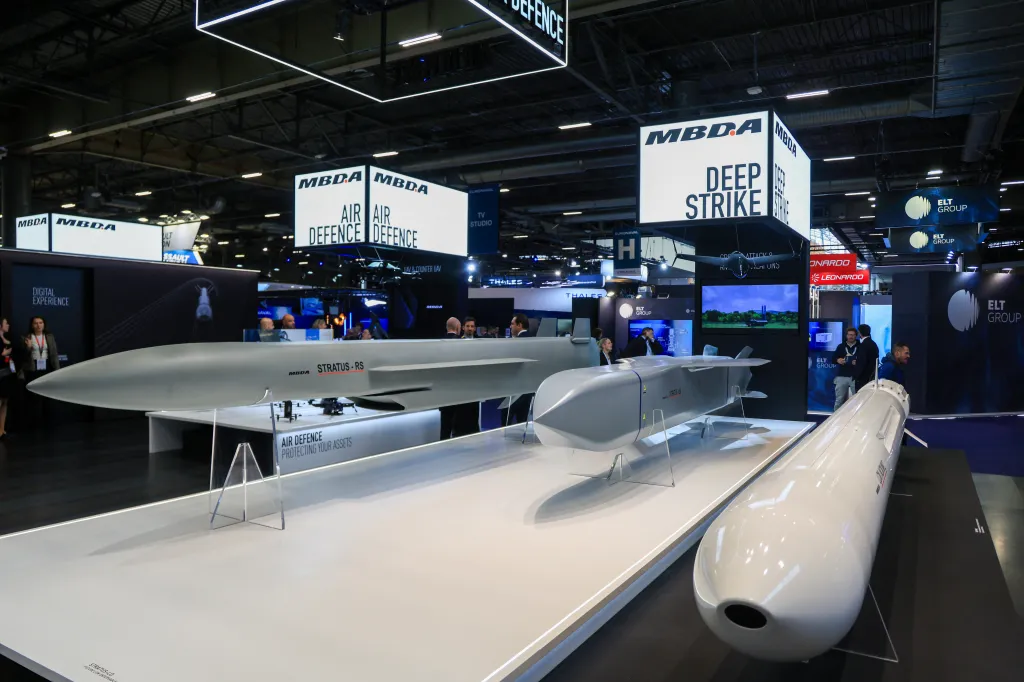
European weapons manufacturer MBDA is developing the STRATUS RS high-speed strike missile, whose range will significantly exceed that of Exocet anti-ship missiles.
This was reported on November 4 by MBDA Vice President for Sales and Business Development Olivier Goffin at the Euronaval 2026 exhibition in Paris, according to Defense News.
According to the company representative, the range of STRATUS RS will be “much, much, much” greater than that of the Exocet, which exceeds 200 km. MBDA is not yet disclosing specific characteristics of the future missile.
STRATUS RS (Rapid Strike) is being developed to perform four main combat missions:
- Deep Strike — hitting important targets deep inside enemy territory.
- Anti-ship — destroying surface ships, including frigates and destroyers.
- SEAD/DEAD — suppressing and destroying enemy air defense systems.
- Anti-HVAA — hitting high-value airborne assets, including airborne early warning aircraft and aerial refueling tankers.
One of the missile’s features will be the ability to change its flight profile. According to Goffin, STRATUS RS will be able to use both very low and high trajectories, which should help it overcome air defenses and hit well-protected targets.
Liquid-fuel ramjet and radar seeker
STRATUS RS is to be powered by a liquid-fuel ramjet air-breathing engine. One of its features will be the ability to adjust thrust in flight.
This will make it possible to change the operating mode of the engine depending on the stage of the mission, including during the final phase of the attack. Combined with high maneuverability, such a system should make it possible to hit complex targets protected by modern air defense systems.
MBDA already has experience using ramjet engines. In particular, similar technology is used in the Meteor air-to-air missile. At the same time, a separate propulsion system with adjustable thrust is being developed for STRATUS RS.
The missile’s guidance system will combine a radio-frequency seeker and a synthetic aperture radar (SAR). This combination will enable target detection and recognition, and will also support modes for striking ground targets and attacking ships from above.
The French company Thales will supply the seeker technology.
When the new missiles will appear
STRATUS RS is being developed for France and the United Kingdom. The company expects a contract from the French Directorate General of Armaments (DGA), which coordinates the program on behalf of the two countries.
According to the MBDA representative, the company has already conducted a significant number of tests of key components, including the engine, guidance system, warhead, and data management system.
The full-scale development phase is expected to begin soon. The first flight tests of both missiles in the STRATUS family are expected before the end of the decade, with entry into service in the early 2030s.