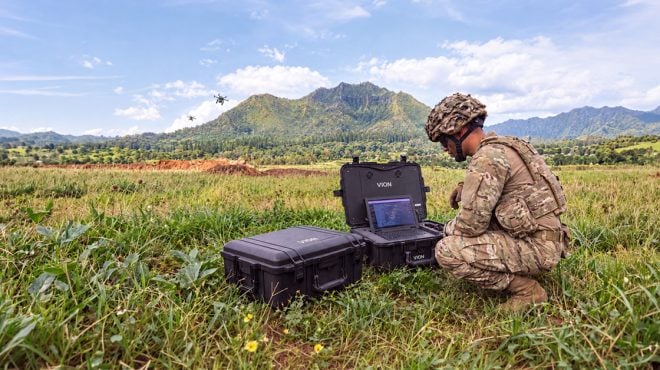
On November 2, 2026, the U.S. Army’s DEVCOM Army Research Laboratory announced a successful flight demonstration of the VICTOR unmanned aerial vehicle featuring a hybrid heavy-fuel propulsion system. At its core is a rotary engine whose components were manufactured using metal 3D printing. The propulsion system also incorporates a 400 V motor-generator and is designed for vertical take-off and landing unmanned aerial vehicles.
The development was created under the Versatile Tactical Power and Propulsion research program. Industrial partners were involved in the work, including the American company Griffon Aerospace, which participated in the development of the VICTOR platform.
According to the U.S. Army, the research results have already been transferred to industrial partners for further refinement and integration of the technology into prospective unmanned systems.
Heavy-Fuel Rotary Engine
A key feature of the development is the use of a rotary internal combustion engine capable of running on heavy fuel.
Unlike a piston engine, in a rotary power unit the working process occurs through the rotation of a rotor inside a dedicated chamber. This design makes it possible to create compact power units with a relatively small number of moving parts.
Engineers at DEVCOM Army Research Laboratory applied Computational Fluid Dynamics (CFD) and developed the engine design essentially from scratch. During their research they focused on several challenges:
- Improved the process of atomizing fuel into fine droplets for more efficient mixing with air.
- Optimized fuel-air mixture preparation for more stable combustion of heavy fuel.
- Reduced leakage of compressed air and fuel vapors inside the engine.
- Developed an air-cooled design without a separate liquid cooling circuit.
Metal 3D Printing of Components
To manufacture the engine parts, researchers employed additive technologies — layer-by-layer formation of metal components. Metal 3D printing makes it possible to create complex geometry directly from a computer model. Within the project, this technology became a tool for accelerating engineering experimentation.
In particular, it allowed:
- Faster modification of the geometry of individual engine components.
- Manufacturing new versions of parts after deficiencies were identified during testing.
- Validating computer modeling results in practice.
- Shortening the cycle between design, production, and the next experiment.
According to DEVCOM ARL program manager Chol-Bum “Mike” Kwon, the use of metal 3D printing allowed engine components to be quickly redesigned based on experimental results.
Series Hybrid Propulsion System
The rotary engine is integrated with a motor-generator, forming a series hybrid propulsion system. In this architecture, the internal combustion engine drives the generator, which produces electrical energy to power the electric propulsors.
The main components of the system:
| Component | Function |
| Rotary ICE | Converts fuel energy into mechanical energy |
| Motor-generator | Converts mechanical energy into electrical energy |
| 400 V electrical system | Provides electrical power transmission |
| Electric propulsors | Generate thrust for flight |
| Air cooling system | Dissipates heat from the engine |
The series hybrid architecture offers several potential advantages for vertical take-off and landing unmanned aerial vehicles:
- Electric motors can be placed in various parts of the aircraft without a mechanical connection to the main ICE.
- The generator and internal combustion engine do not need to be directly connected to each propulsor.
- The electrical architecture allows power to be distributed among individual propulsors according to the flight mode.
The 400 V voltage also allows the same electrical power to be transmitted at lower current compared to low-voltage systems. This potentially reduces energy losses in cables and the requirements for their cross-section.
VICTOR Drone: The Test Platform
To test the new propulsion system under real-world conditions, it was integrated into the VICTOR unmanned aerial vehicle — Versatile Intelligence Controlled Tactical Operational Reconnaissance and Attack.
The platform was developed by DEVCOM Army Research Laboratory together with industrial partners, including Griffon Aerospace.
Under the U.S. Department of Defense classification, VICTOR belongs to Group 3 unmanned aerial systems (Group 3)*.
Key known characteristics of the platform:
| Parameter | Characteristic |
| Name | VICTOR UAS |
| Developer | DEVCOM ARL and industrial partners |
| Development participant | Griffon Aerospace |
| Class | Group 3 |
| Propulsion type | Series hybrid |
| Engine | Rotary, heavy-fuel |
| Electrical system | 400 V |
| Take-off and landing type | Vertical |
*Group 3 — a medium-class unmanned aerial vehicle category. Under the U.S. Department of Defense classification, it includes aircraft with a maximum take-off weight of 25 to 600 kg, operating at altitudes below 18,000 feet (approximately 5.5 km) and at speeds of up to 250 knots (463 km/h).
The U.S. Army has not yet disclosed the exact take-off weight, dimensions, speed, range, endurance, or payload capacity of VICTOR.
From VICTOR to the PULSAR Concept
The research results are planned for use in subsequent U.S. Army projects, in particular in the PULSAR concept — Persistent Unmanned Aircraft System for Logistics, Strike, Autonomy, and Reconnaissance.
It envisions the use of groups of VICTOR unmanned aerial vehicles to carry out various missions, including:
- Logistics support.
- Strike operations.
- Reconnaissance.
- Autonomous execution of multi-role missions.
Within the VICTOR research program, the American laboratory collaborated with more than 30 universities, more than 13 federal laboratories, and more than 20 industrial partners.
The result was hundreds of scientific publications in the fields of combustion chemistry, materials science, sensor systems, control, batteries, and hybrid electric technologies, as well as dozens of patents and patent applications.
The U.S. Army plans to provide the VICTOR unmanned aerial vehicle and the PULSAR concept to military partners for further experimentation and development. Industrial partners will continue to refine the platform for other application areas.