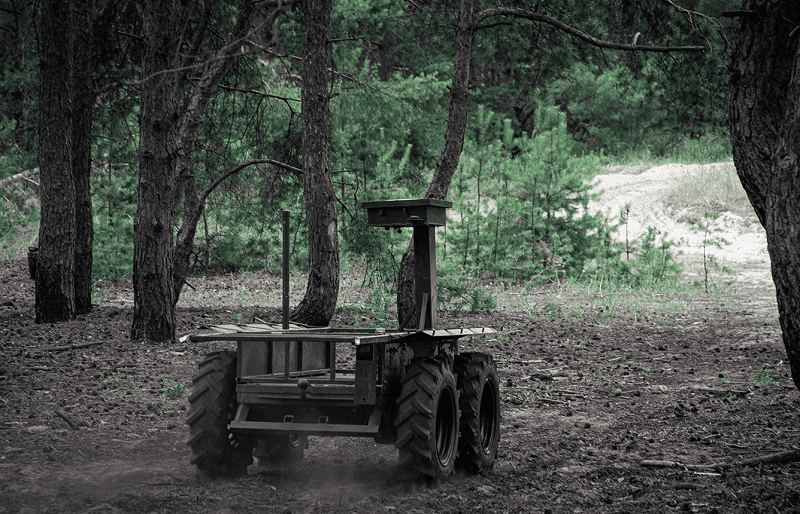
On the Vovchansk axis, an “air-ground” war for logistics is underway: both sides are trying to deliver ammunition, fuel, and reinforcements to positions without coming under drone attack. At the same time, Russian use of ground robotic systems has become a systematic practice. Meanwhile, the occupiers continue to use motorcycles, ATVs, and cars.
This was reported by communications officer of the 57th Separate Motorized Infantry Brigade named after Kish Otaman Kost Hordiienko, Ruslana Bohdan. According to her, the logistics routes of both armies fall within the drone and electronic warfare strike zone, which covers approximately 30 km on both Ukrainian and Russian territory. This forces both sides to constantly change delivery methods — from light aircraft and radio-controlled FPV drones to fiber-optic-guided UAVs.
Ukrainian units are betting on rapid equipment adaptation for specific directions — frequency adjustments and FPV drone modifications. In contrast, according to observations by ground robotic system operators of the 57th Brigade, the Russians compensate for this simply with the quantity of equipment and operators.
The behavior of the enemy’s infantry is also changing. Whereas Russians previously more often moved in groups of three, such cases are now rare: movement in pairs or even alone predominates, in order to covertly filter through Ukrainian positions.
Bohdan also described an “echeloned” assault model: the first wave consists primarily of poorly trained infantry whose task is simply to gain a foothold on a position. Once this is achieved, more experienced soldiers are brought in. According to the officer, this scheme is generally typical of Russian assault operations on this axis.
Despite losses in personnel and equipment, the Russian Federation’s command continues to regularly transfer new units to the Vovchansk axis.
The 57th Separate Motorized Infantry Brigade named after Kish Otaman Kost Hordiienko has been defending Vovchansk for over a year — as of May 2026, the brigade reported 730 days of continuous containment of the offensive on this axis. The city itself, according to soldiers’ accounts and footage published by the brigade, has been virtually razed to the ground: what remains of the built-up area is predominantly ruins.