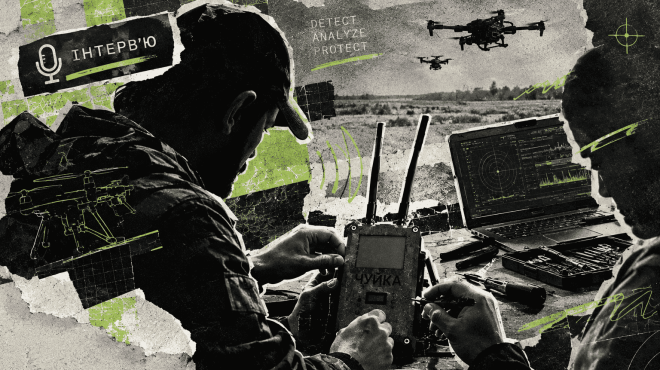
Military communication on the front line is the basis of the management of battle. It is precisely through communication that orders, the coordinates of targets, requests for support, information about the situation, and changes on the battlefield are transmitted. Without stable communication, even a well-prepared unit loses controllability and acts blindly.
This material was prepared by BlueBird Tech for those who want to understand how military communication works in practice in combat conditions: how coordination between units is organized, which assets are used on the front line, what problems the military encounter, and why communication is no less important than weapons or equipment.
What Military Communication Is and Why It Is Critically Important on the Front Line
Military communication is a system of the transmission of information between servicemen, units, and command points during combat operations. This is not only about radios but about the entire chain of management: from a soldier at a position to the commander of a unit and the staff.
On the front line, communication performs several key functions simultaneously: the transmission of orders, the exchange of reconnaissance data, the coordination of actions between branches of the troops, the calling of fire or medical support, the clarification of the situation in real time. If this chain is interrupted, decisions are made with a delay or without up-to-date information at all, which directly affects losses and the result of battle.
That is precisely why in modern warfare communication is considered a critical resource, and its protection and redundancy are just as important a task as the defense of positions.
How Coordination Between Units Is Organized in Combat Conditions
Coordination between units is built according to a clear hierarchy of management. Information moves along defined channels — from the lower level to the higher and back — with minimal delays and distortions. Each level of management is responsible for its own volume of decisions and is not overloaded with unnecessary data.
In practice this looks as follows: an infantry unit records a change in the situation or detects a target, transmits the information to the commander, then the data reaches the staff or adjacent units, after which a decision is made — the adjustment of positions, the calling of artillery, the application of drones, or a change of the route.
The interaction between infantry, artillery, the units of unmanned systems, and staffs is especially important. For this, coordinated terminology, standardized formats of the transmission of coordinates, and clearly defined procedures are used in order to avoid mistakes and the loss of time. In modern battle, the speed of the transmission of information is often more important than the quantity of fire.
Means of Military Communication Used on the Front Line
On the front line, a combination of several types of communication is applied. The basis remains tactical radio communication, which makes it possible to maintain contact between fighters and commanders at short and medium distances. In parallel, digital management systems, protected channels of data transmission, and specialized assets for the exchange of coordinates and reconnaissance information are used.
A mandatory element is backup channels of communication. If the main channel is suppressed or goes out of order, a unit has the ability to switch to alternative frequencies, other types of equipment, or pre-agreed signals. It is precisely redundancy that makes it possible to preserve controllability even under the active impact of the enemy.
In this context, electronic warfare assets also play an important role. They are used for the protection of one’s own channels of communication, the reduction of the effectiveness of enemy management, and counteraction to drones, which are actively applied for reconnaissance and destruction. Solutions in this segment are also developed by Ukrainian miltech producers, in particular BlueBird Tech, in whose product line various types of EW systems for combat conditions are presented.
The Main Challenges of Military Communication in the Zone of Combat Operations and Ways of Overcoming Them
The main threats to military communication on the front line are electronic suppression, the interception of signals, the overloading of channels, the physical destruction of equipment, and the human factor. The enemy actively tries to deprive units of communication, since this sharply reduces their effectiveness.
For counteraction to these threats, several approaches are applied: the use of protected and variable frequencies, the minimization of the time of communication sessions, airwave discipline, the training of personnel in actions during the loss of communication, and the constant monitoring of the radio situation. That is precisely why military communication is closely connected with electronic reconnaissance and the analysis of the airwaves. More about this can be read in the material «Electronic reconnaissance (ER): essence, directions, and modern challenges».
Conclusion
Military communication on the front line is the nervous system of modern battle. Through it pass decisions, the coordination of actions, and the control of the situation. Stable and protected communication makes it possible for units to act coordinatedly, quickly adapt to changes, and reduce losses.
An understanding of how military communication is organized and which challenges it encounters helps to better realize the real logic of modern combat operations, where the one who wins is not the one who has more resources but the one who better manages information.