Two elderly residents of Orikhiv — 80-year-old Valentyna Dmytrivna and 90-year-old Henislav Markovych — were evacuated from the shelled city on a robotic platform. The journey along field paths under the threat of Russian drones lasted more than half a day.
Twelve hours on the “pony”
The operation was conducted by fighters of the 65th Separate Mechanized Brigade “Velykyi Luh” with the participation of a ground robotic complex. Orikhiv in Zaporizhzhia Oblast is under constant shelling, so ordinary evacuation transport cannot reach it. The platform carried its passengers to a safe location where a vehicle was waiting for them.
The brigade emphasizes that this is the first evacuation by UGV over such a large distance. Dozens of service members took part in it. Some conducted aerial reconnaissance and route monitoring, while others covered and escorted the platform the entire way. A separate vehicle operated for the evacuation group.
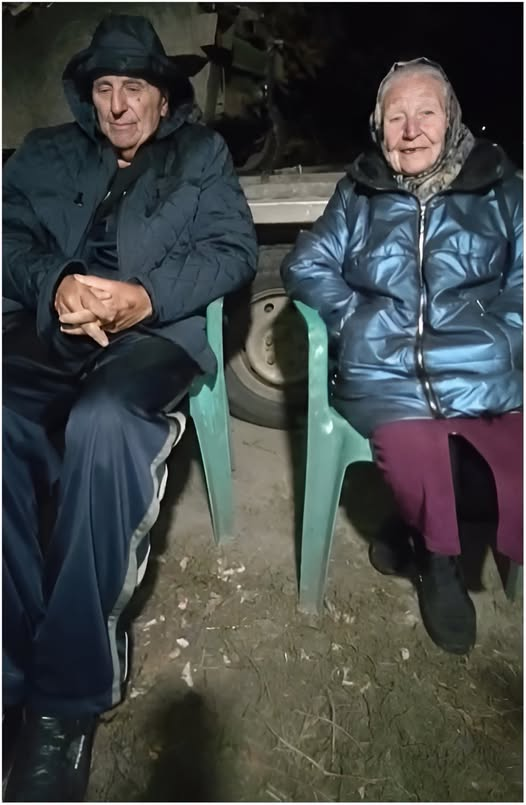
Brigade fighters say they protected their “pony” and its precious passengers as if they were family.
The last mile an armored vehicle cannot cover
UGVs have become evacuation transport in the most dangerous zones. The commander of the UGV company “Tryhlyav” of the 110th OMBr previously stated that classic evacuation by armored vehicles or pickups no longer works: getting through where a pickup once could has become very difficult. So, as early as early 2026, Oleksandr Syrskyi tasked units with using UGVs to carry wounded out of the kill zone.
Robots have an advantage. According to the commander of the 3rd Medical Company of the 1st Separate Medical Battalion, Maksym Shtrul, it is less visible than a large armored vehicle: it can be hidden under trees and its thermal signature is smaller. Therefore:
- in the first half of 2026, the Ministry of Defense contracted 25,000 UGVs;
- in March 2026, the military completed more than 9,000 UGV missions;
- from the beginning of 2026 to early September, approximately 112,000 logistics and evacuation UGV missions were recorded. Evacuation of the wounded accounts for only a small fraction of this volume.
Three design schools
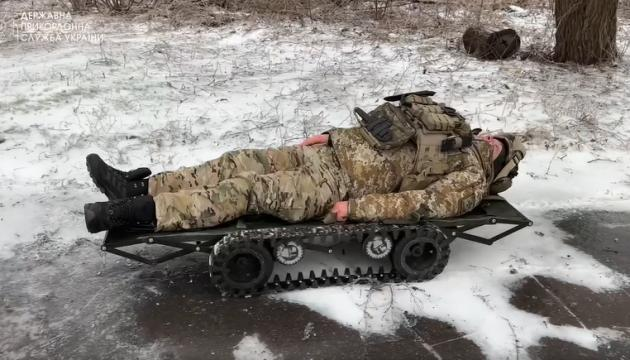
Evacuation UGVs in Ukraine are divided by logic: slow and highly mobile, fast and armored, multipurpose with a passenger module. Evacuation vehicles are fitted with armored capsules, electronic warfare systems, and anti-cumulative cage armor.
Small tracked platforms
Vepr, Ardal, TerMIT. Speed 7–14 km/h, payload 250–350 kg, range 30–40 km. Can carry 1–2 wounded. Strong points — mobility and low visibility. Weak point — slowness: even the shortest journey takes hours.
Fast armored “capsules”
Maul by AIDronesUA is the best-known example. An internal combustion engine on a heavy quad bike chassis, an armored capsule protecting against shrapnel with patient restraint straps, head support, a soft mat, and two-way voice communication. Speed — tens of kilometers per hour. Can carry out missions up to 110 km in range. Tactic: break through and get out fast.
Multipurpose wheeled carriers
Ratel M/H, Bandura, Kalach. These are designed primarily for logistics, with evacuation as an additional role. They carry up to 200–500 kg of cargo at a speed of approximately 8 km/h.
Evacuations involve large teams. For example, during an Ardal operation by Regiment K-2, one operator served as navigator, another controlled the vehicle, and the route was adjusted in real time from a reconnaissance drone. A medic maintained communication with the wounded soldier. Another specialist prepared the route.

Speed matters more than payload capacity: a review of UGV evacuation specifications
| System | Manufacturer | Chassis | Payload, kg | Speed, km/h | Range, km |
| Maul | AIDronesUA | Wheeled (quad bike base) | 200 | up to 64 with casualty (82 without) | up to 100; mission record 110 |
| Vepr | KB Vepryk | Tracked | 350 | 7.5 | 40 |
| Ardal | BUREVII | Tracked | 250 (per developer) | 14 | 30 |
| TerMIT | Tencore | Tracked, modular | 300 | — | — |
| Ratel M | Ratel Robotics | Wheeled | from 400 | 8 | from 80 |
| Ratel H | Ratel Robotics | Wheeled | up to 500 | 8 | up to 55 |
| Bandura | BlueBird Tech | Wheeled | 200 | 8 | 30–40 (off-road) |
| Kalach | YEDRON | — | 250 | 8 | 20 |
A chronicle of evacuations: from three kilometers to one hundred and ten
- Orikhiv, 65th OMBr. Two elderly civilians were evacuated along field paths over more than 12 hours. This is the first such operation over such a large distance.
- Orikhiv direction, September 11, 2026. The UGV company “Asgard” of the 153rd OMBr evacuated two Russian prisoners of war from the front line, captured by the “Arey” unit. The mission lasted approximately six hours: this is the first such evacuation of prisoners by ground drone.
- Lyman, April 25, 2026. The UGV unit Cerberus of the 3rd Army Corps picked up a 77-year-old woman who had been walking along a shelled road for hours. The side of the robot read: “Grandma, get in!” Three other civilians were guided by drones to a pickup point.
- Enemy rear, January 23, 2026. The 53rd OMBr together with the 1st Separate Medical Battalion evacuated a soldier with a gunshot wound who found himself effectively behind enemy positions. The route was 64 km; the mission lasted 5 hours 58 minutes. Success came on the 11th attempt: before that, the medical battalion had lost two UGVs.
- Kupyansk direction, April 2025. The Ardal of Regiment K-2 evacuated three wounded soldiers from encirclement, covering more than 17 km under mortar and artillery fire. Drones dropped water and medicine to the troops.
- Autumn 2025, “Tryhlyav” of the 110th OMBr. In a single night, one UGV evacuated eight wounded soldiers, four per trip. By spring 2026, the company had carried out approximately 60 medical evacuations.
Things do not always go smoothly: obstacles occur almost every time. The “Forsazh” unit of the 128th Separate Mountain Assault Brigade “Dyke Pole,” on its first of three attempts to evacuate wounded, completed the mission with a punctured tire; on the second, with three anti-personnel mine detonations. Only on the third attempt did the UGV bring the evacuation group, which retrieved the wounded from approximately three kilometers away.
Evolution: from “cargo carrier” to rescue system
Over two years, ground robotics has evolved from isolated experiments to a means of mass application with its own doctrine.
Stage 1: UGV cargo and combat engineers (2024)
Brigades add robot operator positions. In spring 2024, the first certified engineering demining vehicle, Zmiy, is codified. Dozens of models are then codified through Brave1.
Stage 2: first evacuations (2025)
At the end of 2023, the 1st Medical Battalion seeks an alternative to conventional evacuation: this is how Maul begins. In January 2025, it conducts its first logistics operations; in October — the first successful evacuation of a wounded soldier. At the same time, the tracked Ardal in Regiment K-2 carries out four successful evacuations.
Stage 3: systematization and scaling (2026)
The General Staff tasks units with evacuating the wounded by UGV. Maul production is transferred to the company DevDroid, as military units cannot launch serial production independently. In June, the Ministry of Defense announces that 50 UGVs have been approved for service since the start of the year (60 were approved in all of 2025). In June at Eurosatory, AIDronesUA signs a memorandum with Sweden’s Njord Technology for 400–500 systems per year.

Communications, EW, and FPV protection: the main technological challenges
One of the biggest challenges for ground robots is stable control over rough terrain. Buildings, hills, tree lines, ravines, and concrete structures can obstruct radio signal transmission. Enemy electronic warfare assets pose an additional threat.
Modern UGVs therefore use multiple communication channels that can complement one another.
Key technologies:
- Radio channels. Used to transmit control commands and telemetry.
- LTE. Enables platform control via mobile networks where coverage is available.
- Mesh networks. Enable data transmission through multiple intermediate nodes.
- Starlink. Can be used for satellite communication if the relevant system is integrated into the complex.
- Aerial relay nodes. UAVs can act as an intermediary link between the operator and the ground robot.
- Fiber-optic control. Provides signal transmission via a physical cable and is independent of the radio environment, but limits mobility to the cable length.
For example, MAUL EVAC uses the Droid Box control system, which supports multiple communication types, including a fiber-optic channel with a range of up to 20 km.
- Armored capsules. Protect the passenger from shrapnel and some other damaging factors.
- Frame superstructures. Can reduce the risk of damage from drop munitions.
- EW systems. Designed to counter specific control channels of enemy drones, but do not provide universal protection.
- Physical interception systems. Net guns and other specialized devices can be used to counter UAVs.
- Air escort. Reconnaissance and intercept drones help detect threats and protect the route.
None of these solutions makes a UGV invulnerable. It can be destroyed by an FPV drone, artillery, or a mine. Protection is therefore ensured through mission planning and inter-unit coordination.
A wounded soldier may be on the platform for tens of minutes or several hours without a medic present. It is therefore necessary to stabilize his condition, ensure he is secured, and prepare him for extended transport before departure.
Vibration poses a particular problem. When traveling over damaged roads and off-road terrain, the platform transmits jolts to the body that can worsen the condition of a person with spinal, pelvic, or limb injuries. To reduce this risk, the following are used:
- Vacuum mattresses. Secure the body in conformity with anatomical contours.
- Spinal boards. Used when spinal injury is suspected.
- Shock absorption systems. Reduce the transmission of impact loads from the running gear.
- Thermal blankets. Help prevent hypothermia.
- Restraint straps. Keep the patient in a stable position during movement.
Another challenge is loading. Most current UGVs lack fully functional robotic manipulators capable of independently lifting and placing a seriously wounded person onto the platform. An evacuation team is therefore still required at this stage.
What comes next: the future of evacuation UGVs
Today, most combat UGVs remain remotely controlled. However, developers are working on systems that will be able to continue moving even after losing connection with the operator.
In particular, Ukrainian company Swarmer is developing autonomous navigation solutions that include obstacle recognition, crater avoidance, and return to a designated point. Integration with digital maps and onboard computing systems is also expected to improve performance under conditions of limited GPS signal.
A promising direction is the iMEDCAP concept — Integrated Medical Capability — which envisions the creation of an integrated unmanned medical evacuation chain.
In such a system, aerial drones could detect casualties, other sensors could assess their condition, and a ground platform could independently plot a route to the injured person. In the future, specialized medical modules could enable remote monitoring of vital signs and the performance of certain medical procedures under specialist supervision.