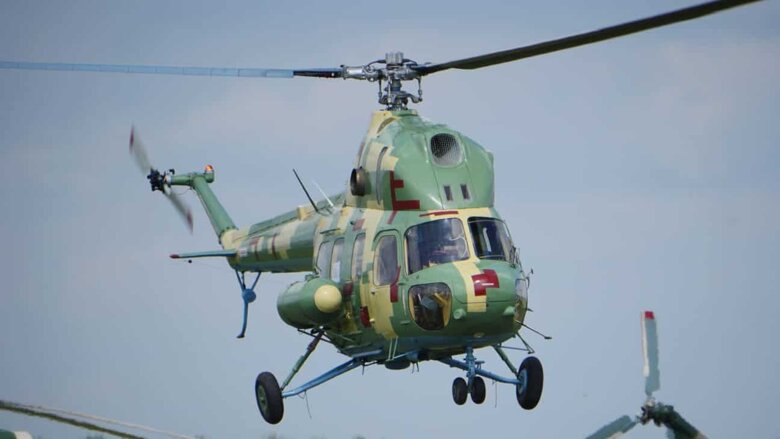
Russia’s full-scale war against Ukraine has forced army aviation to rethink combat employment principles that had been forming for decades. Helicopters designed to support ground troops, destroy armored vehicles, and conduct air assault operations are now forced to fly at extremely low altitudes, attack targets from behind cover, and intercept strike drones. At the same time, they have themselves become targets for cheap FPV drones.
DefPulse examined how Ukraine uses helicopters in the war: in a unified system together with reconnaissance, ground units, drones, and electronic warfare assets.
Ultra-Low-Level Flight
One of the main challenges facing army aviation in the war in Ukraine has been the density of air defense. A helicopter that climbs to a significant altitude to search for a target or conduct an attack risks entering the detection range of radar stations and becoming a target for surface-to-air missile systems.
As a result, crews increasingly use the Nap-of-the-Earth (NOE) flight profile — movement that makes maximum use of terrain features and ground obstacles for concealment. The helicopter flies close to the surface, using tree lines, hills, folds in the terrain, and built-up areas to remain outside the direct line of sight of enemy observation assets.
This places a significant workload on the crew. The airspace must be constantly monitored, as power lines, trees, antennas, buildings, and other obstacles are just as dangerous as enemy missiles. Such flights become especially challenging at night, in limited visibility, or over unfamiliar terrain.
A telling example was provided by Ukrainian army aviation operations during the defense of Mariupol in the spring of 2022. Mi-8 helicopters flew to the besieged garrison at Azovstal through territory controlled by Russian forces. Crews used low altitudes, speed, and complex routes to avoid detection by air defense assets.
According to the Ministry of Defense, the operation consisted of seven missions involving 16 helicopters. They delivered ammunition, medicine, food, and reinforcements, and also evacuated the wounded. Three aircraft were lost during the operation.
Lofting Attacks: A Compromise Between Range and Accuracy
The air defense threat has changed the ways weapons are employed.
One common technique has become the firing of unguided air rockets (UAR) using a lofting maneuver — a brief pitch-up of the helicopter’s nose before launch. Rather than making a direct approach to the target, the crew breaks cover, executes the maneuver, and releases a salvo of rockets on a ballistic trajectory, then returns to low altitude.
This technique can extend the range of unguided munitions and reduce the time the helicopter spends in an exposed section of airspace.
Ukrainian crews use Soviet-era S-8 rockets for this purpose, among others. However, this tactic has a fundamental drawback: unguided rockets cannot guarantee precise engagement of individual targets. Their dispersion depends on launch conditions, and firing from a masked position reduces the ability to assess the results of an attack.
In effect, the helicopter functions as a mobile multiple-launch rocket system, delivering area fire. Yet this is a necessary compromise: it is better to attack while protecting the crew and the aircraft.
An alternative solution has been the use of precision-guided weapons. One example is the American APKWS (Advanced Precision Kill Weapon System), which converts 70 mm unguided Hydra 70 rockets into laser-guided munitions using a guidance section installed between the warhead and the rocket motor.
This concept makes it possible to combine relatively inexpensive rockets with the ability to engage point targets precisely. Instead of a salvo of unguided munitions, the crew can fire one or more rockets against a designated target.
Mi-8 and Mi-24: Soviet Legacy on the Battlefield
The backbone of Ukrainian army aviation consists of Soviet-designed helicopters — primarily the multi-role Mi-8 and its variants, as well as the Mi-24 attack helicopter.
Despite the age of its design, the Mi-8 remains one of the most versatile platforms available. It can transport personnel, deliver cargo, evacuate the wounded, and perform fire support missions. Depending on the modification and configuration, the aircraft can carry several tons of payload.
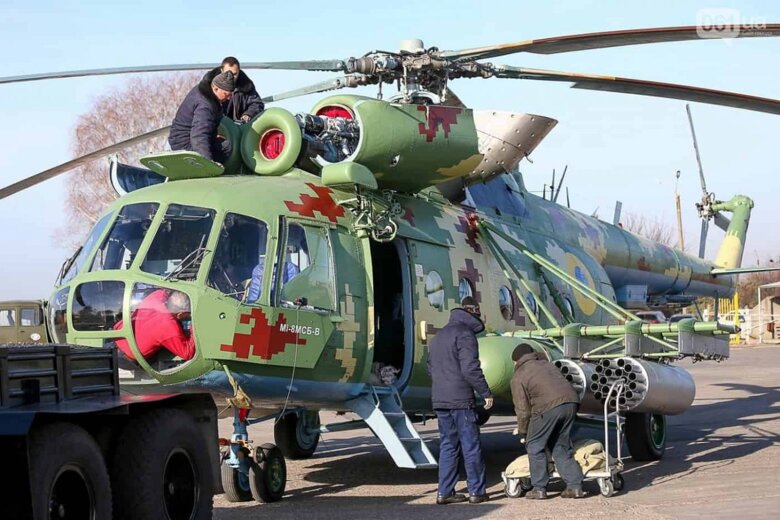
A distinct upgrade line is the Mi-8MSB-V, fitted with Ukrainian TV3-117VMA-SBM1V engines manufactured by Motor Sich. The powerplant upgrade improves flight performance during operations in high-temperature conditions and at significant altitudes.
The Mi-24 has a different specialization. Its concept combines the role of an attack helicopter with the ability to carry a small assault group. The aircraft features armor protection, powerful cannon armament, and the capability to employ both unguided and guided rockets.
However, versatility has a downside. This is a relatively heavy aircraft built around a concept that envisaged direct support of ground forces — which means the helicopter must approach the air defense engagement zone in order to identify a target and employ weapons. That tactic has clearly become obsolete under current conditions.
Ukraine’s fleet has also been supplemented with Western platforms. The HUR, in particular, operates American UH-60 Black Hawks, while the Ukrainian Navy has received British Sea Kings transferred by partner nations.
These aircraft expand the capabilities of Ukrainian aviation. The Black Hawk is a multi-role platform suited for troop transport, special operations, and medical evacuation. The Sea King was originally designed for naval aviation, making it useful for operations over the Black Sea.
Ka-52 and Mi-28: Russian Attack Aviation Is Also Forced to Adapt
At the outset of the full-scale invasion, Russian army aviation made active use of the specialized Ka-52 Alligator and Mi-28N/NM Night Hunter attack helicopters.
The Ka-52 uses a coaxial rotor system — two rotors turning in opposite directions — which eliminates the need for a conventional tail rotor. The aircraft is fitted with a 30 mm cannon and can employ both guided and unguided rockets, and is equipped with electro-optical surveillance systems.
The Mi-28NM is built on a classic design with a tandem crew arrangement. One of its distinctive features is a mast-mounted radar station, which allows targets to be detected while the helicopter remains behind natural cover.
However, the technical capabilities of these aircraft have not given Russian aviation an unconditional advantage. Ukrainian air defenses, mobile anti-aircraft systems, and man-portable air defense systems have imposed serious constraints on its operations.
Helicopters vs. Drones: A New Role for Army Aviation
Mi-8 and Mi-24 helicopters armed with machine guns have begun to be used to intercept Russian Shahed strike drones. In August 2025, AFU Commander-in-Chief Oleksandr Syrskyi reported that over the previous year Ukrainian helicopters armed with machine guns had shot down more than 3,200 Shaheds.
At the same time, the opposite trend has emerged: drones have begun to hunt the helicopters themselves.
In September 2025, Ukrainian forces reported the first confirmed air-to-air destruction of a helicopter by an FPV drone. The target was a Russian Mi-8. In July 2026, Ukrainian drones attacked a Russian Mi-28N in the Belgorod region. The strike was delivered by a Ukrainian-made Shrike 10 drone.
Previously, helicopters were primarily concerned with missiles and ground fire. Now crews must account for the possibility of an attack by a small drone that can approach from an unexpected direction and strike vulnerable structural components.
Russia is attempting to counter this threat by installing additional electronic warfare equipment on its helicopters. In particular, photographs of the Mi-28NM have captured additional antenna arrays that analysts associate with FPV drone countermeasures.
But EW is not a universal solution. If a drone uses a fiber-optic control link, conventional radio-frequency jamming cannot sever the connection between the operator and the aircraft.
What Will the Helicopter of the Future Look Like?
The future of the attack helicopter will likely depend on several development directions:
- long-range precision-guided weapons;
- advanced electro-optical systems;
- integrated threat warning suites;
- effective electronic warfare;
- interoperability with drones.
The last direction is particularly important. A helicopter can receive intelligence from UAVs, engage targets on the basis of off-board targeting data, and remain outside the enemy’s direct detection range. Meanwhile, unmanned systems can perform some of the missions for which a crewed aircraft previously had to be put at risk.
It is therefore too early to abandon helicopters entirely. They remain essential for medical evacuation, troop transport, search and rescue operations, and the interception of aerial targets.
Notably, a helicopter’s survivability is no longer determined solely by its technical characteristics. What have become decisive are information superiority, weapons accuracy, speed of decision-making, and integration into the overall combat system.