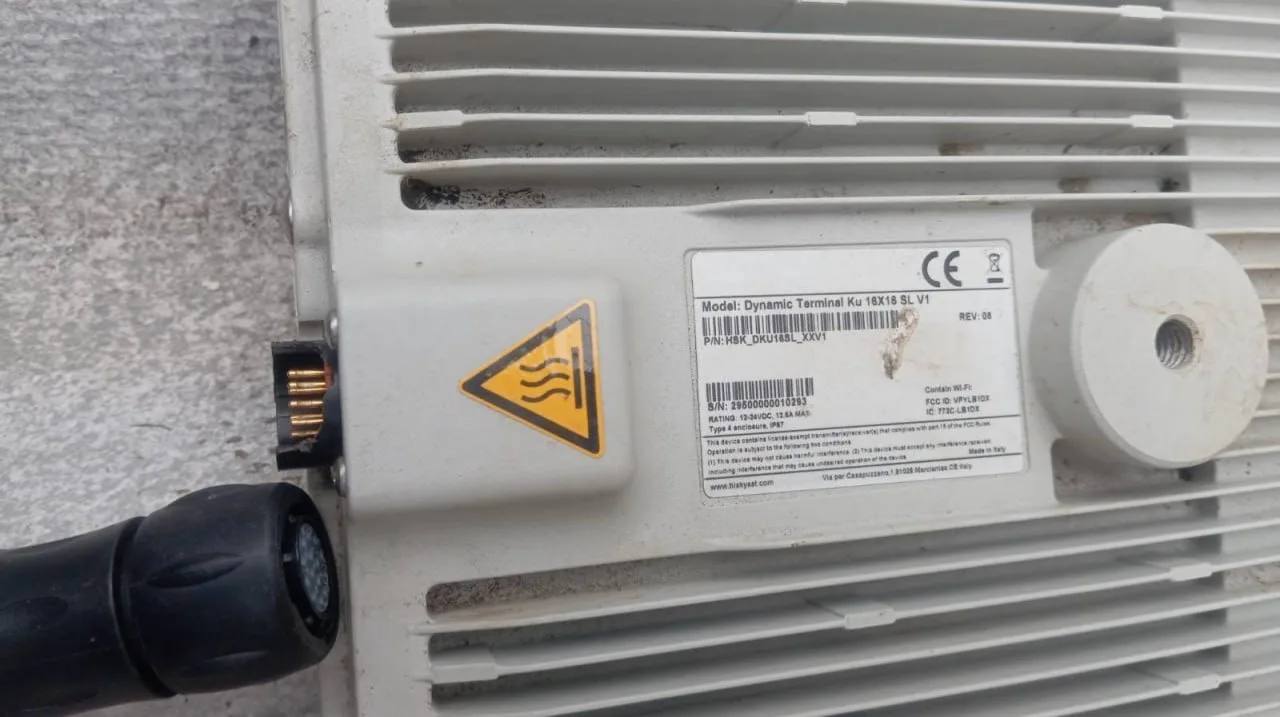
Enemy military information resources have claimed that Ukrainian long-range drones are equipped with hiSky SmartLITE Sirius 16×16 satellite terminals. According to their account, the equipment provides connectivity via satellites in various orbits and can be used for data exchange between an operator and a drone. Ukrainian radio technology specialist Serhii Beskrestnov (Flash) commented on these reports but neither confirmed nor denied the information.
The possible use of the terminals was reported by the Russian analytical center KCPN (Coordination Center for Assistance to Novorossiya). In a video published on October 29, its representatives claim to have obtained a satellite terminal for research, allegedly removed from a Ukrainian fixed-wing drone. They assert that the equipment can support transmission of telemetry, video, and control commands.
What is known about the hiSky satellite terminal
The company hiSky develops satellite communication systems, including compact terminals with flat antennas and electronic beam steering.
The manufacturer offers the SmartLITE SIRIUS 16×16 Ku model. Its design features a phased array antenna with 256 elements and a built-in modem. Such a system can electronically steer the antenna beam to track a satellite without the mechanical rotation of a traditional satellite dish.
According to the technical documentation for the previous Dynamic 16×16 version, the device measures approximately 60.4 × 29 × 3 cm and weighs less than 6 kg.
The terminal is designed to work with geostationary (GEO) and low Earth orbit (LEO) satellites. In a press release from February 2024, the company stated data transfer speeds of up to 2 Mbps via GEO satellites. For LEO connections, the manufacturer anticipated the possibility of significantly increased throughput.
How the technology differs from Starlink
A key feature of such terminals is their ability to work with satellite constellations in different orbits.
Geostationary satellites orbit at an altitude of approximately 35,786 km above Earth. They provide wide coverage, but due to the great distance, the signal experiences high latency. This limits the use of such a channel for tasks requiring rapid data exchange.
Low Earth orbit satellites are located much closer to Earth’s surface and therefore provide lower latency. At the same time, the antenna must track the satellites as they move along their orbits in order to maintain a connection.
Similar solutions have long been available on the commercial market. For example, Kymeta develops flat-panel Hawk u8 antennas compatible with the OneWeb satellite network. In 2023, the manufacturer announced approval of this terminal for use while in motion via the OneWeb low Earth orbit constellation. Support for GEO and LEO satellites does not make hiSky a full equivalent of Starlink. It represents a different satellite communication architecture and depends on the availability of the respective networks and their infrastructure.
The emergence of reports about hiSky comes amid the growing role of satellite communications in the war. In particular, on November 6, Reuters reported that Russian forces are already using their own low Earth orbit constellation “Rassvet” for communications with drones over Ukraine. According to Ukraine’s Defense Intelligence, the system does not yet provide continuous coverage of Ukrainian territory.