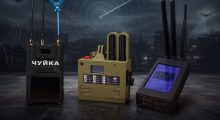
Electronic warfare (EW) systems are extremely important on the battlefield. However, choosing the right technology can be difficult, as the market offers a wide variety of options with different characteristics and purposes. To help you make the right choice, below we review the main types of EW systems (dome, vehicle-mounted, and trench), and help you determine which one best suits your needs.
How to Choose an EW System for a Specific Task
There is no universal EW system, because different drones operate on different frequencies and have different use-case scenarios. FPV drones typically use 5.8 GHz for video and 2.4 GHz for control, commercial quadcopters may operate in the same bands, while long-range systems use lower frequencies.
If a system does not cover the required bands, it effectively has no impact on the drone, regardless of its power. That is why the first selection criterion is matching the threat’s frequencies. The second criterion is power within the operating zone. For close-range protection, signal stability and density matter more than maximum range.
The third criterion is the deployment format: stationary, mobile, or portable. The system must match the task in terms of dimensions, power consumption, and deployment speed. The right choice starts with a clear understanding of the task, not with comparing specifications.
What is a trench EW system?
A trench EW system is a technology designed to protect personnel and equipment in trench positions.
Specialized EW Systems as a Distinct Type of EW Means
A specialized EW system is a solution developed for a specific type of threat or a clearly defined use-case scenario. Such systems are typically optimized to operate within a limited frequency range or against a particular type of drone, control channel, or navigation system.
The main advantage of specialized systems lies in their precision and operational stability. They are simpler to configure, less resource-intensive, and more predictable in combat conditions. At the same time, their effectiveness directly depends on how accurately the nature of the threat has been identified.
Universal EW Complexes as a Multifunctional Type of EW System
Universal EW complexes are designed to cover a wide range of threats. They can operate across multiple frequency bands, switch modes, and adapt to different types of drones and use-case scenarios.
The main advantage of such systems is flexibility. A single complex can be used to protect positions, escort vehicles, or provide cover for units during movement. This is especially relevant in conditions of rapidly changing situations.
At the same time, versatility always comes with trade-offs. Extended functionality complicates configuration, raises demands on operator training, and can reduce effectiveness in narrow scenarios where specialized solutions perform more reliably.
Comparing the Effectiveness of Different EW Types in Combat Scenarios
The effectiveness of specialized and universal EW systems differs significantly depending on the conditions of use. In static defense, where the nature of threats is known and stable, narrow-profile solutions often deliver better results due to precise tuning and minimal signal loss.
In dynamic scenarios involving unit movement or changes in the types of enemy drones, universal complexes offer greater flexibility. They allow faster adaptation to new conditions, but require constant monitoring of operating modes.
Thus, effectiveness is determined not by the type of system, but by how well its capabilities match the specific combat task.
Limitations of Universal EW Systems in Real-World Conditions
Despite their obvious advantages, universal EW systems have a number of limitations that are important to consider. Broad functionality complicates operation, and configuration errors can lead to reduced effectiveness or interference with friendly communications.
In addition, universal complexes typically have larger dimensions, more complex logistics, and higher power supply requirements. In field conditions, this can limit their operating duration or deployment speed.
Features of EW systems:
Mobility and adaptability. The technology can be quickly transported and deployed in trenches. This is critically important during combat operations.
Protection. Using remote antennas, you can keep the EW system right in the trenches without damaging it (antennas can be mounted on a tripod, a tree, etc.).
Directional and omnidirectional antennas. Effectively block signals in specific directions and create jamming over a large area.
BlueBird Tech offer the “Hrets” EW series for purchase: ХЛ, 4МЦ and 4МО. They are perfectly suited for military personnel operating in active conflict zones.
What is a vehicle-mounted EW system?
A vehicle-mounted EW system is a technology that protects military and specialized vehicles from drone attacks while in motion or stationary (mounted on the roof via roof rails).
Features:
Flexibility. The EW system can be easily installed on tanks, armored personnel carriers, APCs, ambulances, and other vehicles.
Response speed. Can adapt in real time to new threats and unpredictable situations on the battlefield.
Wide coverage range. Disrupts the operation of enemy UAVs through the use of directional and omnidirectional antennas (at distances from 30 to 500 m).
What is a dome EW system?
A dome EW system is a device designed to protect military facilities, equipment, strategic infrastructure, and more.
Features:
Mobility and adaptability. The system is easy to install and configure on the battlefield, in a vehicle, or directly in a shelter.
Dome-shaped protection. The quadrifilar antennas used in the system create an effective barrier (a “dome”) that provides protection from all directions.
Resistance to external influences. Thanks to the dome design, the systems are resistant to adverse weather conditions and other external factors (strong wind, snow, sand, etc.).
By the way, you can purchase the dome-type “Hrets” EW series 4MC and XL from BlueBird Tech.
What are the differences between EW modifications?
The main differences between these systems lie in their mobility, types of application, and levels of protection. Trench EW provides high effectiveness directly in combat conditions, vehicle-mounted EW offers mobility and protection during the movement of military and specialized vehicles, and dome EW provides a high level of protection for critical infrastructure, military units, ammunition depots, and more.
Frequencies and Bands of EW Systems Against Drones
Most drones use 2.4 GHz and 5.8 GHz frequencies for control and video signals. In some cases, lower frequencies are used to extend range, especially in relay-based systems.
If an EW system covers only one band, the drone may retain control or transmit video through another channel. That is why effective solutions either simultaneously cover multiple bands or allow quick mode switching.
In practice, “blind spots” arise not only due to the absence of the required frequency, but also due to uneven coverage. For example, in complex terrain or built-up areas, the signal may not reach certain sectors. Frequency coverage is a baseline parameter. If a system does not operate in the required band, it does not solve the task regardless of its other characteristics.
Integration of EW into the C-UAS System
EW operates effectively only in conjunction with detection systems. Sensors allow the direction and type of threat to be determined, while EW affects the control or data transmission channel. Without integration, the system either operates continuously, consuming resources, or responds with a delay, which reduces effectiveness against fast-moving targets.
The impact on friendly communications must also be taken into account. In field conditions, improper EW configuration can block friendly control channels, creating additional risks.
To understand the basic principles of system selection, it is advisable to review the material “How to Choose the Right EW System?”, which covers approaches to evaluating and selecting solutions.
Common Mistakes When Choosing an EW System
The most common mistake is choosing a system without a clear understanding of the task. In such cases, the focus is on maximum specifications that do not match the actual conditions of use. The second mistake is ignoring frequencies. If the system does not cover the control and video channels, it has no effect on the drone.
The third is underestimating the environment. In built-up areas, forests, or complex terrain, effectiveness differs significantly from open ground. The fourth is the lack of integration with other systems, which reduces the speed of threat response. These mistakes typically become apparent during use, when changing the decision is difficult or impossible.
Conclusion.
In general, choosing the right EW system depends on your objectives: vehicle-mounted systems are suitable for protecting vehicle convoys and frequent repositioning, dome systems for protecting important facilities or bases, and trench systems for protecting military units in active combat conditions.
If you want to learn more about our vehicle-mounted, dome, and trench EW systems, contact our managers. They will provide all the necessary information and help you select the system that best fits your situation.