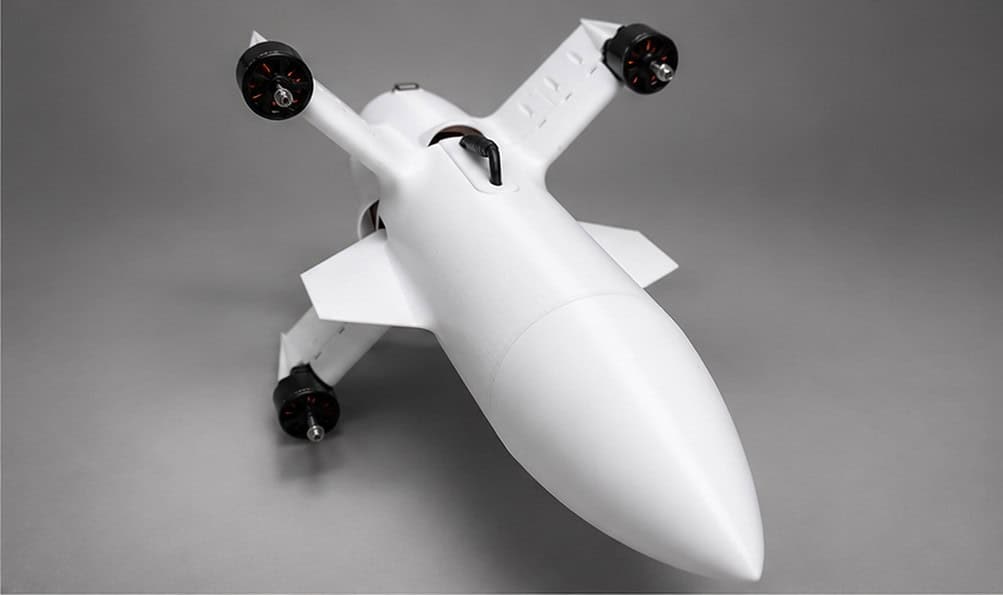
Ukrainian developers are creating jet-powered interceptor drones with artificial intelligence to counter new jet-powered Shaheds. Six such systems are already at various stages: from codification to combat deployment.
This was reported by the portal zbroya ua. Over the past month and a half, jet-powered kamikaze drones have been causing damage to Ukrainian cities. Conventional Shaheds fly at speeds of 150–200 km/h, while jet versions reach 400–600 km/h. The time available to detect and destroy a target has been reduced by 2–3 times, and the flight altitude has increased from a few hundred meters to 4–9 km. Mobile groups with machine guns physically cannot reach such targets, and spending Patriot or IRIS-T missiles worth millions of dollars on cheap drones means exhausting air defenses.
Among the threats: Geran-3 (a compact drone for reconnaissance and precision strikes), Geran-4 with a warhead of approximately 50 kg, and Geran-5 with a warhead of up to 90 kg, described as a cheap substitute for a cruise missile.
What Ukrainian arms developers are offering
- «Zorelit v5» («Vluchnyk») is ready for delivery to the Defense Forces. Speed up to 416 km/h, range up to 47 km, an AI-guided terminal homing system, and integration with SkyMap for trajectory planning.
- P1-SUN JetKiller (SkyFall) is being prepared for mass production. It accelerates to 370 km/h, operates at altitudes up to 9 km, and its AI module tracks a target at distances up to 1 km. It has already destroyed Geran-3, Geran-4, and Geran-5.
- Sting S («Wild Hornets») is undergoing combat trials. Using the Hornet Vision Ctrl remote control system, operators have destroyed approximately 10 jet-powered Geran-4s and several Geran-5s. The manufacturer is preparing for mass production.
- SPYS (WIY Drones) reaches speeds of up to 480 km/h using domestically produced Motor-G engines and can remain airborne for up to 14 minutes. Codification is planned to be completed by mid-October.
- LITAVR+ (F-Drones) has a speed exceeding 400 km/h and confirmed kills of Geran-3 and Geran-4. It features GPS-independent navigation and autonomous terminal guidance. To counter the Geran-5, the company is working on a different product.
- Alexa Spatium is already in service with the Defense Forces; the manufacturer remains undisclosed. It features a powerful turbojet engine, is launched from a mobile catapult, and can return to its launch point if the combat mission is not completed.