Eight more modules armed with 12.7 mm machine guns will be deployed in the Kyiv region. Russia is increasing its use of high-speed UAVs, and Ukraine is protecting key facilities accordingly.
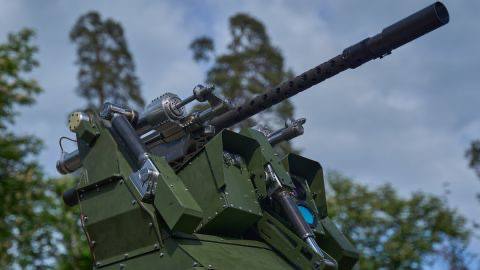
Twelve automated turrets have been installed in Kyiv to counter Russian jet-powered Shahed UAVs, reported presidential adviser on technology Serhii “Flash” Beskrestnov. According to him, more turrets will continue to be installed. Beskrestnov described them as a fully Ukrainian development: machine guns controlled by artificial intelligence. The systems can automatically detect and engage enemy drones.
President Volodymyr Zelenskyy cited the figures earlier during a joint press interaction with German Chancellor Friedrich Merz. According to the head of state, in addition to the 12 turrets installed in Kyiv, eight more will be deployed in the Kyiv region in the near future. These are automated combat modules fitted with .50-caliber machine guns, which the president refers to as “fifties.” The model and technical specifications of the system are not officially disclosed.
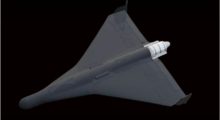
Zelenskyy stressed that combined defenses are needed against new threats. He expects Russia to focus on quality rather than quantity — that is, to shift from conventional Shaheds to maximum use of jet-powered variants.
According to the president, in the past week alone Russia launched 900 jet-powered Shaheds, in addition to conventional drones and a significant number of ballistic missiles. Intercepting such targets is more difficult: the Defense Forces shoot down 85–92% of conventional Shaheds, while the interception rate for jet-powered ones was approximately 50–70% at the time of the interview.
The speed difference is significant. The propeller-driven Geran-2 reaches approximately 185 km/h, while the turbojet Geran-3 can reach 600 km/h and up to 800 km/h in a dive. According to GUR assessments, the Geran-4 is capable of reaching up to 500 km/h, while the Geran-5 has a warhead of up to 90 kg and a speed of 500–600 km/h.
Beskrestnov has repeatedly explained over recent weeks why defending Kyiv is difficult. He reported that several weeks ago the Russians upgraded the inertial navigation system on the Shaheds to minimize the effect of electronic warfare, and that not all jet-powered Shaheds are controlled online. He also claims that 1–3 Russian signal repeaters may be operating in the capital, providing a temporary drone control channel, and that as long as they are active, fully closing the city off with electronic warfare means is ineffective. That is why the emphasis is placed on kinetic means.
Separately, Beskrestnov reminded Kyiv residents not to stand near windows during air raid alerts.