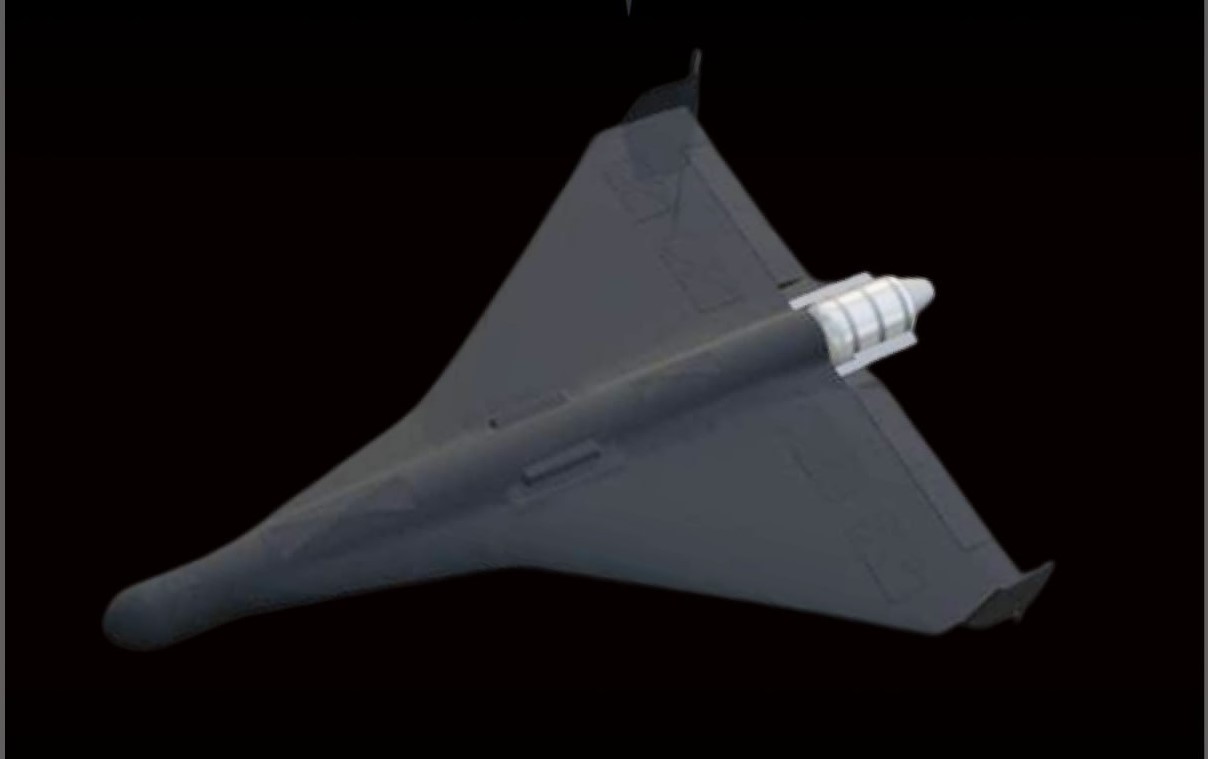
Russia has upgraded its jet-powered UAV ‘Geran-4,’ adding new autonomous navigation systems and a specialized warhead designed to destroy bridges and power line pylons.
Ukraine’s Defence Intelligence Directorate (DIU) of the Ministry of Defence published details on the War&Sanctions portal about the new version of the ‘Geran-4,’ which Russian forces began deploying in autumn 2026. According to the DIU, the drone received a number of changes to its navigation system, warhead, and powerplant.
One of the new components of the ‘Geran-4’ is the DISMAG V1.1 magnetic compass module, designated ‘MOKh.’ Its core is a PNI5GA magnetometer manufactured by the American company PNI Sensor Corporation. The DIU notes that the module operates in conjunction with the SADRA inertial navigation system and is intended to reduce gyroscope drift, improving the accuracy of autonomous navigation.
Another addition is the ‘Susanin’ system — an electro-optical correlation system that matches imagery from the onboard optical sensor against reference images preloaded into memory. This allows the drone to correct its route from launch point to target without relying exclusively on satellite navigation.
According to Ukrainian intelligence, a similar system is also used on the new version of the ‘Geran-5‘ K5.
At the same time, the ‘Geran-4’ retains its satellite and inertial navigation systems. On the War&Sanctions portal, the DIU also identified dozens of other drone components, including a Unicore GNSS module and microcontrollers and electronics of various origins. In total, 74 components are listed for this version.
Another change is the introduction of a cumulative-cutting special payload (CCSP).
According to the DIU, this warhead is designed to strike bridge structures and power transmission line pylons. Its operating principle involves severing structural elements with a shaped-charge jet.
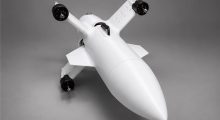
On the ‘Geran-4’ page, the DIU indicates a maximum warhead mass of 50 kg. The drone’s total length is 3.6 m, wingspan — 3.05 m, and maximum takeoff weight — up to 450 kg. The stated maximum speed is 350 km/h, with a flight range of up to 770 km.
Changes also affected the powerplant. According to the DIU, the Chinese Telefly turbojet engine used in the previous variant has been replaced in the new modification by a locally produced Russian equivalent manufactured at ‘Alabuga.’
At the same time, a significant portion of the electronic components remains unchanged and corresponds to earlier versions of the ‘Geran-4.’
The agency noted that Russia’s modernization is following the path of increasing the drone’s autonomy. The combination of satellite, inertial, magnetic, and optical navigation may provide the ‘Geran-4’ with several independent means of orientation during flight.