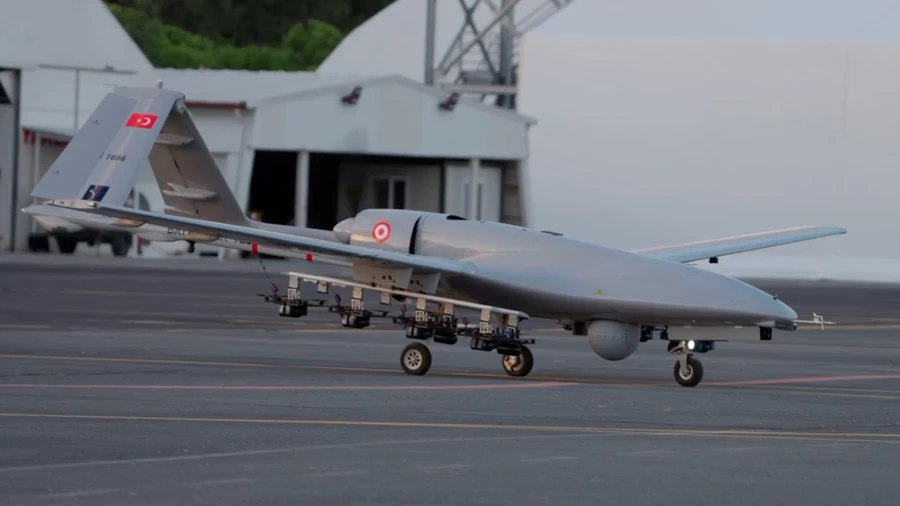
Turkish company Baykar has tested the Bayraktar TB2 drone as an airborne carrier for FPV drones. During the test, the UAV launched two Skydagger strike quadcopters that hit designated targets. This was reported by Baykar on November 4, 2026. In total, the drone carried 16 FPV drones and also served as an airborne communications relay.
Bayraktar TB2: Carrier Specifications
The test demonstrates a new mode of employment for the already mass-produced strike drone. Instead of relying solely on its own guided munitions, the TB2 can deliver a group of smaller strike drones to the operational area.
Key specifications of the Bayraktar TB2 according to the manufacturer:
| Specification | Value |
| Length | 6.4 m |
| Wingspan | 12 m |
| Height | 2.2 m |
| Maximum takeoff weight | 700 kg |
| Payload capacity | 150 kg |
| Endurance | Over 18 hours |
During the test, special DAGGER POD mounts manufactured by Turkish company Skydagger were installed under the wings of the TB2. They allow up to 16 FPV drones to be carried — eight on each side. The system has a modular design, potentially allowing it to be adapted to other platforms.
How the Airborne Carrier Concept Works
The system combines three functions:
- Transport: the TB2 delivers FPV drones to the employment area, reducing the distance they must cover on their own.
- Launch: the quadcopters separate from the carrier in the air.
- Relay: the Bayraktar maintains the communication link between the FPV drones and the operators controlling them from the ground.
An airborne relay potentially enables operations beyond line-of-sight between the operator and the FPV drone, including in complex terrain.
The airborne carrier concept makes it possible to combine the endurance of a large UAV with relatively inexpensive strike FPVs. This may expand the operational capabilities of small drones and reduce dependence on ground-based launch positions.
The test demonstrated the possibility of launching FPV drones from a Bayraktar TB2. The next important stages will be verifying the launch of a larger number of aircraft, communication link stability, and the system’s performance under electronic warfare countermeasures.