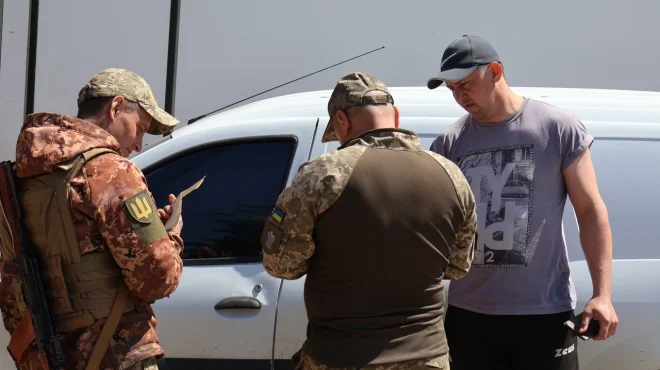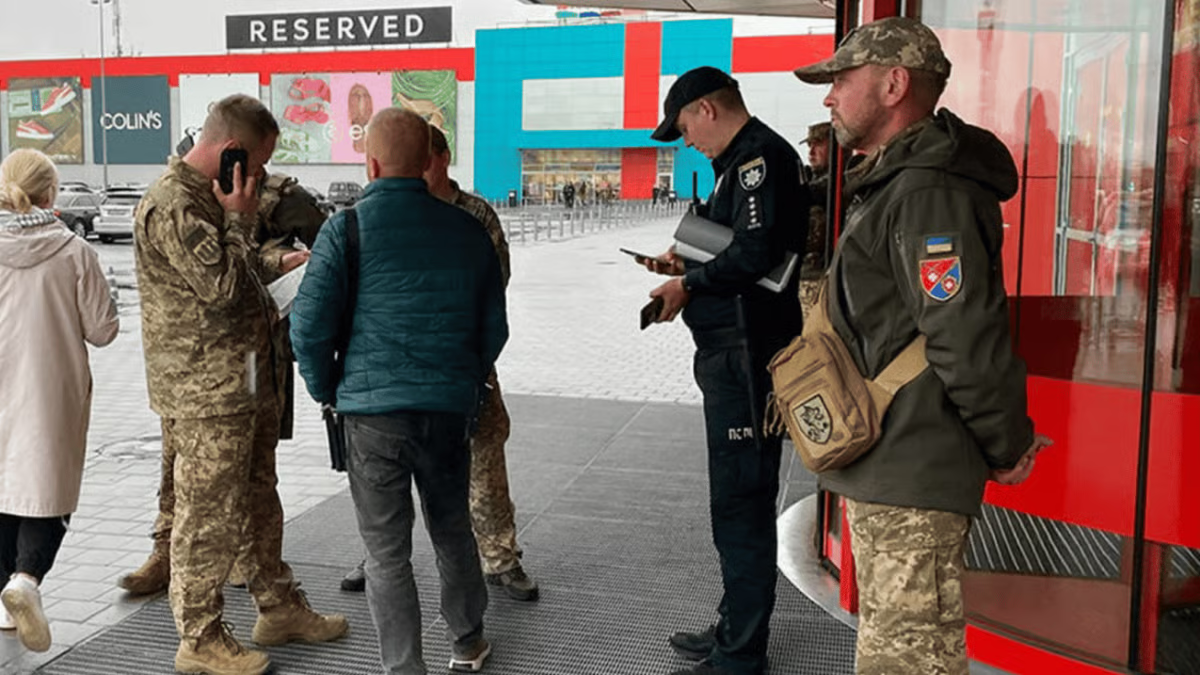
What can representatives of territorial recruitment centers demand, what can they never do, and what to do if they openly violate rights.
On the evening of September 8, a conflict occurred in Lviv during another raid by the alert group, the video of which spread across social networks in a few hours. In it, a serviceman of the CCC forcibly pulls a woman away from the entrance door. The Lviv Regional CCC later commented that the woman interfered with the work of the group and used tear gas against the military. Ombudsman Dmytro Lubinets instructed to check the actions of all participants – both the military CCC, the policeman who was nearby, and the woman herself.
This story almost literally repeats dozens of similar ones that are analyzed every month by the courts, the Ombudsman’s Office, and the State Bureau of Investigation. In many cases, there are no obvious “guilty” or “right” parties in such conflicts: usually both sides violate the law.
The problem is that few people know exactly where the powers of the CCC and the SP end and the excess of power begins. We have tried to structure information about the powers of the bodies and provide the necessary explanations.
Who has the right to inspect documents?
Verification of military registration documents (VOD) is not a monopoly of the CCC. Article 22 of the Law “On Mobilization Training and Mobilization” obliges men aged 18–60 to carry a VOD with them and show it upon request of authorized persons. But who exactly is authorized is specified in the Resolution of the Cabinet of Ministers No. 560 of May 16, 2024.
To conduct inspections and serve summonses, so-called notification groups are created. The group may include representatives of the CCC itself, employees of state administrations, local government bodies and, necessarily, police officers. The State Border Service has its own separate sphere of authority: from July 17, 2024, the presence of a military ID card is a mandatory condition for crossing the border for all men aged 18–60, regardless of the reasons for leaving.
| Who checks? | What can | Limitation |
| Representative of the CCC | Check the ID card (paper or electronic), verify data with “Oberig”, serve a summons, draw up a refusal certificate, conduct video recording | Has no right to demand a passport without the police, to detain, search, seize things or a phone |
| Policeman | Check identity documents; superficial check of person and car; administrative detention of “wanted” persons for delivery to the CCC | Does not issue summons without a representative of the CCC; detention – no more than 3 hours and only on reasonable grounds |
| Representative of the State Service of the Republic of Georgia | Checking the VOD together with documents for crossing the border, reconciliation with “Oberig” | The powers are valid only within the borders of the checkpoints and the border strip. |
That is, the CCC is responsible for registration data and documents, the police are responsible for public order, identifying a person in case of refusal to show documents, and for the use of any coercion.
The right to inspect documents begins with the identification of the inspector
Paragraph 54 of Resolution No. 560 requires: before requesting documents from a citizen, the CCC representative must first go through a self-identification procedure:
- State your last name, first name, patronymic, and position held.
- Present an identification document – passport, service card, officer’s card, or military ID.
- Present a special service ID card of a person authorized to serve summonses – it is valid only together with an identity document and is valid only within the territory under the jurisdiction of the CCC that issued it
The absence of at least one of these three elements or the refusal to show them relieves the citizen of the obligation to present his documents in response.In such a situation, the actions of people in uniform are legally equated with the demands of unknown persons, and the citizen has every right to call the police to establish the identity of those who are contacting him.
Video recording has become the norm and has clear rules
From the fall of 2024, video recording of document verification and serving of summonses is the duty of the notification services. A representative of the CCC or a police officer is obliged to record on a body camera and warn the person about this. It is forbidden to turn off the camera during communication, delete or change the material, or transfer it to third parties. Exceptions are only if strategic military facilities may be captured in the frame, or for the personal needs of a serviceman.
After the end of the duty, all recordings are automatically uploaded to a secure server administered by the Military Law Enforcement Service. The basic retention period is 30 days, but it is automatically extended if the recording appears as evidence in a case, in a complaint to the hotline, or at the request of a lawyer.
Is it possible to film the actions of the CCC on a smartphone? Article 34 of the Constitution guarantees citizens the right to openly videotape the actions of officials in public places – provided that the location of equipment or infrastructure facilities is not captured in the frame.
Electronic Water Supply: “Reserve+” and the “Oberig” register
Resolution of the Cabinet of Ministers No. 559 finally equalized the paper military registration document and its electronic counterpart in the “Reserve+” application. The e-VOD contains a QR code and a full set of data: full name, date of birth, RNOKPP, VLK status, deferment or reservation, rank and VOS. A representative of the CCC on the street does not have the right to demand only a paper military ID card – scanning the QR code with an official tablet gives access to the same data in real time. The document can be shown from the phone screen, without handing over the device itself to someone else, or in the form of a printed PDF.
The status in the application determines what happens next during the review:
On the record
The data is current. This status alone does not protect against mobilization: if the VLK conclusion has expired, a summons for a medical examination may be served.
Needs clarification
The data is incomplete or outdated, e-VOD with QR code is not generated. It is suggested to correct the data online. If it is impossible, a summons is issued for updating.
Deregistered
Temporarily removed from registration in a specific CCC (moving, serving a sentence). It is checked whether the deadline for registration at the new place of residence has not been missed.
Excluded from the register
The person is finally exempted from military service (age over 60, unfitness according to the Military Code). If there are supporting documents, mobilization actions are not carried out.
Wanted
Trigger for police involvement: CCC sends a request, police deliver the person to CCC.
It is the “wanted” status that is the source of the largest number of controversial situations. The judicial practice of 2025–2026 is replete with cases where the status appeared due to a technical failure or human error of the CCC operator.
In the case No. 520/23485/25, a man was put on wanted list for allegedly “failing to pass the VLK by order of the General Staff,” although he had updated his data in Reserve+ on time. The court noted that a general order of the General Staff does not create a personal obligation without a properly served summons. The actions of the CCC were found unlawful, and the entry was ordered to be deleted.
What the CCC cannot do: never and under no circumstances
The legislation distinguishes between the administrative and accounting functions of the CCC and the law enforcement powers of the police. CCC representatives are not a law enforcement agency, but a military management agency.
Beyond the powers of the CCC and the Joint Venture
- Stop vehicles on the road
- Conduct a cursory check, feel clothes, inspect bags or cars
- Demand to open the trunk or show the contents of the pockets
- Self-detain or hold a person in the premises of the CCC
- Take away your phone, passport, or other personal belongings
- Require unlocking the phone to check messengers or photos
- Use physical force to force someone to sign a subpoena
Even a superficial check — a procedure regulated by Article 34 of the Law “On the National Police” — is available exclusively to a police officer, and then in a limited form: a visual inspection and running a hand or special device over the surface of clothing, necessarily by a person of the same sex.
Reaching into a pocket, groping with both hands — this already qualifies as an illegal search. The person shows the contents of the bag or trunk himself. The law enforcement officer does not go through the things himself.Representatives of the CCC do not have such powers in principle.
Joint raids of the CCC and the police: responsibilities of participants
Often, joint teams of representatives of the CCC and the police work on the streets. But even if a police officer is part of the alert group, he does not have the right to fully search a person or things.
He is only allowed a superficial check under Art. 34 of the Law “On the National Police”: visual inspection and running a hand or a special device over the surface of clothing, by a person of the same sex. Reaching into a pocket, feeling with both hands, independently going through the contents of a bag or trunk – this is already qualified as an illegal search. The contents of the bag or trunk are shown by the person himself.
Detaining people in collective groups is possible — but only by police officers and only under the conditions of the Code of Administrative Offenses: after identifying the person and establishing the fact of the violation (usually the status of “wanted” in “Oberig”), with a mandatory protocol under Article 261 of the Code of Administrative Offenses and clarification of the right to a lawyer.
The CCC representative is not doing any of this on his own at this point:he does not receive either the right to search or the right to arrest simply from the fact that a police officer is standing nearby.His role remains the same: checking the ID card, reconciling it with the register, and serving the summons.
Will the mobile phone still be confiscated?
Confiscating phones under the pretext of “secrecy regime on the territory of the military enlistment office” is one of the most common practices of some representatives of the CCC, which causes the most complaints.
A phone is private property, and it can only be seized within the framework of criminal proceedings by decision of an investigating judge, or within the framework of administrative proceedings under Articles 264–265 of the Code of Administrative Offenses with mandatory recording in the protocol in the presence of witnesses.
None of these norms fall within the competence of the CCC.The requirement to unlock a phone to view correspondence is a violation of the constitutional right to privacy of correspondence. Only a police officer can check the device and only with the owner’s voluntary consent.
Detention: three hours or less
The term “busification” arose precisely around attempts to physically deliver people to military registration and enlistment offices, bypassing the procedure. From a legal point of view, everything is clear: the CCC does not have the authority to independently detain or detain citizens. If a person evades registration, the CCC makes a request to the police. Only a police officer, having identified the person and established the fact of a violation (Articles 210, 210-1 of the Code of Administrative Offenses), has the right to conduct an administrative detention, drawing up a protocol under Article 261 of the Code of Administrative Offenses with an explanation of the right to a lawyer.
Administrative detention cannot last longer than three hours.Detaining a person in the premises of the CCC beyond this period is a gross violation of constitutional rights with the prospect of criminal liability for officials.
When does abuse of authority become a criminal matter?
Systematic violations force human rights activists and investigators to work with specific articles of the Criminal Code:
| Article of the Criminal Code | What is covered? | Sanction |
| Article 146 Unlawful deprivation of liberty | Forced pushing into a car, detention without consent and without police detention procedure | Up to 3 years (qualified cases – up to 5) |
| Article 365 Abuse of power | Violence, use of special means, actions that offend dignity | 3–8 years (serious consequences – up to 10) |
| Article 371Knowingly unlawful detention | Increasingly used for illegal detention at collection points beyond the established time limits | Depending on qualifications |
High-profile cases this year include the SBI investigation into the possible abuse of a detainee in the Odessa pre-trial detention center and the death of a man after his stay in the Kremenchug RTCC in July 2026.
Bill No. 15303: separate article for “busification”
On June 8, 2026, the Verkhovna Rada registered draft law No. 15303, which proposes to supplement the Criminal Code with a special article 146-1. The idea is to eliminate the legal vacuum surrounding the qualification of the actions of the military CCC and the police during mobilization events.
What the bill proposes:
- Criminal liability for keeping a person in the premises of the CCC for more than three hours, established for administrative detention
- Direct prohibition of forcible seizure of phones to prevent a detainee from contacting a lawyer or relatives – from 5 to 7 years of imprisonment
- The liability of the CCC management for knowingly illegal orders is from 5 to 8 years; the execution of such an order by a subordinate does not exempt him from liability.
- Aggravating circumstances (group of persons, violence, minors) increase the sanction to 7–12 years
As of mid-September 2026, the draft law is under consideration by a specialized committee.
Fines: how much, for what, and how courts are mass-cancelling them
Administrative liability for violation of accounting rules is based on Articles 210 and 210-1 of the Code of Administrative Offenses, and Law No. 3696-IX increased the size of sanctions during a special period.
| Violation | Subject | Fine amount (2026) |
| Violation of accounting rules (failed to register, failed to update data) | Citizens | 17,000–25,500 UAH |
| Failure to appear for a summons, refusal to appear for a hearing | Citizens | 17,000–25,500 UAH |
| Failure to comply with CCC orders regarding reservations or submission of lists | Officials of enterprises | 34,000–59,500 UAH |
We wrote more about fines for violating accounting rules in a separate article.
Why do courts overturn CCC resolutions?
The main reasons for the cancellation in practice in 2025–2026:
- Defects in postal service – if the CCC cannot prove the fact of proper service of the summons by mail (case No. 677/445/26)
- Violation of the note to Art. 210, 210-1 – the CCC is obliged to first make a request to other state registers (demographic, tax) and only then impose a fine for failure to provide information
- Phantom “wanted” status due to technical failure – the court finds the CCC’s actions unlawful and orders it to delete the entry (case No. 520/23485/25)
- Missing the deadlines for imposing a penalty – no later than 3 months from the date of detection and one year from the date of commission of the violation (Article 38 of the Code of Administrative Offenses, case No. 707/2116/26)
The deadline for appealing the decision is 10 days from the moment it is issued or received (Article 289 of the Code of Administrative Procedure). And for those who challenge the decision of the Military Commission on mobilization or refusal to postpone, an effective tool has become “securing the claim” under the Code of Administrative Procedure: the court may prohibit the CCC from sending the plaintiff to a military unit for the duration of the case, and such a decision is effective immediately, despite the CCC’s appeal.
What’s new?
According to the Ombudsman’s Office, in the first five months of 2026 alone, more than 3,000 complaints were received about the actions of the CCC – and, according to Lubinets himself, the real figure should be multiplied by at least three, because official statistics do not take into account violations revealed from social networks and the media. For comparison: for the entire year of 2025, 6,127 appeals were recorded. The most frequent complaints are the use of force, concealment of insignia, and the use of balaclavas during inspections.
What to do if the inspection goes beyond the law
Algorithm of actions
- Calmly demand full self-identification of the CCC representative – name, document, official ID
- Demonstrate electronic VOD from the screen without handing over the phone
- Conduct your own video recording — it’s your constitutional right
- If you are asked to show the contents of your pockets, bag, or take your phone away, refuse: this is beyond the powers of the CCC.
- If there is any forceful pressure, call 102 and call the police to the scene.
- Capture witnesses, save your own video recording
- Report violations to the Ministry of Defense hotline 1512 or 0-800-500-442
- For serious violations (violence, illegal detention, seizure of property) – contact the Specialized Prosecutor’s Office for Defense and the State Bureau of Investigation to initiate proceedings under Articles 146 and 365 of the Criminal Code of Ukraine.