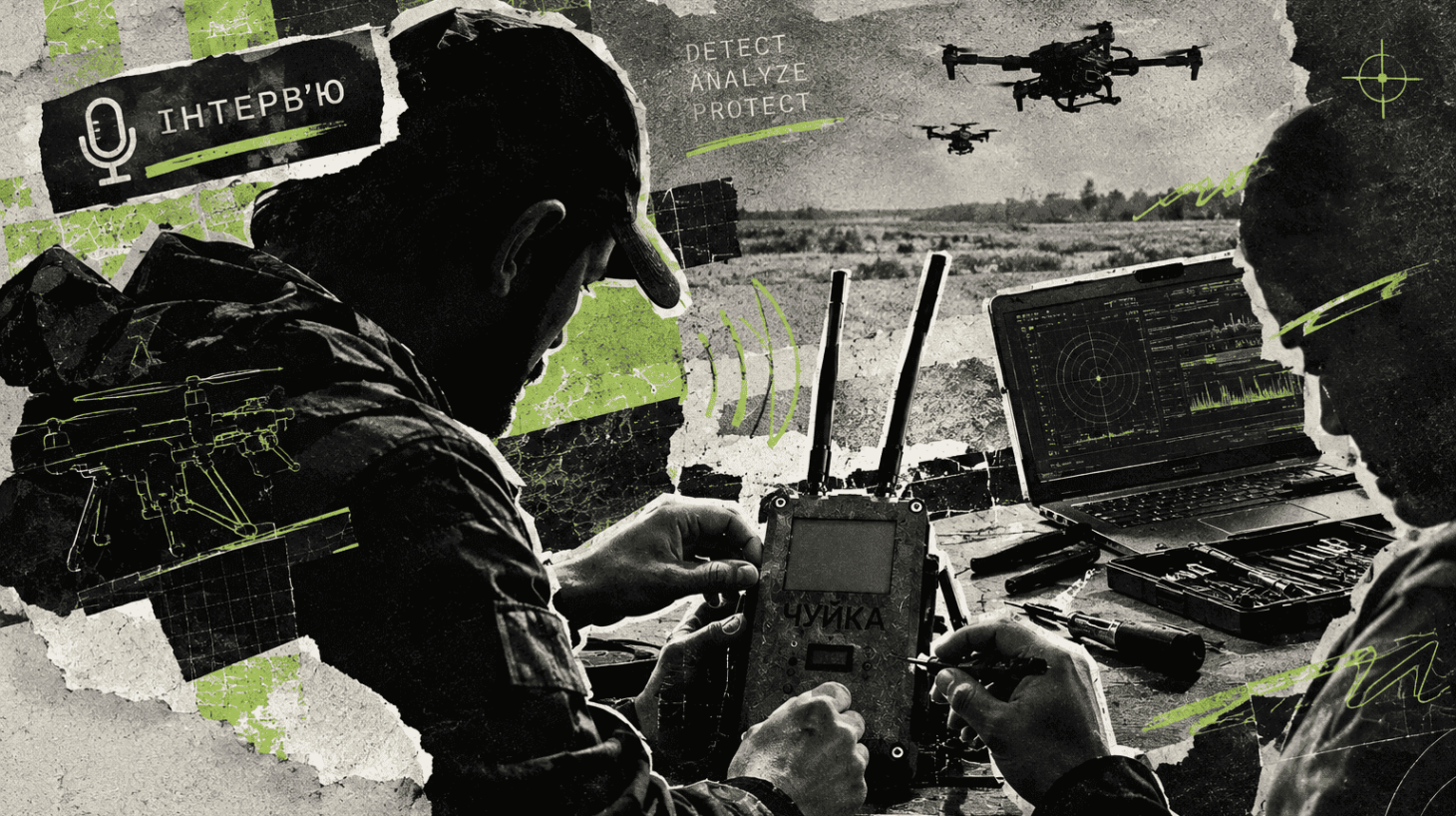
A conversation with the head of the detection division at R&D company BlueBird Tech.
The word “chuika” (roughly, “gut feeling”) in Ukrainian frontline slang carries two meanings at once. The first is a synonym for intuition. The second is the name of one of the most recognizable personal drone detectors at the front, manufactured by BlueBird Tech. These meanings have merged so organically that the phrase “chuika went off” is understood as interchangeable.
Over four years of full-scale war, the detector market has grown from a handful of homemade solutions into a distinct category of C-UAS devices. On Brave1 Market alone, the “Drone Detectors” category lists 29 product entries. And the Chuika itself has come a long way — from a basic 2.0 alarm unit to the multi-band flagship 4.0.
We spoke with the person who stood at the origins of this device and leads the detection division at the company: about how it all began, what mistakes users make, and how the Chuika differs technically from its competitors.
How Ukraine’s Most Well-Known Drone Detector Was Created
The technical specification that the Chuika started from had little in common with the device soldiers carry at the front today. I was given the task: create a device without a screen — just a buzzer, one or two buttons, and a blinking LED. Dual-band, as cheap to manufacture as possible, straightforward to use.
The biggest challenge was that we were developing the device literally from scratch. There was nowhere to look for how to do it properly. At that point, there were effectively two engineers on the team who could take on the development of such a detector: I was responsible for the software, the circuit, and the interface, while my colleague handled the hardware.
You know what the most interesting part was? After we had already worked out the concept, built a prototype, and started refining it, we were handed a captured enemy drone detector as a trophy. We took it apart with great curiosity and… were disappointed. There was nothing innovative, interesting, or impressively inventive inside. So our prototype took no inspiration from that bog-water trophy, and fortunately our concept for the device had been laid on far more promising foundations.
Changes were introduced along the way. We added a small screen for service information on our own initiative — and it caught on immediately. Then word came of an industry exhibition where it was important to present a new detector, and we decided to specially upgrade the prototype for it.
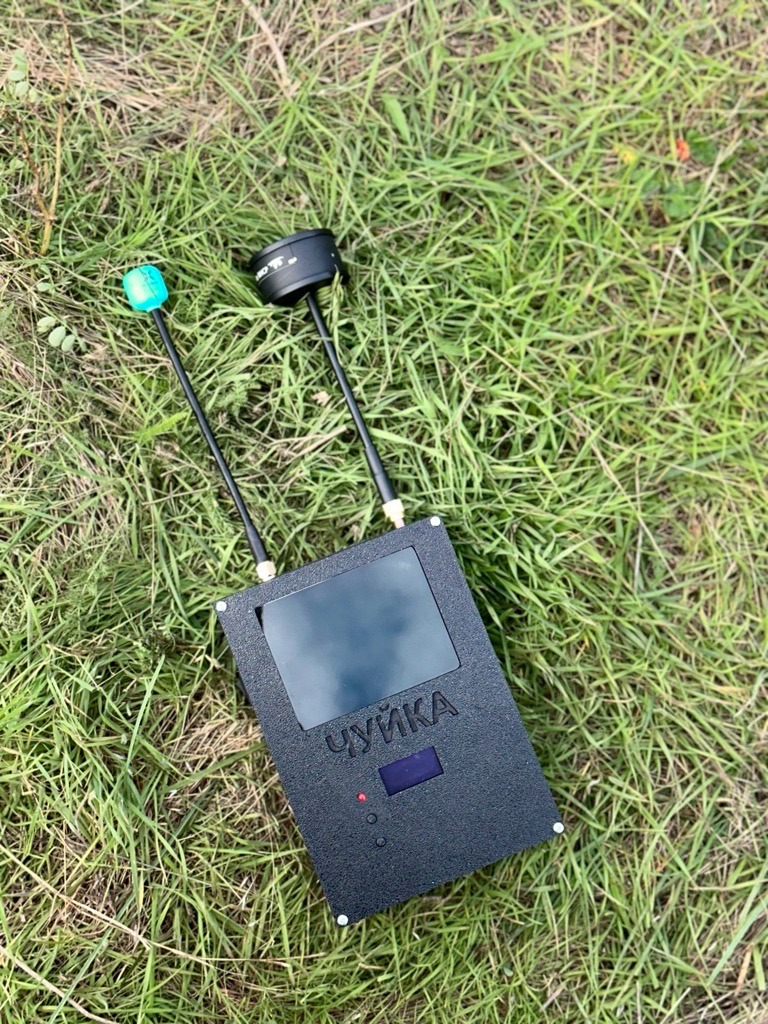
Eventually, after a few more updates, the first version appeared on the market — in a somewhat “cyberpunk” enclosure and with a large display for streaming intercepted video from enemy drone cameras.
What Is the Biggest Mistake Chuika Users Make?
The most important and most dangerous thing users can do is endlessly watch intercepted video on the screen. The Chuika’s large display is useful, but this “TV” is a serious distraction for some users.
The thing is, while video is being intercepted, the other detection channels may work less effectively. As a result, there is a risk of missing another threat. The correct behavior is: turn on the video, assess the situation — and turn it off. Let the device work the way it was designed to.
That is why we deliberately do not make automatic scanning mode the default, even though most competitors do exactly that. Their devices automatically switch on the video feed as soon as something is detected. This is dangerous: the automation cannot distinguish a friendly drone flying nearby and producing a stronger signal from a real threat further over the horizon. The user spends three to five seconds on each such false trigger while the device switches between channels. Meanwhile, the dangerous target is closing in unnoticed.
In the Chuika, the default mode is manual: the device does not activate on a signal automatically, leaving that decision to the person. We recognize the downside of this approach — for example, a driver with occupied hands may find it difficult to press a button. So our team constantly debates whether to ultimately add a fully automatic mode. We have not yet reached a final decision.
What Makes Up the Chuika? What Can It Do — and What Can’t It?
We do not try to pass the Chuika off as a device that catches absolutely everything. If we have gaps between bands, we don’t stay silent about it — unlike some competitors who claim there are no gaps between their bands. That’s not true: sensitivity there is very poor, and a drone can only be spotted when it is already directly overhead.
We test all our devices at real-world distances, starting from two kilometers, and generally at three to four, sometimes five kilometers. And not when a drone is hovering high in the sky, but when it is flying close to the ground, at up to 50 meters. In our documentation we only state figures we have personally verified: if it says 8.8 GHz, that means we simulated those 8.8 GHz and detected them at exactly the stated range.
We deliberately do not cut corners on components where it affects detection quality. The receiver for the 5.8 GHz band is one of the most expensive on the market. Cheaper alternatives cost half as much, but their quality can be simply terrible and their consistency is very low. The receiver we use for the highest band also has record-level specifications — coverage up to 8.8 GHz — and by our preliminary estimates is theoretically capable of reaching up to 10 GHz, though we are not declaring that yet and are still conducting testing.
When one of the frontline reviewers pointed out that the Chuika, like other detectors, does not cover the gap from 4 to 4.5 GHz, we worked on that feedback and were able to reliably extend coverage across the 3.3–4.5 GHz range. However, for already-shipped devices this requires a hardware rework and antenna replacement at a service center. We are taking care of that.
It is also worth noting that there are always limits no detector of our type can overcome. Built-up areas and terrain are a universal problem for any radio signal that nothing can be done about — except raising the receiver higher. Fiber-optic drones controlled by cable emit nothing at all and are fundamentally inaccessible to RF detection.
The Chuika was not designed for detecting digital signals. It can sometimes pick up RF noise from a commercial drone such as a Mavic or Autel and trigger an alert. We can simply tell the user “something may be flying” to make them more cautious. But our detector works reliably and with guaranteed quality only for detecting analog signals.
What Comes After the Chuika 4.0?
Continuing to expand functionality by adding new physical modules is a dead end, and we have understood that for a long time. We had not planned to add a fourth module in exactly the way it was done, but certain technological and time constraints locked in the decision to make the Chuika 4.0 the way it is. We are now moving away from that approach: we will not be adding any more modules, and instead we are preparing other architectural solutions that will reduce power consumption while simultaneously expanding detection capabilities. We are not sharing details yet.
It is worth saying here that in modern technology there is almost no room left for a breakthrough. Even if we were given a million dollars and a year of time, we would not create anything fundamentally new. Well, perhaps the Chuika would become the size of a smartphone. But its functionality would remain the same. All developers are running into technological limits right now: us, the adversary, and China and the United States with their enormous resources.
At the same time, there is positive momentum: technologies that not long ago cost thousands of dollars have dropped to a few hundred, and that opens the door to mass adoption of solutions that were previously economically out of reach for the industry.
Firmware Instead of New Hardware: What Is the Strategy?
Our detection concept has changed fundamentally several times: at first we relied solely on signal strength, then we added confirmation by the presence of a video signal, and eventually we concluded that detection should begin with the video image and then be refined by other methods.
This was only possible because from the very beginning we built firmware update capability into the device. Without that capability, we would not have been able to improve device quality. Everything we released even a year ago was based on a different operating principle from a software standpoint.
We have several firmware tiers by level of verification: from beta versions to the stable release, which we consider virtually free of known bugs. The guiding principle is top-down compatibility: the oldest devices can receive the latest firmware and thereby gain functionality that did not exist at the design stage. Devices that physically cannot receive updates number only a few dozen or hundred across the entire installed base, but this can be fixed free of charge with a rework at a service center.
That said, updating is not necessary for everyone or at all times. If a user feels everything is working perfectly, they do not need an update. But when a firmware update brings additional functionality, we try to communicate that, and in those cases updating can be worthwhile. The reason new firmware is released more frequently than it might appear from the outside is the constant refinement of the devices themselves. Every new hardware revision requires its own update, and the same features implemented differently can improve detection quality or simply make the interface more convenient.
We have also added a convenient way to update firmware through the BlueBird Tech mobile app. A user links their device to the app and receives all updates in a timely manner, and can update firmware on multiple devices simultaneously.
Who Works on the Chuika?
Behind it all stands a large team: several departments, different specializations. This is the division informally called “drone detection.” These people, who for understandable reasons do not lead public lives, decide every day how far the device’s capabilities can be pushed.
What Is the Most Widespread Myth About the Chuika?
Among Chuika users there is a common belief that the device must never be fully discharged — otherwise it will need to be restored at a service center. Experienced soldiers pass this warning on to newcomers in their units: the myth is alive and spreading.
This is only partially true. The very first Chuikas — no more than a hundred or a couple hundred units were produced — genuinely had no battery protection. But in all later devices the problem has been resolved both in hardware and in software. A situation where a device simply will not turn on because of the battery no longer occurs with ours. Many competitors have still not solved this — they simply do not address it. We not only resolved this issue long ago but continue working on related ones: even with the problem solved, we do not stop there.
Is It Possible to Stay Ahead of an Adversary That Is Also Developing Detectors?
We may be ahead of them at the moment. But this is a dynamic process. We will keep working to push beyond the boundaries of what is possible.