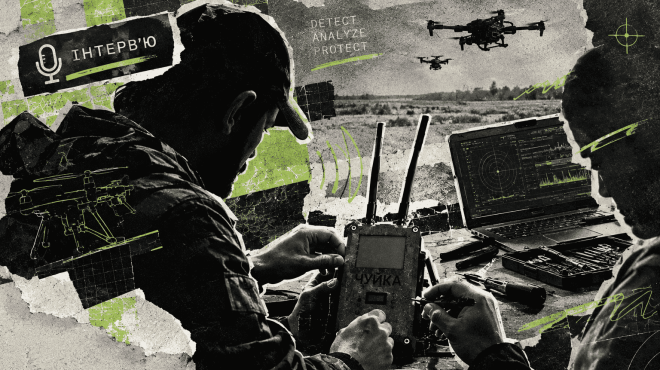
Modern drones rarely operate in a single frequency band. Control, video signal, and telemetry can be transmitted separately, use different frequencies, and change during flight. In such conditions, systems that cover only one channel often produce no result.
Multi-band EW systems are created specifically to deal with such threats. They affect several frequency bands simultaneously or in a coordinated mode, which makes it possible to cover the various communication channels of drones and reduce their effectiveness in real conditions.
How Multi-Band EW Works: The Basic Principle of EW Operation
Electronic warfare against drones is based on creating interference in the bands where the control and data-transmission channels operate. When the interference level exceeds the level of the useful signal, the drone loses the ability to steadily receive commands or transmit video.
In practice this means that EW does not ‘switch off’ the drone but disrupts its link with the operator. Depending on the settings and the type of UAV, this can lead to a loss of control, a switch to an emergency mode, or the termination of the mission. The effectiveness of such an impact is determined by how precisely the system covers the drone’s operating frequencies and whether it can maintain a sufficient level of interference in the required zone.
Multi-Band EW Systems: How Coverage of Several Frequencies at Once Is Achieved
Multi-band EW systems work through simultaneous or coordinated impact on several frequency bands. This makes it possible to cover different channels — control, video, and telemetry — without the need to switch modes during operation.
In such systems, interference is generated either through independent channels tuned to specific frequencies or through a wideband signal that covers several bands at once. The first approach provides greater precision, the second greater versatility.
In practice, multi-band EW is used where it is impossible to determine the exact parameters of the threat in advance. This allows the system to remain effective even when frequencies or signal configuration change.
Wideband solutions are especially useful in a dynamic situation where drones can switch channels or use combined data-transmission systems. In such cases, covering several bands at once becomes a critical factor.
How EW Works Against Drones in Different Frequency Bands
Most modern drones use the 2.4 GHz and 5.8 GHz bands, but this does not limit the range of threats. Systems with greater range or a more complex architecture may use other frequencies or their combinations.
If only one channel is covered, the drone can continue to operate through another. For example, when video is jammed, control may remain active, or vice versa. That is why multi-band EW systems affect several channels at once in order to reduce the overall resilience of the link.
In real conditions, what matters is not only the list of frequencies but also their overlap in space. Terrain, buildings, and distance affect exactly how the signal propagates, and even a properly configured system can have local ‘blind spots’. Effectiveness is achieved when the system not only operates in the required bands but steadily covers them within the area of use.
For a deeper understanding of how such systems work, see the article: «How EW systems work», which examines in detail the basic logic of signal suppression.
When Multi-Band EW Is Critically Necessary in Combat Conditions
Multi-band EW becomes critically necessary in conditions where the threat is not limited to one type of drone or one communication channel. This is typical of situations where different UAVs are used simultaneously or where the tactics of their use change.
In defending positions or objects, such systems make it possible to create stable coverage without the need for constant readjustment. In mobile scenarios they provide flexibility and readiness for changing conditions without a loss of effectiveness.
They become especially important when working against FPV drones and combined systems, where reaction speed and simultaneous coverage of several channels determine the result.
For such tasks it is advisable to use solutions that ensure operation in several bands at once, in particular the «Hrets» 4MO EW system, which makes it possible to cover different frequency channels and adapt to changes in usage scenarios without the need for readjustment during operation.
Conclusions
Multi-band EW systems solve the key problem of modern threats — the diversity of communication channels and their variability. They do not just operate in several bands but ensure steady suppression of different types of signals within a single system.
Their effectiveness is determined not only by technical specifications but by the ability to cover several channels at once and adapt to changes in drone behavior without losing controllability.