The effectiveness of a counter-drone system is determined not by its power or price but by whether the system can detect, track, and stop a threat in specific conditions.
In practice, even strong systems can show poor results if they are deployed incorrectly or do not cover critical zones. That is why the assessment of effectiveness is based not on specifications but on real performance indicators.
What Scaling C-UAS Means in Counter-UAV and Air Defense Systems
Scaling C-UAS means moving from local protection to building a full-fledged counter-drone network. This becomes necessary when the threat ceases to be a point one and begins to act from different directions or at different altitudes.
In such conditions, a single system no longer covers all scenarios. Drones can bypass it on the flanks, come in at a different altitude, or use weak coverage zones. It is at this moment that the need for scaling arises.
The main principles of scaling are coverage, integration, and command. Coverage is responsible for there being no ‘blind zones’. Integration makes it possible to combine different sensors and systems into a single structure. Command (C2) ensures rapid decision-making and coordination of actions. Without these principles, scaling produces no effect. The system simply expands physically but does not become more effective.
A Basic C-UAS System as a Starting Point for Scaling
Any counter-drone system starts with a basic level. This is a set of sensors, detection assets, and countermeasure elements that work within a single zone. In a typical scenario, such a system is able to detect a drone, determine its direction, and try to neutralize it. For a local object this is often enough.
But the problem is that such a system works only within its coverage. If a drone comes in from a different direction or is outside the operating zone, it is simply not detected.
Another limitation is the lack of redundancy. If one element fails, the system loses part of its functionality. It is these factors that make a basic C-UAS only a starting point rather than a full-fledged solution.
How to Scale C-UAS: Key Stages of Building a Counter-Drone Network
Scaling begins with a threat assessment. You need to clearly understand where drones can come from, at what altitudes they operate, and what attack scenarios are possible. After this, coverage is expanded. New sensors and observation points are added to close weak spots and form a continuous field of control.
The next stage is integration. The various elements of the system must exchange data so that the operator sees the full picture rather than separate signals. Then a command system (C2) is built that unites all components. It is what makes it possible to react quickly and coordinate actions. Without a clear sequence of these stages, the system becomes complex but ineffective.
The Architecture of a Scalable C-UAS System and Layered Defense Against Drones
Modern C-UAS systems are built on the principle of layered defense. This means that protection is organized into several levels, each of which performs its own function. The first level is early detection. It makes it possible to detect a threat before it approaches. The second level is tracking and analysis, where the coordinates and type of target are refined. The third is neutralization.
This approach makes it possible not to rely on a single element. If one level does not work, another backs it up. The key point is fault tolerance. The system must work even when some elements are lost and must not create ‘dead zones’ through which a threat can pass.
Typical Mistakes When Scaling Counter-Drone Systems
The most common mistake is the lack of coordination between elements. The systems work but do not exchange data, so the effect of a single network is lost. The second problem is conflicts between EW and other assets. For example, signal jamming can affect one’s own communication channels and complicate control.
Another critical factor is incomplete coverage. Even a small ‘hole’ in the system becomes an entry point for a drone. The complexity of control is also often underestimated. The operator may be overloaded with information and unable to react in time. As a result, the system looks powerful but has critical weak spots.
How to Evaluate the Effectiveness of a C-UAS System After Scaling
The effectiveness of a system is determined through specific metrics. The main ones are detection accuracy, reaction time, and completeness of coverage. For example, if the system detects only 70–80% of targets, this already means a risk of a breakthrough. If the reaction time exceeds a few seconds, the operator may not have time to make a decision.
Operational stability is assessed separately. The system must work equally effectively in different conditions — from open terrain to complex terrain.
An important element is testing. The system must be checked in real scenarios, not only in laboratory conditions. To better understand the methods of such verification, see the article: «How to test the effectiveness of EW assets: key methods», where this topic is covered in more detail.
Where Scaling of C-UAS and Counter-UAV Systems Is Applied
Scalable systems are used where constant control of large territories and a quick response to threats are needed. At military objects this makes it possible to create a multi-level defense that closes all directions and minimizes the risk of a breakthrough.
At critical infrastructure, such systems provide continuous monitoring and protection against unexpected attacks. In these conditions, the system’s effectiveness directly affects the object’s safety and the stability of its operation.
The Practical Importance of Modular EW Systems in a Scalable C-UAS
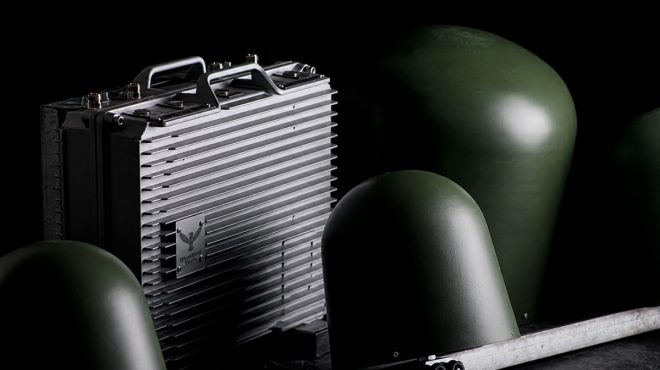
Scaling is impossible without flexible solutions that can be quickly deployed and combined. That is why modular EW systems play a key role. In this context, the modular «Hrets XL» EW system is used. It is a separate element of the system that can work both independently and as part of a network.
Its main advantage is the ability to quickly expand coverage by adding modules. This makes it possible to adapt the system to specific conditions. Without such solutions the system remains rigid and difficult to scale. With them it becomes flexible and more effective.
Conclusions
The effectiveness of counter-drone systems is determined not by individual specifications but by the ability to work as a single system. Scaling, the right architecture, and metric monitoring make it possible to create real protection rather than an imitation of it.