From a $300 FPV to aircraft flying thousands of kilometres. The brigade’s main product is a conveyor belt: find, strike, confirm, and exchange results for new equipment.
The sun is setting over a sunflower field when the evening silence is torn apart by a sound resembling the growl of a moped. A lieutenant colonel with the callsign “Rey” leaps into a roadside ditch. A British reporter from The Guardian who was nearby describes what happened next.
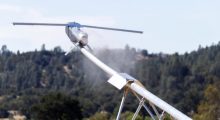
A grey aircraft resembling a biplane with a wooden propeller banked sharply at a 45-degree angle and vanished over the horizon. Two more followed. Each carried between 50 and 100 kg of explosives, and the crew coiled up their cables and abandoned the position within ten minutes. About four hours later, the first drone reached the resort town of Alushta and flew into a substation.
“We are making history,” Rey told the reporter. “Here, democracy is defeating totalitarianism.”
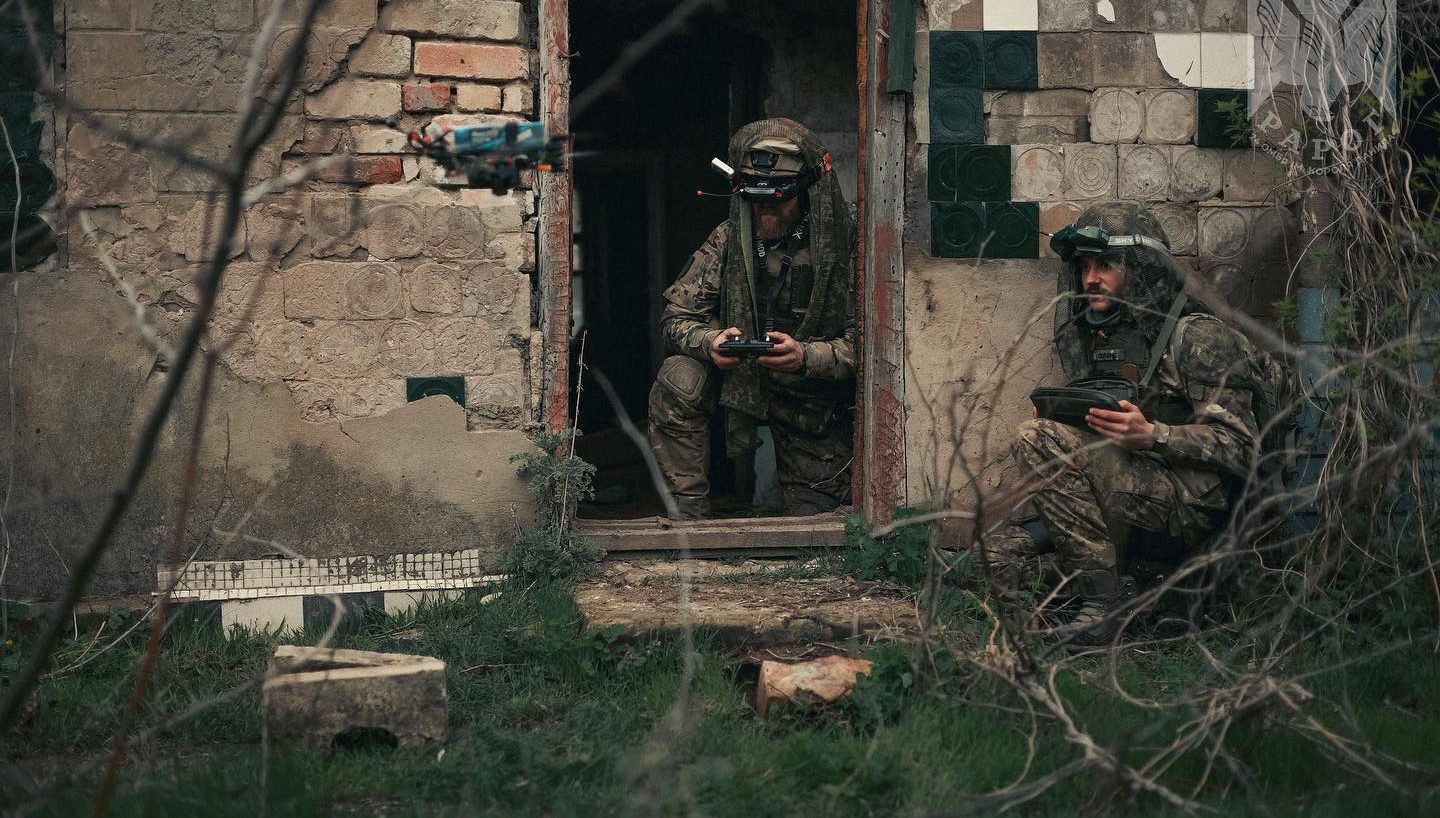
This is far from the only example of how the 414th Separate Unmanned Systems Brigade operates. Its arsenal includes FPV drones assembled from written-off government-supplied airframes for $250–300. And also — night bombers, interceptors, electronic warfare and electronic reconnaissance assets, its own munitions production, a naval division, and a digital accounting and logistics system.
One Answer to Every Challenge
In 2022, Robert Brovdi, callsign “Madyar,” commanded a rifle platoon in the 2nd assault company of the 206th Territorial Defence Battalion. In May–June, on the Kherson axis, he formed a separate aerial reconnaissance unit that became known as “Madyar’s Birds.” It all started with a single FPV drone purchased with his own funds. In August 2022, fighters began practising piloting and initial strike applications with it.
In the early months it was a small group performing classic tasks: reconnaissance, observation, and fire adjustment. But gradually the unit began transitioning from reconnaissance to target engagement. In November 2022, Brovdi took command of a strike unmanned aerial vehicle company within the 59th Separate Motorised Infantry Brigade. The next step was transforming “Madyar’s Birds” into a separate company-level tactical group operating as a specialised strike drone unit.
In 2023, “Madyar’s Birds” began operating not only as reconnaissance assets. FPV drones became a standalone strike tool, and alongside them, night strike copters, reconnaissance fixed-wing drones, and other unmanned systems continued to develop.
In January 2024, the 414th Separate Strike Unmanned Aerial Systems Battalion was formed from the company-level tactical group, within the Marine Corps. Later that same year it was expanded to a regiment.
In the summer of 2024, the 414th Regiment operated on the Kharkiv axis, and subsequently its units were active on, among others, the Pokrovsk axis. In August of that year, “Madyar’s Birds” reported 778 targets struck in a single month on the Pokrovsk axis.
By the end of 2024 the structure had changed again. In June the regiment was officially expanded to a brigade, and in December the 414th became a separate unmanned systems brigade. In early 2025 another important change occurred: the brigade was transferred from the Marine Corps to the Ground Forces. It became part of the “Drone Line” project, which unites specialised unmanned units on key sections of the front.
In June 2025, Brovdi left his post as commander of the 414th following his appointment as Commander of the Unmanned Systems Forces. The brigade was taken over by Andrii Klymenko, callsign “Klima.”
FPV: Handmade Technology
The backbone of the brigade’s strike work is FPV drones. After the adversary learned to effectively jam radio-controlled aircraft using electronic warfare systems, “Madyar’s Birds” began developing their own solutions.
The brigade also developed its own solutions for fibre-optic FPV drones. One of them was presented as a development by the “Klima-Team” engineering service.
In December 2024, Robert Brovdi spoke about one of the technical trade-offs the team managed to solve in-house. A spool of 10 km of fibre-optic cable weighs around 1.2 kg, and each additional kilometre adds roughly 65–70 grams. A drone of this type therefore requires a platform with a payload capacity of around 3 kg: roughly half of that is taken up by the fibre spool, leaving the other half for the warhead. According to Brovdi’s estimate, converting a single aircraft cost around $250–300 at the time.
Night Bombers, Mines, and the “Sugar Factory”
Reconnaissance and fire adjustment remain the foundation of effective operations. The brigade works with FPV drones, Mavics, reconnaissance and strike fixed-wing drones, and night bombers. Commercial quadcopters also serve as weapons against drones: operators have already shot down an enemy reconnaissance drone by ramming it with their own Mavic.
Pilots have many examples of employing the heavy bomber — the Vampire, known as “Baba Yaga.” The platform climbs to approximately 400 metres, flies up to 10 km, and drops thermobaric, shaped-charge, and high-explosive fragmentation munitions. For instance, in November 2024 reconnaissance spotted a Borisoglebsk-2 electronic warfare complex in Serhiivka near Pokrovsk. It was struck by a fighter with the callsign “Night Doctor.”
Heavy drones also perform “engineering” work. They took over remote mining using Soviet PTM-3 anti-tank mines. And when those ran short, the brigade solved the problem at its own level: in October 2024 it launched a fundraiser for UAH 43 million to procure 20,000 mines, which were then distributed free of charge to approximately 60 units.
When the munitions shortage became systemic, the solution was the “Sugar Factory” — a system of in-house production facilities. It produced tens of thousands of drone munitions per month, used by more than 120 units. The brigade also took on the role of supplier: it orders and distributes F7 FPV drones to other units, as well as boats for marines.
A Shield Overhead: “Dome” and Drone Hunting
When the adversary responded with mass employment of its own FPV drones, the brigade had to defend itself. Thus the “Domes” emerged: first over Pokrovsk, then over Kherson. According to the brigade’s description, this is 12 layers of influence along a front strip of more than 150 km, ranging from radar and electronic reconnaissance to electronic warfare and drone interceptors. Using the “Dome,” 20,681 enemy FPV drones were detected, of which 15,114 were suppressed or destroyed.
Drone hunting is the responsibility of the 7th Battalion “Topota.” In 2025 it was the most effective unit in the “Army of Drones” project. A notable episode occurred on 27 July 2026. Pilots of the 414th Brigade’s 7th Battalion “Topota” shot down a Russian Forpost-R strike-reconnaissance UAV — a carrier of KAB-20 laser-guided aerial bombs — over the Kursk region. The Ukrainian “Chaklun-KM” interceptor struck it at an altitude of 4,300 metres.
According to Robert Brovdi, this is the sixth confirmed Forpost destroyed since the beginning of the full-scale invasion, and the second to the credit of the 414th Brigade. The first Forpost was struck by “Madyar’s Birds” on 20 April 2025 at an altitude of approximately 4 km. Its value was estimated at around $7 million.
The Long Arm: “Kairos” Battalion
Rey commands the 9th Battalion “Kairos” — a unit specialising in medium- and long-range strikes. According to its commander, over approximately 200 days of operations the battalion struck around 200 targets — oil refineries, depots, ammunition sites, ports, roads, and railways.
Experts suggest FP-1 drones are used for this purpose. The Guardian reported in August 2026 that this model is capable of flying more than 2,500 km. And the manufacturer stated at the end of July 2026 that after an upgrade the FP-1’s range had increased to 3,400 km with a 60 kg warhead, at a cost of $55,000–75,000.
The cost of launching long-range drones is high. According to Rey, roughly one-third of drones are shot down over occupied territories, and losses over Russia are significantly greater. A pilot with the callsign “Panama” recounted that in the early days crews used foreign drones that sometimes let them down, but now there are no such problems.
The strategic logic is explained by Brovdi. According to him, the drones “significantly thin out” Russian air defences, so with each destroyed unit the gap in the adversary’s air protection widens.
Worth mentioning separately is the FP-2 — a “mid-strike” drone from Fire Point. Following a strike on a command post in Kadiivka, Brovdi publicly stated that six drones had to be expended to destroy a single post, even though each carried a 100 kg warhead. A co-founder of Fire Point responded at the time that warheads are supplied by third-party manufacturers, but quality control is conducted regularly.
Sea, Land, and “Mid-Strike”
The 414th Brigade is gradually moving beyond purely airborne unmanned systems. In 2026 it began developing capabilities across several domains simultaneously — at sea and on land — while a separate focus became the so-called “mid-strike”: engagement of targets at medium ranges.
Little is yet known about the maritime component. Robert Brovdi announced the creation of a naval unmanned systems division within the brigade. According to him, it is intended to perform two primary tasks: striking naval targets and countering Shaheds. In April 2026, the Unmanned Systems Forces also showcased unmanned surface platforms that can be used as carriers for interceptors to combat strike UAVs.
Ground robotic systems (GRS) occupy a separate place. They are used, among other things, for logistics and other tasks at the front line. Even in his 100-day plan for the Unmanned Systems Forces, Brovdi cited robotic systems as one of the key means of delivering munitions, drones, and other equipment to operator positions.
“Pidrakhuika” and E-Points: The USF’s “Accounting”
The brigade’s results are displayed on the online scoreboard “Pidrakhuika” — verified strikes only. The situation with e-points and Brave1 Market differs from being a “brigade invention.” This is a nationwide programme: points are awarded for verified strikes, reconnaissance, and GRS missions, and are exchanged for equipment on the Brave1 Market. The first unit to exchange points was the 3rd Assault Brigade, in October 2025, within 6 days. As of June 2026, more than 400 units had used the system, ordering equipment worth over UAH 33 billion, including more than half a million unmanned systems.
According to brigade data, from July 2024 to May 2026 it conducted more than 534,000 sorties, struck more than 160,000 targets (more than 71,000 destroyed), and eliminated more than 49,000 enemy personnel.
On 29 August 2026, Brovdi disclosed casualties for the first time: 79 killed over 4.5 years of war. Each fallen fighter accounts for 637 “maimed or torn apart” enemies. This refers to 50,336 confirmed Russian losses (29,023 killed and 21,313 wounded) over “the two most recent rotation years.”
“Self-Contained”
What began with a single FPV drone for aerial reconnaissance has evolved into a comprehensive system. Today “Madyar’s Birds” simultaneously conduct reconnaissance and attack, intercept enemy drones, manufacture munitions, carry out long-range strikes, operate at sea, and supply other units with equipment. This is precisely their “closed loop”: reconnaissance finds a target, a drone strikes it, the result is confirmed by a digital system, and new resources flow back into that same system for the next strike.