У новинах і соцмережах майже будь-яку групу безпілотників сьогодні називають роєм дронів. Проте в більшості випадків цеIn the news and on social media, almost any group of unmanned aerial vehicles is called a drone swarm these days. However, in most cases this is incorrect: a coordinated group of UAVs and a real swarm are different concepts, although they may look the same on the outside. Why these concepts are confused, what is the fundamental difference, and what technologies are already used on the battlefield — we will understand further.
What is a real drone swarm?
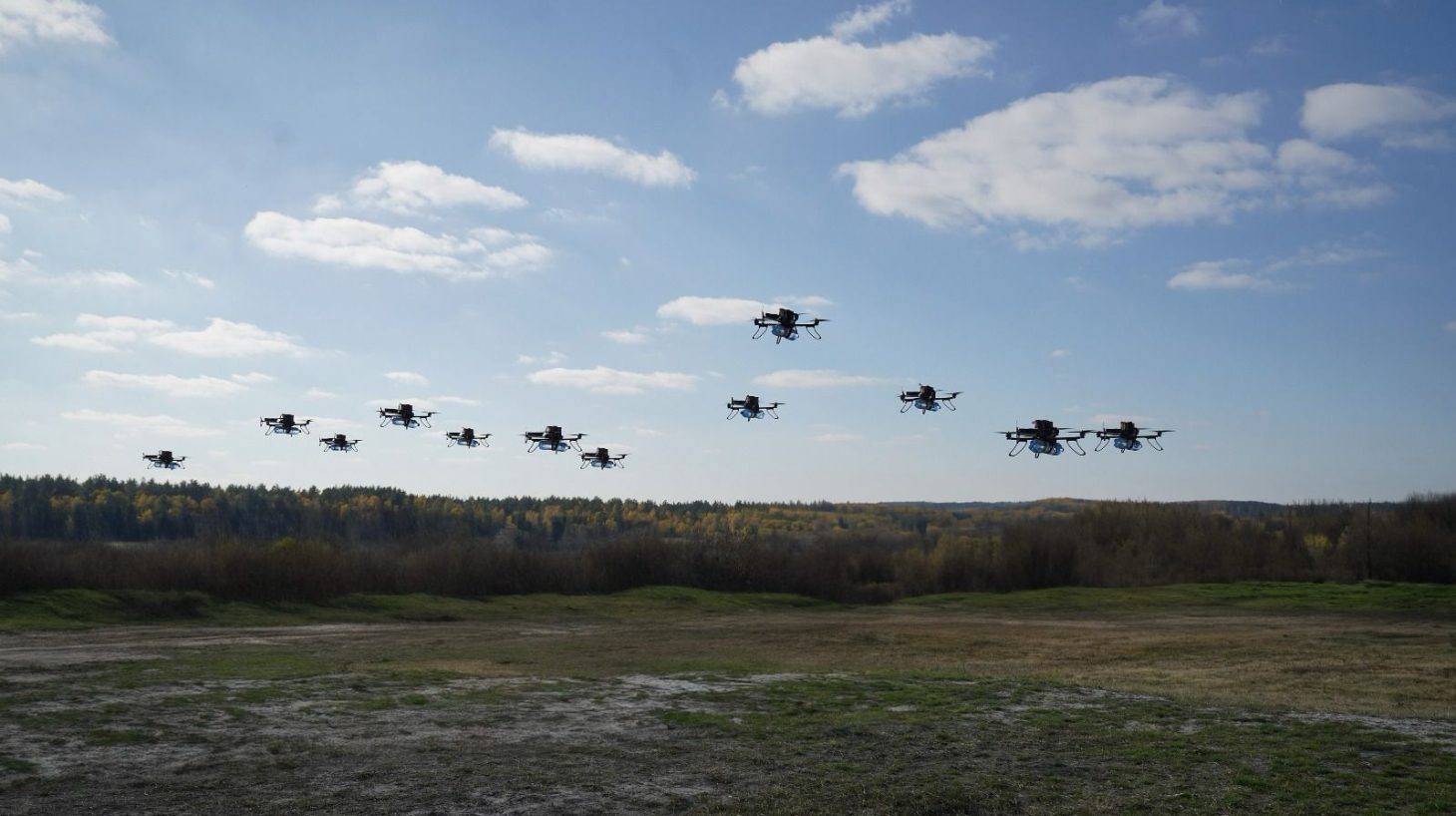
Unlike a group controlled by an operator or crew, a swarm uses algorithms for collective interaction between devices. First of all, these are reusable reconnaissance and strike UAVs of short and medium range, and in the future, also individual deep strike platforms. Drones exchange data about their position, detected targets and network status, and then independently distribute tasks. If one device is lost, the others rebuild the order of operations without a human command.
Yes, the Ukrainian company Swarmerdeveloped the softwarecalled Styx, which allows a group of drones to independently decide which of them will attack the target first, and adapt to changes in real time: for example, if one of the devices runs out of battery. The system combines reconnaissance and strike platforms into an autonomous network – the operator only sets the search area and gives permission to strike, and then the drones themselves agree on the distribution of roles and the order of attack.

Swarmer employees prepare an artificial intelligence drone for flight. Source
The technology has already been used in combat more than a hundred times, mostly in groups of three drones, but in some tests, from eight to 25 devices were launched simultaneously. In the future, they plan to test swarms of up to a hundred drones.
Interest in swarm control extends beyond Ukraine — the technology is being used in the US are considering as a response to the shortage of UAV operators: the country produces about 100,000 drones per year, significantly lagging behind the pace of Ukraine and Russia, and without some level of autonomy, there simply won’t be enough operators for all the devices.
The advantage of this approach is its resistance to electronic warfare: if the drones coordinate with each other at a short distance, the suppression of the channel with the ground station has less impact on the mission. Instead of nine operators, such a group requires only three – a planner, a navigator and an operator.
Coordinated UAV Group: How it works
The main working format at the front is a coordinated group of UAVs, in which each vehicle has its own role, and decisions are made by the operator or command post. Such a group may include:
- a reconnaissance drone that searches for targets and transmits coordinates;
- a strike FPV that performs a direct attack;
- a drone bomber for dropping ammunition;
- communication repeater that extends the range and stability of the channel;
- UAV for adjusting artillery fire;
- a backup device in case of loss of one of the system elements.
If one element fails—due to a crash, loss of signal, or battery drain—the entire group performs worse. Therefore, clear role allocation and redundancy are important for stable operation.
Coordination is impossible without stable data exchange — video, coordinates, statuses, commands. Therefore, servicemen use several types of channels: digital radio channels, analog and digital video, repeaters and mesh networks. Several independent channels simultaneously reduce the risk of loss of communication and increase the range of the group.
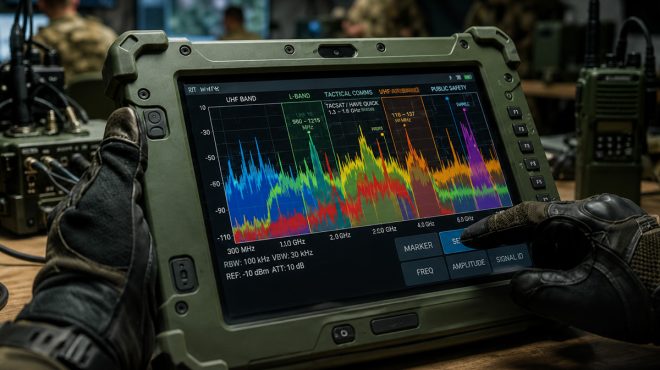
The main threat to such systems is electronic warfare. According to the Defense Minister’s advisor on electronic warfare Sergey “Flash” Beskrestnov, on June 21, 2026, Russia began using a new operating range for drone control — 3900–4100 MHz. Already in early July, according to his assessment, most of the “Shaheds” that attacked Kyiv were operating at these frequencies. This indicates the constant adaptation of Russian drones to Ukrainian electronic warfare equipment.
This applies not only to air systems: analyst at the Center for a New American Security Samuel Bendett notes that Russia is trying to catch up with Ukraine in ground-based robotic complexes, introducing its own systems “Courier”, “Depesha”, “Impulse” – that is, the EW/counter-EW competition is unfolding on several fronts at once, and not only in the air.
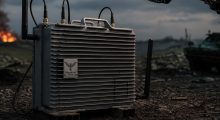
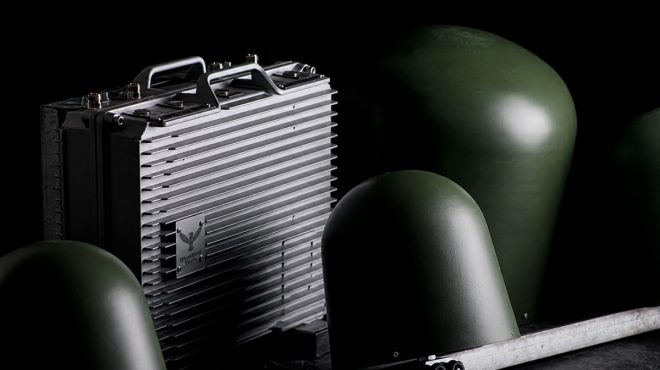
That is why control and suppression are so important. One of the common ground systems used to control FPV drones is the “Vishchun-K1“. The complex includes the ground control station “Vishchun-NS1”, the wireless repeater “Vishchun-5.8” and a telescopic mast up to 9 meters high.
The station receives a video signal from the drone via a repeater and transmits control commands, and the mast raises the antennas and repeater to increase the range and stability of the signal – depending on the modification, up to 25–45 km. Thanks to the wireless connection between the station and the mast (up to 1 km of direct visibility), the pilot and co-pilot can work from cover, maintaining full control of the device and high-quality video.
When will real drone swarms appear?
The opinions of professional players differ.
The state, through Brave1, takes a cautious position: they directly call it full-fledged swarm coordination “problem with an asterisk” and emphasize that no country in the world has yet demonstrated the sustained combat use of a full-fledged swarm in conditions of active electronic warfare.
According to the program’s assessment, the swarm is a superstructure on several unresolved technological directions at once: precise guidance, autonomous navigation without satellites and with obstacle avoidance, target recognition in difficult conditions.
Developers are already looking for alternatives to satellite navigation in the event of GPS jamming — from visual orientation using terrain maps and inertial navigation to ground-based “beacons” or tethering to the Starlink satellite constellation.
Brave1 emphasizes that even after the first full-fledged combat use, the swarm will not become a “finished product” for a long time – it is a matter of constant iterations.
Instead, a military expert, founder of the Reactive Mail Organization Pavlo Narozhnyi, gives a much shorter horizon — a maximum of two years — and explains this by the pace of development of artificial intelligence in general. But even he admits the vulnerability of the concept: a swarm, according to him, is the same mesh network, and if the enemy disrupts communication between drones using electronic warfare, the swarm breaks up into individual devices that are much less effective. According to his observations, enemy mesh networks already pose a serious problem for Ukrainian defense forces — for example, in scenarios where one Shahed strike platform flies high and serves as a relay for others that are flying lower.
What limits the application of technology?
The main limitation of both approaches is their dependence on communication: if it is lost, the system breaks up into separate elements.
For coordinated groups, the workload on the operator is increased, as he has to control several devices simultaneously.
For swarms, this is the complexity of the algorithms, the need for stable interaction between drones at a short distance, and the currently limited number of devices that can be controlled simultaneously without losing control.
Nevertheless, in Ukraine, there is a gradual transition from individual drones to more complex systems: first, coordinated groups with a division of roles, and now the first combat applications of real swarms with elements of autonomous decision-making.
Back in February 2025, the Minister of Digital Transformation Mykhailo Fedorov called drone swarms one of the key directions of war development — and within a year and a half, this thesis had moved on to real combat episodes.
Fully autonomous large-scale swarms are still a prospect, but their development has become one of the priority areas of unmanned warfare. Ukrainian companies, the military, and the state are investing in technologies for autonomy, persistent communication, and collective interaction of drones. These solutions could become the next stage in the evolution of combat UAVs.