Logistics at the front is always associated with risk. The delivery of ammunition, water, or equipment often takes place under the threat of shelling or enemy observation.
That is why robotic systems are increasingly being used. They make it possible to carry out these tasks without the direct involvement of people, reducing the risks to personnel.
Robotic Systems in Front-Line Logistics
Robotic systems in logistics perform one key task — to deliver a resource with minimal risk. This can be transporting ammunition, evacuating the wounded, or delivering water. In real conditions such systems are used where a person cannot work safely. For example, in open areas or under constant observation.
A typical scenario looks like this: the operator sends the platform to a point, it moves along a set route, after which it returns or changes direction. This makes it possible to carry out logistics tasks even in difficult conditions without involving additional personnel.
Ground Robotic Systems for Delivering Ammunition and Equipment
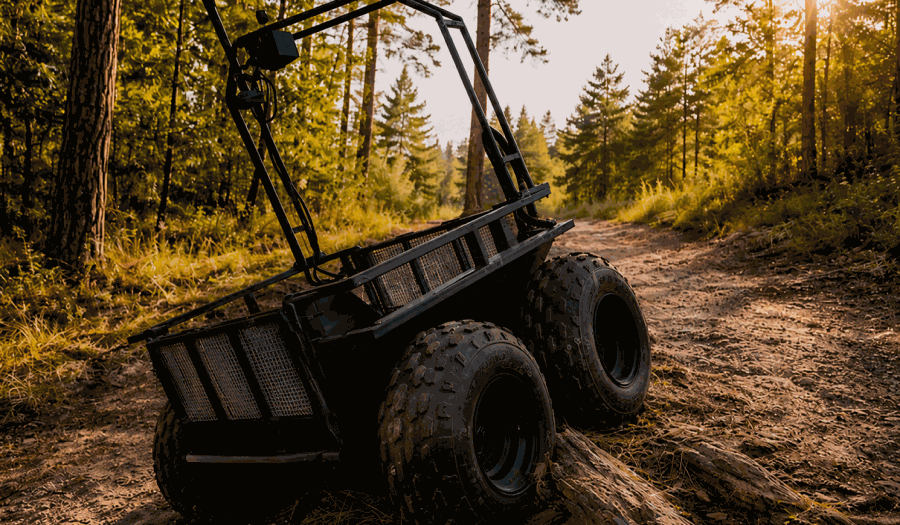
Ground robotic systems are most often used for short and medium routes. They can operate in complex terrain where ordinary vehicles are ineffective. Such platforms are able to carry tens of kilograms of cargo and move off-road. Their speed is usually lower than that of vehicles, but this is offset by safety.
In practice this means that a unit can receive resources even in a zone of active risk. At the same time, the operator is at a safe distance. It is these systems that have become the basis for modern front-line logistics over short distances.
Autonomous Vehicles in Military Logistics Routes
Autonomous vehicles are used for longer routes. They can operate along a set route without constant control. Such systems use a combination of GPS, sensors, and navigation algorithms. This makes it possible to move even with a partial loss of signal.
In real conditions, full autonomy is still limited. Most often a semi-automatic mode is used, where the operator can intervene at any moment. This gives a balance between effectiveness and control, which is critical in combat conditions.
Remote Control and Monitoring of Robotic Platforms
Most robotic systems are controlled remotely. This makes it possible for the operator to control the situation and react quickly to changes. The signal delay is usually from a fraction of a second to 1–2 seconds. In normal conditions this is enough for precise control.
However, in a complex environment failures are possible. For example, interference or a loss of signal can lead to a delay or a temporary loss of control. That is why systems provide backup modes, including returning or stopping the platform.
The Advantages of Ground Robots for Supplying Units
The main advantage of ground robots is reducing the risk to people. They perform tasks where the presence of personnel is dangerous. In this context, the «Bandura» tactical ground drone is used. It is a separate robotic asset that is a standalone platform but can work as part of a unit’s logistics system.
It is designed for transporting cargo, working in difficult conditions, and remote control. Thanks to its design and off-road capability, it can move where ordinary vehicles cannot pass. Without such platforms, delivery often requires the involvement of people, which increases risk. With their use, logistics becomes safer and more predictable.
Limitations of Using Robotic Systems at the Front
Despite their effectiveness, robotic systems have their limitations. One of the main ones is dependence on communication. If the signal is lost, the system can lose controllability or switch to a safe mode. This can delay task execution.
Power supply also plays an important role. The limited battery resource affects range and operating time. In addition, in real conditions the operator may receive too much information at once. This complicates control and requires experience.
To better understand how logistics is organized in combat conditions, see the article: «Military logistics: the supply system», where this process is covered in more detail.
Conclusions
Robotic systems are changing the approach to logistics at the front. They make it possible to carry out tasks faster and more safely. The combination of remote control, autonomous solutions, and ground platforms creates an effective system for supplying units.